Psychological safety at work: measure it, don't guess
Almost every team claims to feel safe. Few can prove it. Here's why psychological safety surveys fail small and remote teams, and how to track it on a cadence instead of a one-time scan.

Ask a team if they feel safe speaking up, and almost everyone says yes. Ask the same team an anonymous question about whether they'd admit a mistake to their manager, and the answers split. That gap is the whole problem with psychological safety at work: it's easy to claim and hard to actually measure, which is exactly why most teams never measure it at all. They just hope.
What psychological safety at work actually means
Psychological safety isn't "everyone is nice here." It's whether someone on your team believes they can take an interpersonal risk, admitting a mistake, asking a question that might sound obvious, pushing back on a plan, without getting embarrassed or punished for it. The concept comes from Harvard's Amy Edmondson, who defined and studied it in her 1999 research on psychological safety and learning behavior in work teams. Her finding, in short: teams that felt safer didn't make fewer mistakes. They talked about mistakes more openly, which is why they learned faster.
That distinction matters for how you measure it. A team that never reports problems isn't necessarily a safe team. It might be a quiet one, which is the same trap a lot of general employee engagement surveys fall into: a clean-looking score that just means nobody answered honestly.
Why it's worth measuring, not just talking about
When Google ran its internal study of what actually made teams effective, known as Project Aristotle, psychological safety came out on top. According to Google's own re:Work write-up of the research, it ranked first, in order of importance, among the five dynamics that distinguished their best teams from the rest. Not who was on the team. How the team treated each other when things went wrong.
That's a strong argument for caring about it. It's a weaker argument for how to actually track it over time, which is where most articles on this topic stop.
Why the usual way of measuring it fails a small or remote team
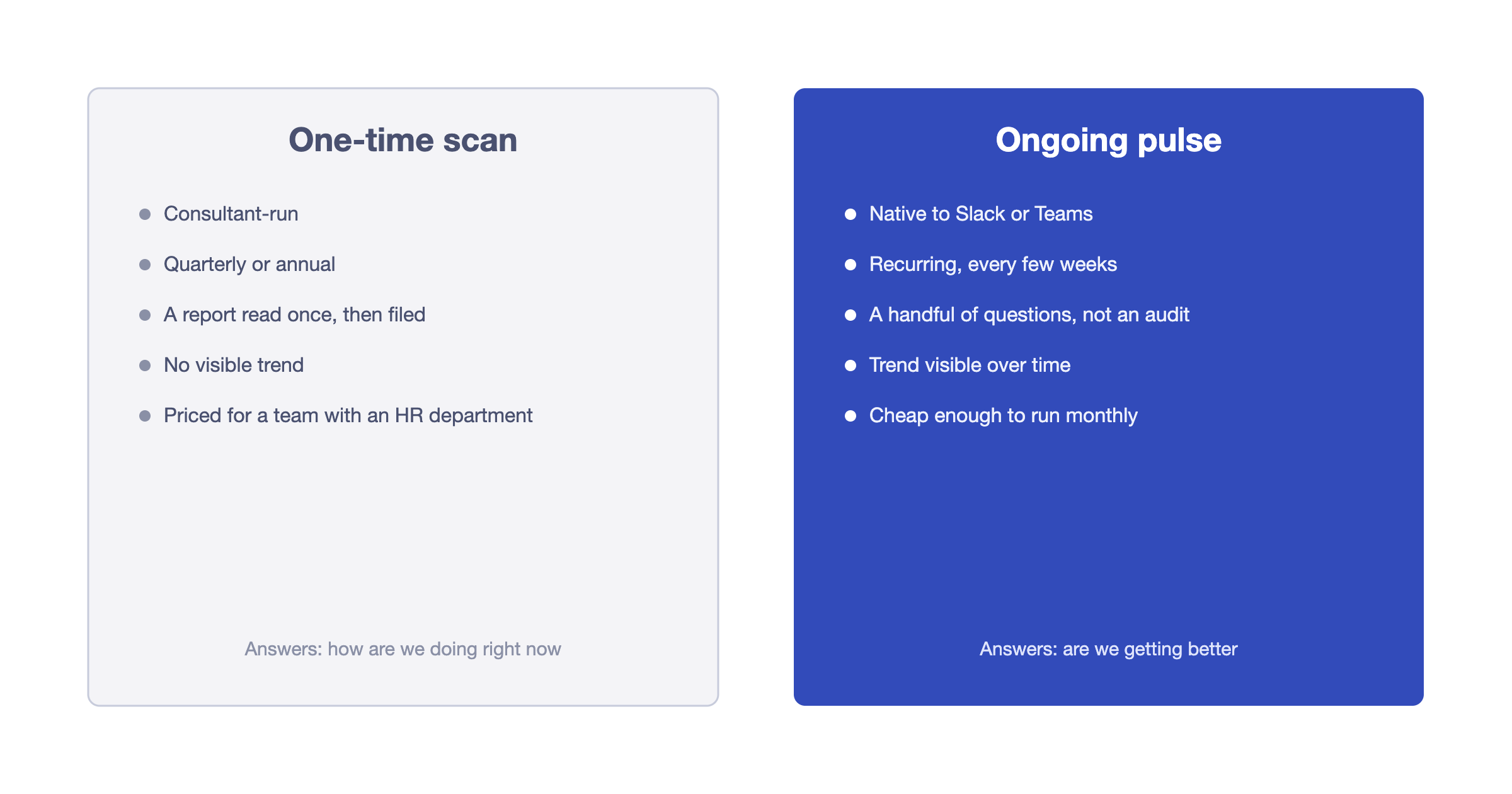
The standard playbook is a one-time survey or a consultant-run "safety scan," usually annual, usually a PDF report that gets skimmed once and forgotten. For a 300-person company with an HR team, that's a workable cadence. For a 20-person team with no HR department, it's a project nobody has time to run twice.
The bigger issue is trust, not frequency. Psychological safety surveys only work if people believe their answers are actually anonymous, and belief is doing all the work in that sentence. Gallup puts it plainly: employees need to trust the process, not just the promise of anonymity, and when they don't believe their input is truly anonymous, response rates drop and the data that does come in gets less honest. A survey sent through a tool employees associate with performance reviews, or a portal nobody opens the other 51 weeks of the year, starts every question already under suspicion.
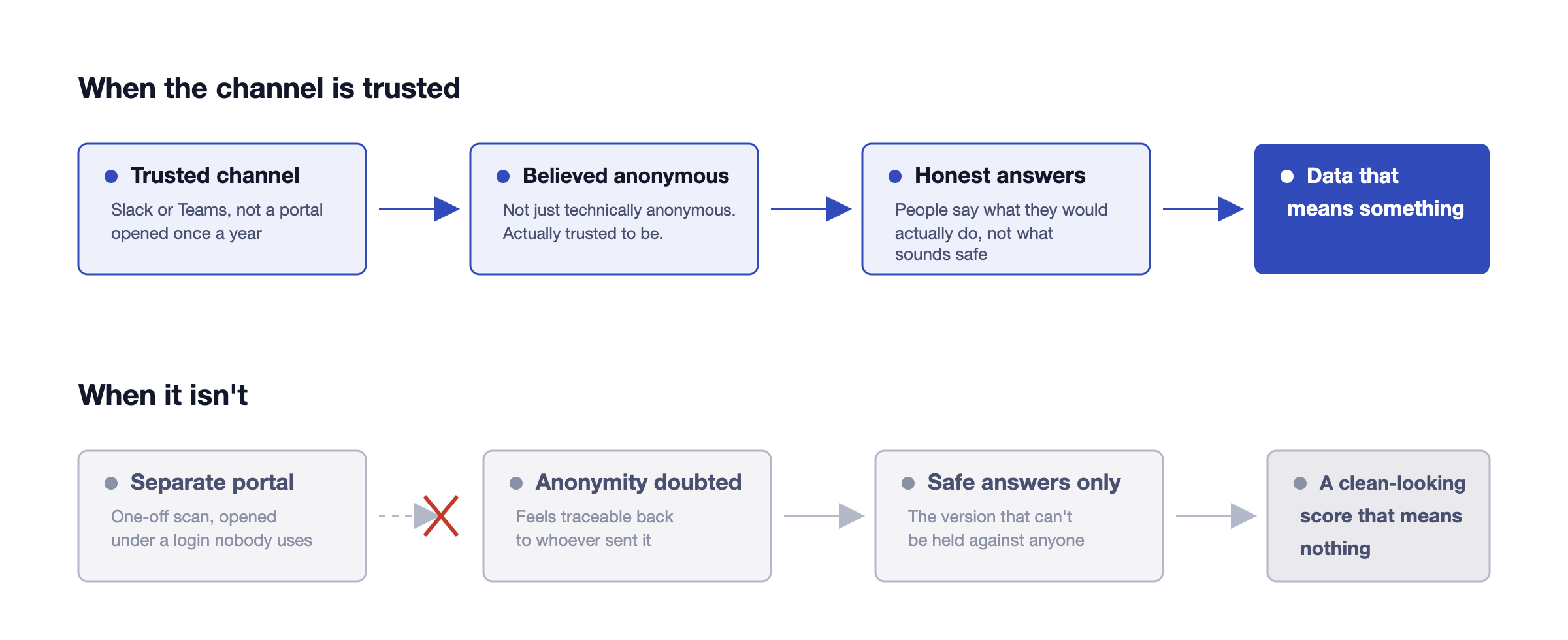
That's the case for running it somewhere people already trust with everything else, on a cadence, instead of as a one-off event run by someone they don't normally hear from.
Psychological safety survey questions that actually work
Keep it short enough to run every few weeks, not long enough to feel like an audit. A handful of questions, rated on a simple scale, tracked over time, tells you more than one long survey ever will:
- If I make a mistake here, it's held against me. (reverse-scored: disagreement is the healthy answer)
- It's safe to raise a problem or a concern with this team.
- I can ask a question that might sound obvious without feeling judged for it.
- People on this team accept each other even when we disagree.
- It's easy to ask teammates for help.
- Nobody on this team would deliberately undermine my efforts.
- My unique skills and perspective are valued here.
That list draws on the themes Edmondson's original research established, reworded for a shorter, recurring check rather than a one-time academic instrument. The scoring matters less than the trend. A single low score tells you almost nothing. A score that's been sliding for three cycles tells you something is worth a direct conversation.
How to run it without a consultant or a platform built for 2,000 people
You don't need a scan, a workshop, or a platform priced for an enterprise engagement team to start tracking this. Pulsy runs pulse surveys as a message inside Slack or Teams, answered in-thread, with the same smart reminders BuddiesHR uses across its survey tools to keep response rates above 80% instead of the 20 to 30% a portal-based survey typically gets. Anonymous by default, recurring on whatever cadence you set, and it lives in the same place your team already answers everything else, which is the whole point given what Gallup's research says about perceived anonymity.
Start with one team, one cadence, and the seven questions above. You'll have a real baseline before a consultant would have finished the intake call. If you're already running eNPS in Slack to track overall sentiment, this runs alongside it as a second, more specific signal, not a replacement.
Reading the results without punishing honesty
The fastest way to kill psychological safety is to run a survey about it and then react badly to what it turns up. If a low score leads to a manager asking "who said this," you've just proven the point the survey was trying to measure.
Share trends with the team, not just with leadership. Talk about what changed between a good cycle and a bad one. And if you're not going to act on what you learn, don't ask. A survey that goes nowhere is worse for trust than no survey at all.
FAQ
How often should you measure psychological safety?
Monthly or every few weeks works better than an annual scan. The value is in the trend, and a trend needs more than one or two data points a year to mean anything.
Is a psychological safety score actually meaningful?
On its own, a single number isn't worth much. Tracked over time, against your own team's baseline rather than an industry benchmark, it's a useful early signal, closer to a smoke detector than a diagnosis.
Can a psychological safety survey really be anonymous?
Technically, usually. The harder problem is whether people believe it, which is why where you run it matters as much as how you configure it. A tool with no track record of protecting anonymity has to earn that trust before the answers get honest.
If your team already lives in Slack or Teams, that's the fastest place to start. Pulsy is free to try under 10 employees, with no card required.