Rewards vs recognition: why recognition has to come first
A rewards catalog nobody redeems is worse than none. Recognition has to be a real habit first. Here's the order that actually works, and why a separate rewards portal undoes it.

Most teams say "we do recognition" and mean a points system. Someone gets a shoutout, it comes with fifty points, the points sit in an account until there's enough for a water bottle or a gift card. That's not wrong exactly. It's just built backwards.
Recognition and rewards solve different problems, and the order you build them in decides whether either one actually works. Get the order backwards, and you end up with a rewards catalog nobody redeems and a team that still feels invisible.
What each one actually is
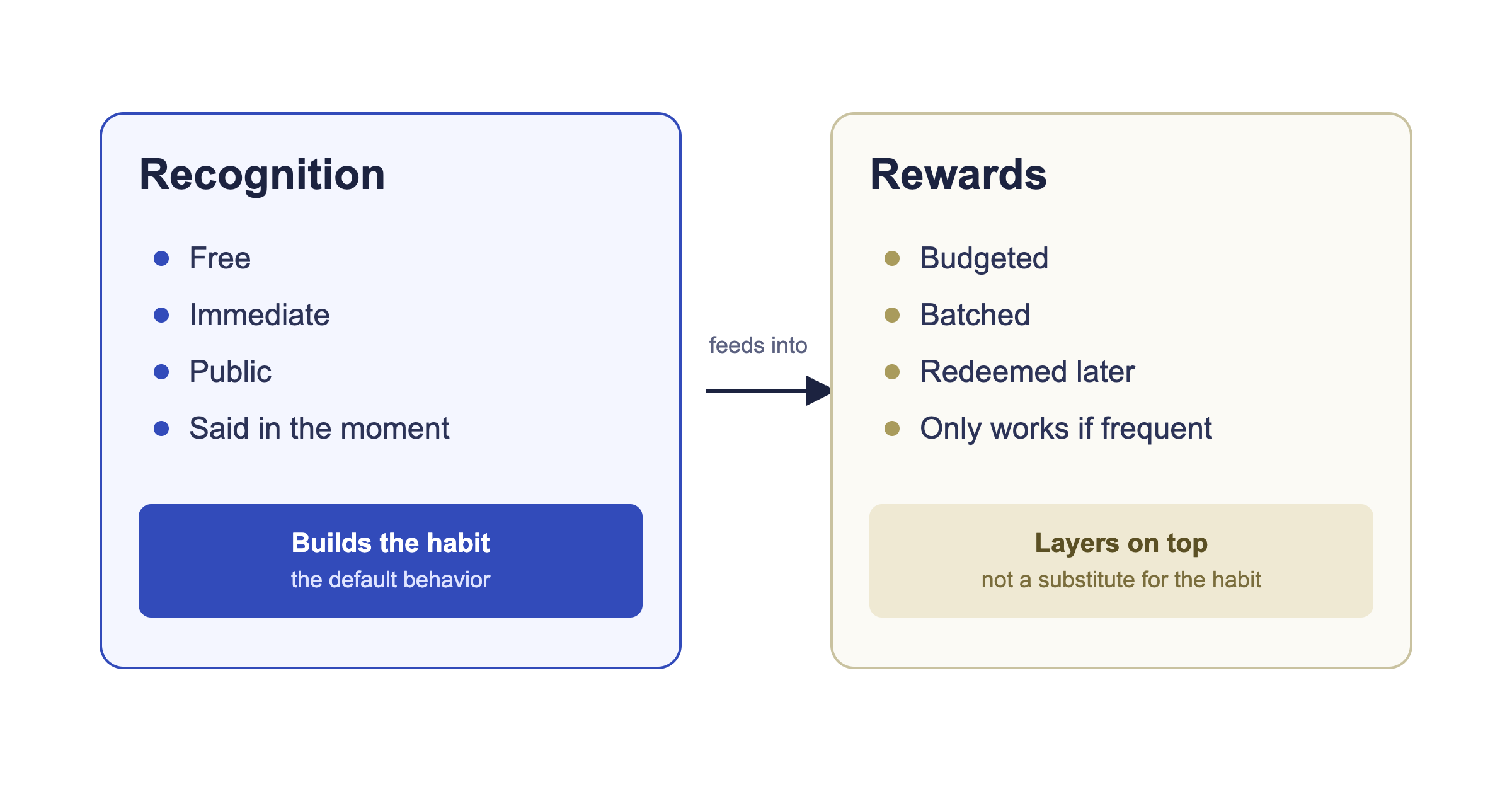
Recognition is social. It's a specific sentence about specific work, said where other people can see it. It costs nothing, it's immediate, and its whole value comes from being public: "the fix Priya shipped Tuesday kept the whole pipeline from breaking" does something a private Slack DM never will.
Rewards are transactional. Points, gift cards, a catalog, a redemption flow. They're tangible, they're budgeted, and they work on a completely different psychological lever: not "I was seen," but "I was paid, a little."
Both are legitimate. The mistake is treating them as the same tool, or worse, building the second one before the first one is actually working.
Why teams build the rewards catalog first, and why that's backwards
Rewards are easier to sell internally. A points budget is a line item a finance team understands. A points balance is a number you can show in a slide. "We give out recognition" is a harder thing to put a number on, so it's the thing that gets skipped in favor of the part that looks like a program.
But a rewards catalog only works if recognition is already happening at a pace that makes the points meaningful. If kudos are rare, the points attached to them are rare too, and the catalog sits there half built, a cost with no usage to justify it. Recognition has to be the default behavior first. Rewards are what you layer on top of a habit that already exists, not what you build to create the habit.
What recognition needs before rewards are worth adding
Three things, in order:
- It has to be public. A private "nice work" is kind, but it doesn't do the thing recognition is actually for, which is making good work visible to people other than the person who did it. That's the whole mechanism: peers see the bar, and the person who cleared it gets seen clearing it.
- It has to be specific. "Great job this week" teaches nobody anything. "The client deck you rebuilt Thursday night saved the pitch" tells the rest of the team exactly what good looks like.
- It has to be frequent enough that it's not an event. A quarterly recognition moment at an all-hands is a nice ceremony. It is not a system. If kudos only happen when someone remembers to organize them, they're not going to be frequent enough for a rewards layer on top to mean anything.
Once those three are true, and only then, a points or rewards layer has something real to attach to.
Where rewards genuinely add something
Rewards aren't decoration once recognition is real. They solve a specific problem recognition can't: they give people a reason to keep noticing, past the point where saying nice things starts to feel routine. A small points value attached to a kudos gives the giver a reason to be specific about the value it maps to, not just generous. And for the person receiving it, an occasional tangible reward alongside the social one is a genuinely different kind of motivation, not a replacement for the social one but an addition to it.
The test for whether a rewards layer is worth adding isn't budget. It's whether recognition is already happening often enough that points would actually accumulate into something. If the honest answer is "barely," fix that first.
The portal problem
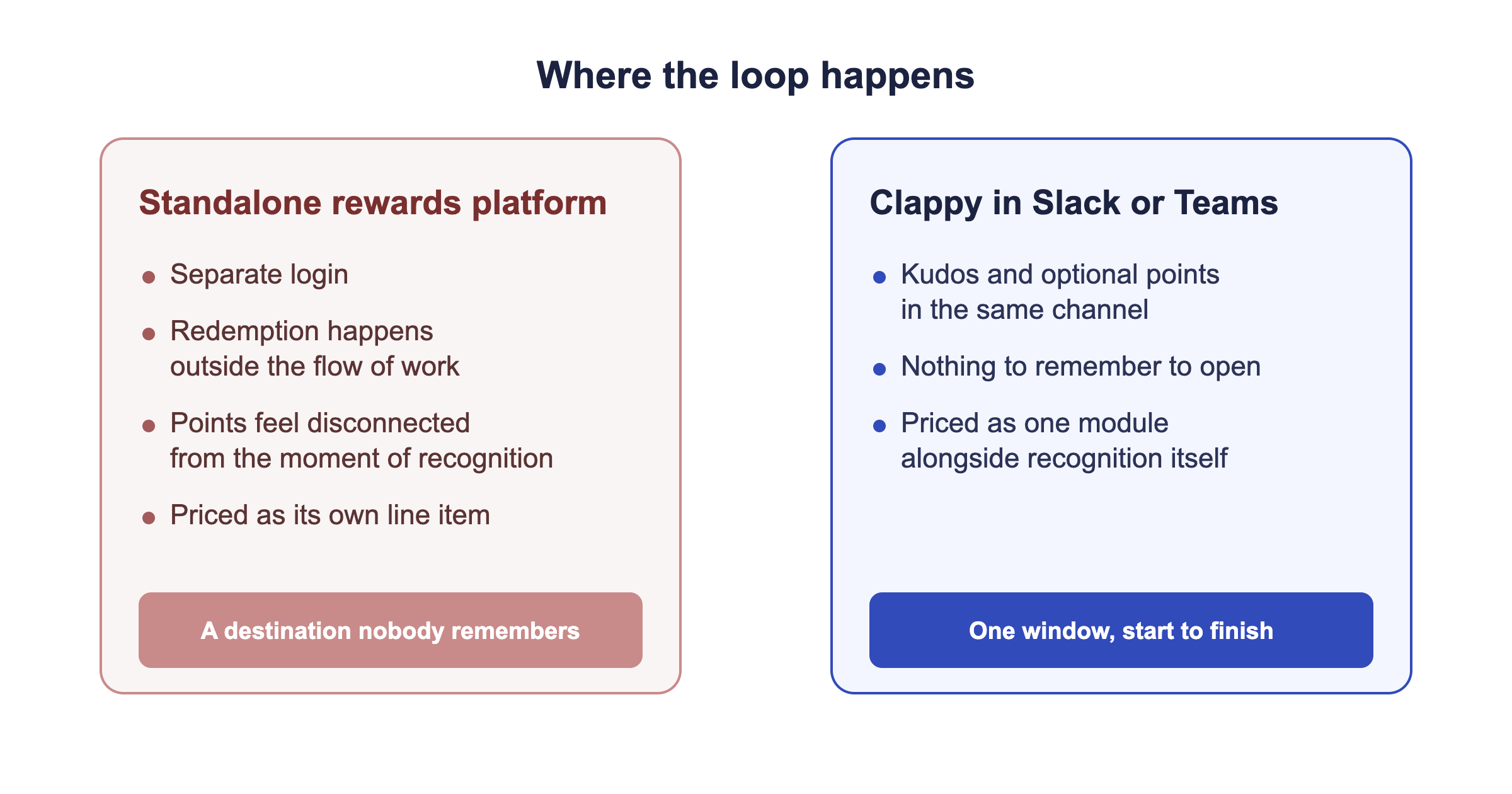
The other reason rewards catalogs go unused has nothing to do with sequencing. It's that most of them live somewhere else: a separate rewards portal, a separate login, a separate app nobody has a reason to open outside of redeeming points twice a year. That's the same failure mode as every other tool that lives outside where people already work. A portal nobody opens produces a program nobody feels, whatever the budget behind it.
This is where a modular, chat-native tool has a real advantage over a standalone rewards platform. If kudos and points both live in Slack or Teams, the loop from "someone did good work" to "it was recognized publicly" to "points landed in an account" happens in the same window the work itself happened in. Nobody has to remember a second destination.
How to start this week
If your team has no recognition habit yet, don't start with a rewards catalog. Start with a public channel and a rule: when you notice good work, say so there, specifically, the same day. Do that for a month before you add anything transactional on top.
If recognition is already a habit and it still feels thin, that's the moment a modest points layer earns its place, not as the program, but as one more reason to keep the habit specific. Budget recognition ideas that don't require a rewards system at all are worth reading first if cost is the concern rather than mechanism.
Clappy runs peer-to-peer kudos natively in Slack and Teams, with points and rewards available as an optional layer once recognition is actually happening, not as a prerequisite for it. BuddiesHR is rated 4.8/5 on G2 across its Slack and Teams apps, and teams like Sched use the recognition side of the suite to run culture without a dedicated HR hire.
FAQs
Is employee recognition the same as employee rewards?
No. Recognition is social: a specific, public acknowledgment of good work, and it's free. Rewards are transactional: points, gift cards or other tangible items, usually attached to a budget. Programs that work well tend to use recognition as the default and rewards as an occasional layer on top, not the other way around.
Do small teams need a rewards program?
Not to start. A consistent, public recognition habit does most of the work retention and morale research points to, and it costs nothing to run. A rewards layer is worth adding once that habit is real and you want an extra reason to keep it specific, not as a substitute for building the habit in the first place.
Why do rewards programs go unused?
Two common reasons: the points never accumulated into anything meaningful because recognition wasn't happening often enough to generate them, or the redemption process lives in a separate portal people don't have a reason to open. Both are fixable by keeping recognition frequent and keeping the whole loop inside the tool people already use all day.
What's the cheapest way to start recognizing people at work?
A public Slack or Teams channel and a habit of saying, specifically and the same day, when someone did something worth noticing. No software required to start. Budget recognition ideas covers more of this ground if cost is the blocker.
Want kudos and recognition running in Slack or Teams by this afternoon? Install Clappy free for teams under 10 employees, points and rewards optional.