Onboarding buddy: the role, a checklist and a 90-day plan
What an onboarding buddy does, how they differ from a mentor, a 90-day checklist, and a plan builder that puts 8+ buddy meetings on the calendar.

An onboarding buddy is a peer, not a manager, who helps a new hire through their first weeks: the unwritten rules, the people worth meeting, the questions that feel too small to ask anyone else. Most companies get the assignment right. What they get wrong is the second month, when the buddy gets busy and the meetings quietly stop.
This guide covers what the role is, how it differs from a mentor and a manager, and the onboarding buddy checklist for the first 90 days. There's also a plan builder that turns a start date into a dated calendar of buddy meetings. The point of all of it is frequency, because that's what Microsoft's own data says the payoff depends on.
What is an onboarding buddy?
An onboarding buddy is an existing employee assigned to a new hire for roughly their first 90 days. They're usually on a nearby team, not in the new hire's reporting line, and they've been around long enough to know how things actually work. Their job is informal: answer the questions that don't belong in a ticket, explain the norms nobody wrote down, and introduce the new hire to the people they'll need.
What a buddy is not: a trainer, a second manager, or a help desk. The best ones do less explaining than you'd expect and more connecting. By the end of month three, a good buddy has made themselves unnecessary.
Onboarding buddy vs mentor vs manager
The three roles overlap enough to get confused, and the confusion is usually why a buddy program drifts. Here's the split we'd use.
- Manager: owns the role, the expectations, the first goals and the feedback. Microsoft found new hires were 3.5 times more likely to be satisfied with their onboarding when their manager played an active role (Microsoft WorkLab, 2021). A buddy doesn't replace that.
- Onboarding buddy: owns the first 90 days of belonging. How lunch works, which Slack channels matter, who to ask about expenses, why the Thursday meeting exists.
- Mentor: owns long-term growth, often for years, usually someone more senior. A buddy can become a mentor later. They don't start as one.
If you have to pick one thing to keep the buddy out of, it's performance. A new hire who thinks their buddy reports back on them will stop asking the questions the buddy exists for.
Why buddy programs work, and why most fade
The most useful number on this topic comes from a buddy pilot Microsoft ran and reported in 2019. Among new hires who met their onboarding buddy at least once in their first 90 days, 56% said the buddy helped them quickly become productive. That rose to 73% for those who met two or three times, 86% for four to eight times, and 97% for more than eight (Microsoft WorkLab, citing its 2019 study).
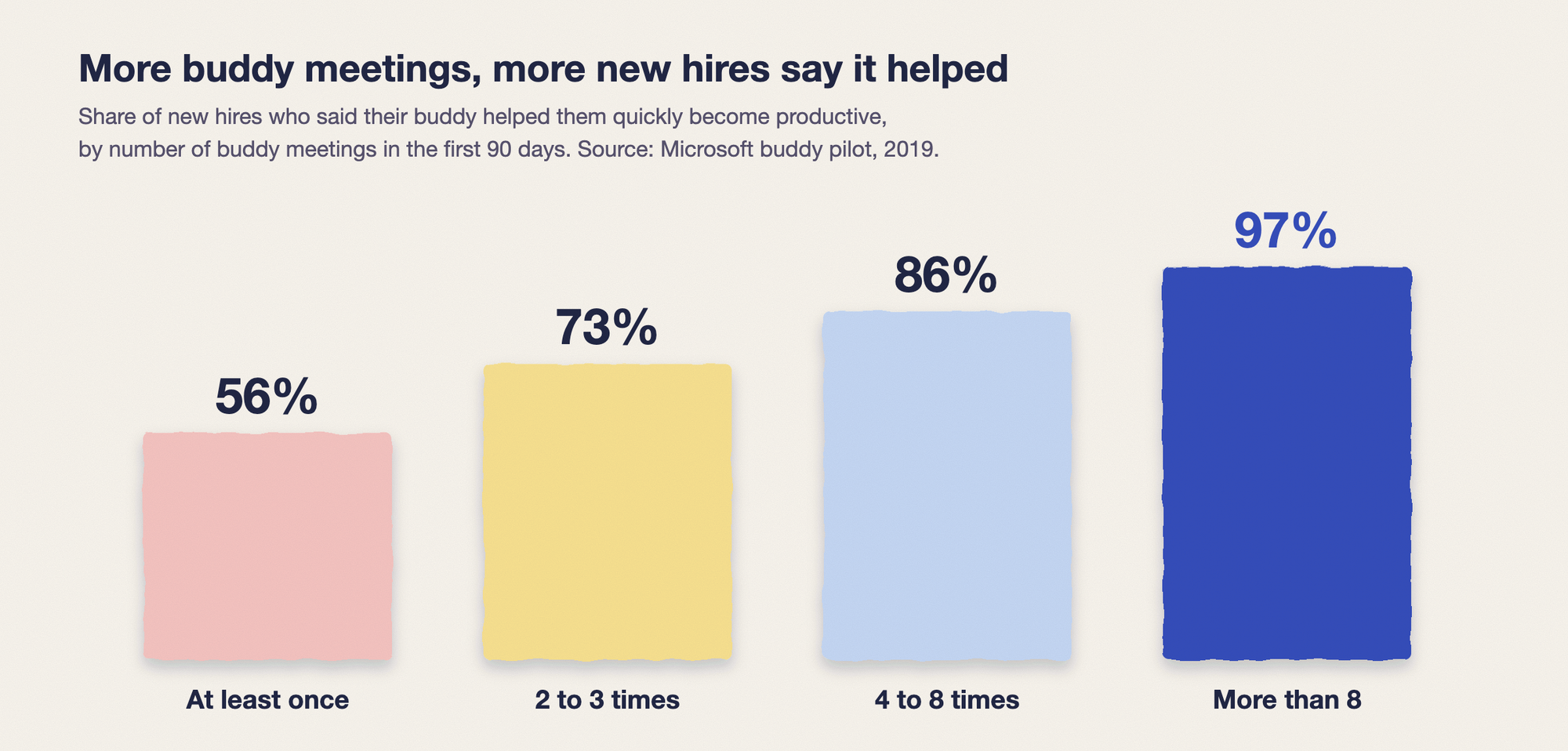
Read that gradient again. It's a survey result, not a controlled test, but the direction is hard to ignore: the buddy didn't get smarter between one meeting and nine. They just kept showing up. And that's exactly the part that breaks in practice: week one is full of welcome lunches, week three is a busy sprint, and by week six nobody remembers the buddy was supposed to check in.
It matters because onboarding is something most companies already do badly. Only 12% of employees strongly agree their organization does a great job onboarding new employees (Gallup). A buddy who stops at two meetings is a nice gesture. A buddy who reaches nine is a program.
Build your 90-day buddy plan
So don't leave the meetings to memory. Put them in the calendar on day one. Enter the start date and the tool below gives you every buddy touchpoint for the first 90 days, with what to cover at each and how many actual meetings that adds up to. Copy it into the buddy's calendar, or into the welcome message, so both people can see the plan.
90-day onboarding buddy plan
Pick a start date and a setup. Weekend dates move to the nearest weekday.
Where do they work?
How much buddy time?
Meeting bands are from Microsoft's 2019 buddy pilot. The schedule itself is our suggestion. Nothing you enter is sent anywhere.
The standard plan lands at 11 meetings, most of them 15 minutes. The light plan lands at 7. Both are our suggestion, not Microsoft's, but they're built so the count lands in a band the data actually measured. If the buddy can't find 15 minutes every week or two, pick a different buddy.
Onboarding buddy responsibilities: the checklist
Eight-item responsibility lists are common on this topic. Most of the items are fine. The problem is that they read as a list of things to explain, which turns the buddy into a part-time trainer. The checklist below is shorter and leans on connecting over explaining. Hand it to the buddy along with the plan.
Before day one
- Send a short hello message, so the first face on day one isn't a stranger.
- Check the new hire has access to the chat tool, calendar and the channels they'll need.
- Pick the first three people to introduce, and tell them it's coming.
Week one
- Have lunch or a welcome call on day one.
- Give the tour: the office, or the channels and docs that matter in a remote team.
- Make the first introductions, in writing, with a reason for each.
- End the week with one question: what's still unclear?
Month one
- Explain the unwritten rules: which meetings matter, how decisions get made, where to ask what.
- Keep a short check-in every week. Fifteen minutes is enough.
- Make two more introductions, outside the new hire's department.
- Flag anything the manager should know, with the new hire's agreement, not behind their back.
Months two and three
- Move to a check-in every week or two, and keep it on the calendar.
- Ask who they go to now besides you. If the answer is nobody, introduce more people.
- Close at day 90 with a wrap-up conversation and step back on purpose.
For the rest of the first 90 days, the parts that belong to HR and the manager, our employee onboarding checklist covers paperwork, equipment and first goals.
How to choose an onboarding buddy
Seniority matters less than you'd think. What you want is someone who's been there long enough to know the unwritten rules, recently enough to remember being new, and generously enough to give up 15 minutes a week for three months. In practice:
- Six months to a few years in. Long enough to know how things work, close enough to remember what was confusing.
- Adjacent team, not the same one. Same-team buddies end up talking about the work. A neighbouring team gives the new hire a second view of the company.
- Not their manager, and not someone who'll review them. The new hire needs one person they can ask anything.
- Volunteered, not drafted. A buddy who was assigned against their will shows up once or twice, which is where the data above shows the smallest benefit.
- Well connected. The buddy's biggest asset is who they know. Pick someone people already go to.
Rotate the role. If the same three people buddy every new hire, they burn out and the new hires all meet the same small slice of the company.
Running a buddy program for a remote team
In an office, a lot of buddy work happens by accident: you sit nearby, you get lunch, they overhear who knows what. Remote, none of that happens unless it's scheduled. So a remote buddy program needs two things the office version can skip: every touchpoint on the calendar, and a deliberate way for the new hire to meet people beyond the buddy.
That second part is where buddy programs quietly fail. The buddy becomes the new hire's only connection, which is fine in week one and a problem by month three, when the buddy is on holiday and the new hire has nobody else to ask. One person can't be a network. Splitting the work three ways fixes it.
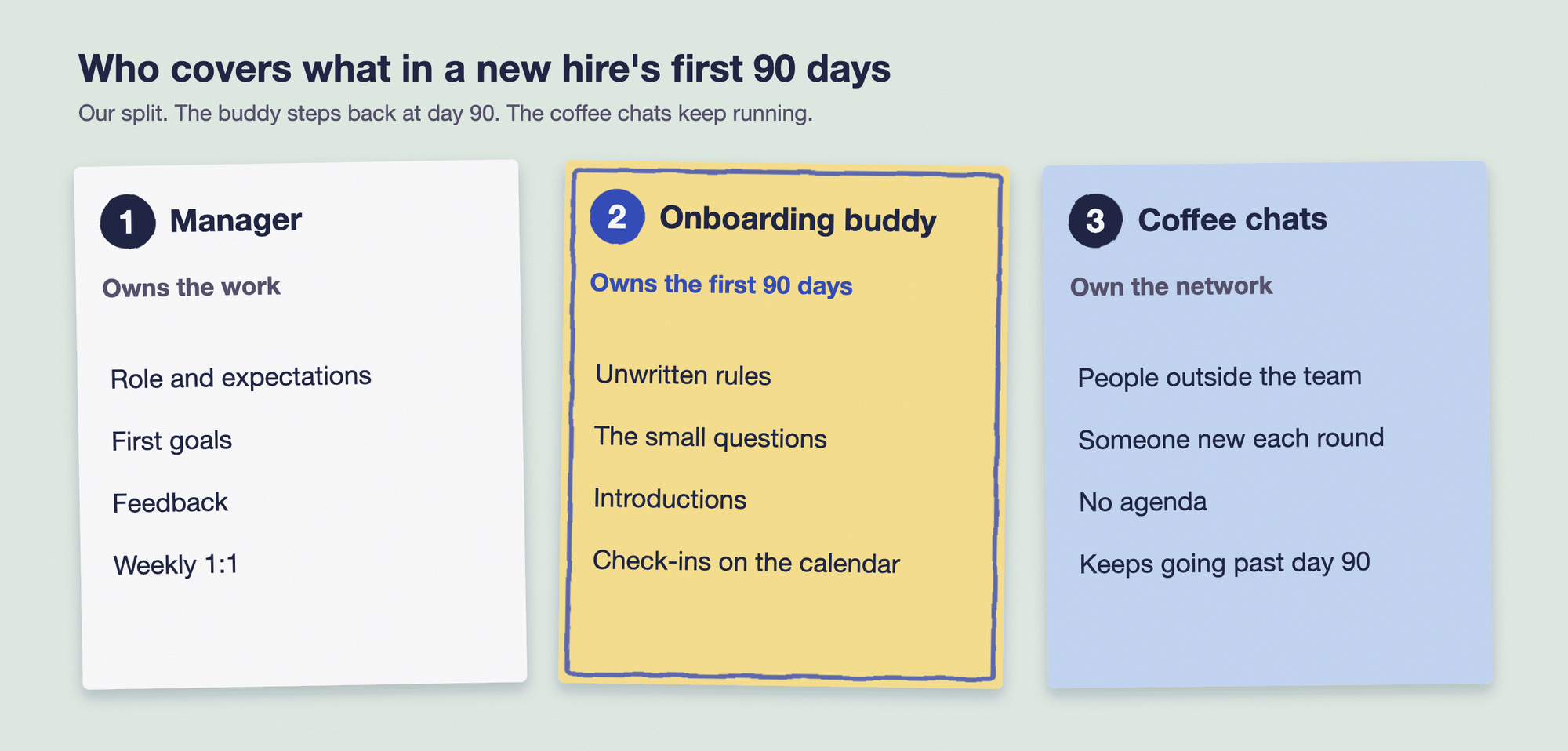
The manager owns the work. The buddy owns the first 90 days. And a rotation of short coffee chats with people outside the team owns everything else, for as long as the new hire is there. For what to talk about once those chats start, our coffee chat questions and icebreaker questions are good places to borrow from. And the manager's side of the first weeks is covered in our one-on-one meeting questions, including a set for a first 1:1 with a new report.
Make the introductions happen without anyone remembering
Onboarding platforms promise to run all of this, and many do, in a portal the new hire opens on day one and rarely after. That's the same problem as the buddy's fading calendar, moved into software. The touchpoints that work are the ones that show up where people already are, which for most teams is Slack or Microsoft Teams. And it shouldn't take a quarter-long rollout to give one new hire a few introductions.
Alfy pairs coworkers for short coffee chats inside Slack or Microsoft Teams, on a weekly, every-few-weeks or monthly cadence you choose per channel. It avoids same-team repeats, respects time zones, suggests a time and drops a calendar invite into the thread, so nobody has to chase anyone. You can also change groups before they're posted. Add each new hire to your coffee channel on day one, and they'll be meeting someone from another team every round, long after the buddy has stepped back. It's the third column of the diagram, running itself.
Kevin Santos, a designer at utility NYC, said Alfy reduces the mental load of scheduling something weekly for his remote team spread across regions. An HRBP reviewing BuddiesHR put it more simply: Alfy, our random coffee chat bot, is a fantastic way to network internally. That's the whole point here. The buddy's job is to be present, not to be a calendar.
For the "who should I ask about this" questions, Linky puts a searchable org chart and directory in Slack, so a new hire can type /whois and see someone's role, team, manager and skills before they message them. It notifies you when someone joins, which makes it a decent reminder to start the buddy plan.
1,000+ HR teams use BuddiesHR and it holds a 4.8/5 rating on G2 (BuddiesHR's own figures). Install Alfy free in Slack or Teams. It's free under 10 employees, there's a 30-day trial, and the pricing page has the current structure. For the wider picture of the first weeks, see our employee onboarding guide.
FAQ
How long should an onboarding buddy program last?
About 90 days. That's the window Microsoft measured, and it's long enough to get past the first month's fog without turning the buddy into a permanent fixture. End it on purpose with a wrap-up conversation rather than letting it fade.
How often should an onboarding buddy meet the new hire?
Weekly in the first month, then every week or two. In Microsoft's pilot, 97% of new hires who met their buddy more than eight times in 90 days said the buddy helped them get productive quickly, against 56% of those who met at least once. Short meetings are fine. Missing them isn't.
Can a manager be an onboarding buddy?
No. The manager has their own job in onboarding, and it matters: Microsoft found new hires were 3.5 times more likely to be satisfied with onboarding when the manager played an active role. The buddy exists for the questions a new hire won't ask the person who reviews them.
What if the new hire and their buddy don't get along?
Swap the buddy, quickly and without drama. Tell the new hire up front that a swap is normal and that they can ask for one. A buddy pairing that isn't working costs the new hire their one safe person to ask, which is the whole point of the program.