The sandwich leave policy: Does it work in 2026?
What is a sandwich leave policy? Learn when it works, legal compliance, and its success globally. Plus: Learn to manage it successfully with a vacation tracker.

The sandwich leave policy is a hotly debated topic in most companies. For some, it is a long-standing rule to prevent the misuse of leave, but for others, it's a source of employee dissatisfaction and disputes.
If you’re a business owner, founder, or HR professional, the real challenge isn’t understanding what it is, but whether it’s worth doing, and how you can handle it successfully. Come with us as we cover everything you need to make a decision. For those that need it, a short summary of a sandwich leave policy follows.
Quick Overview
The sandwich leave policy is a term used to describe how a company handles leave taken before and after weekends, and public holidays. Globally, it is unregulated (through federal or state laws) and must be stipulated in an employment contract to be enforced. According to online debates on the topic, the success of this policy is varied and a source of much debate.
Table of Contents
- What is the sandwich leave policy?
- Sandwich leave policy explained from a global perspective
- When could you implement the sandwich policy?
- When should you not implement the sandwich policy?
- How are sandwich leave policies received in the workplace?
- How to manage a sandwich policy successfully
- Conclusion
- FAQs: Sandwich leave policy
What is a sandwich leave policy?
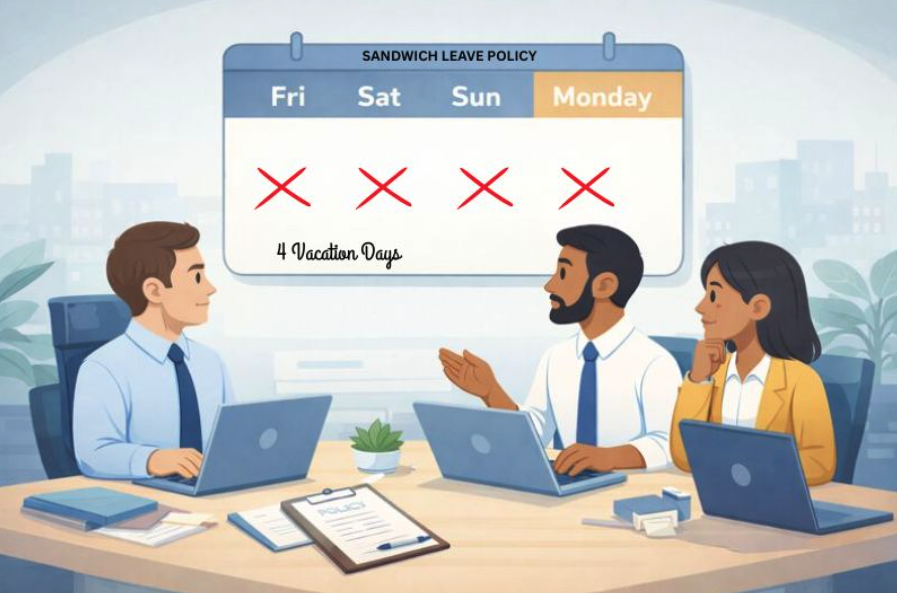
Sandwich leave (or leave encapsulation) treats non-working days (like weekends, public or national holidays) as leave when paid leave falls between these days. For example, an employee asks for a Friday and Monday, giving them a ‘long-weekend’. In this case, Saturday and Sunday will be counted as leave days.
This arrangement is mostly the domain of private sector companies, where mass employee absenteeism affects outputs. In most countries, sandwich leave policies are not explicitly mandated by law and are treated as employer-defined rules, subject to compliance with statutory leave protections
Where rest days, public holidays, sick leave days, and family responsibility days are not protected by federal or state laws, these days can be included in the policy. Employee sandwich leave requests are approved by managers or HR professionals in line with the greater vacation policy, and deducted from the employee’s leave balance.
Palmy Vacation can help you manage PTO requests by automating leave requests and approvals. No more manual tracking in spreadsheets and endless email requests.
Sandwich leave policy explained from a global perspective

Countries around the world approach this type of internal HR rule differently. This is dictated by statutory leave laws that govern the protection of certain leave days.
United States
The sandwich leave policy can be used in the USA, but it is not federally mandated. It is an employer-specific rule aimed at reducing employee absenteeism. In the USA, it is the company’s responsibility to implement it and communicate it via the company's leave policy. It is not a common policy, but it does exist in industries that need 24/7 staffing and have demanding operational schedules.
United Kingdom
According to the statutory document, Working Time Regulations 1998, workers are entitled to 28 days of annual leave a year, which can only be deducted from actual working days. This makes sandwich leaves largely unlawful in the United Kingdom. Implementing this policy in the UK can lead to labor law breaches.
India
In India (especially the IT and corporate sectors), this policy is popular. Due to its vast pool of skilled IT specialists, India is the world’s leading hub for outsourced IT functions. [1] This often requires workers to be available for customer support and enterprise management. Furthermore, it is expected to grow its $1.1 billion generative AI market 15 times bigger by 2030. This kind of output requires low absenteeism, making sandwich leave popular in India.
Phillipines
In the Philippines, it's not as much about leave day deductions as it is about holiday pay. According to the Department of Labor and Employment (DOLE), employees are paid for regular holidays at 100% their normal wages, as long as they were present, or on paid leave the day before the holiday.
In the Philippines, where statutory leave (SIL) is limited to just 5 days, many employers use sandwich leave policies in their internal handbooks as a deterrent. With over 18 public holidays a year, these policies help companies maintain productivity by discouraging employees from 'bridging' every holiday into a 4 or 5-day weekend [2,3]
Eliminate the complications of tracking leave manually with vacation tracking software. Learn how PTO tracking software can help you do this.
When could you implement the sandwich policy?
For most companies that implement this policy, it's about leave management, but more specifically, to discourage employees from taking ad hoc leave days tied to weekends and public holidays.
This is usually environments that rely on a high workforce availability, like factory workers and shift workers. It is also more common where employees work on weekends and public holidays as part of the normal work schedule, for example, emergency responders, hospital staff and the like.
Expert Advice: For decision makers, the workforce type, cultural implications, attrition risks, and alternatives that can get you better employment engagement are key considerations when implementing this policy.
When should you not implement the sandwich policy?
Since this policy is the company’s decision, it should only be used when necessary for business continuity. The following reasons show a lack of a business case for implementing sandwich leave:
- Employees are not required to work on weekends or public holidays, in accordance with the company’s policy.
- Well-structured leave approval processes already maintain productivity at the correct levels.
- You have flexible working arrangements and unlimited PTO, allowing adult workers the freedom to decide how they structure their vacation time.
- It is causing a high level of dissatisfaction and employee turnover in your company.
How are sandwich leave policies received in the workplace?
As a recent LinkedIn post showed, this topic generates a lot of debate and differing opinions. Here is a short snapshot of some of the comments from this post:
Reasons for not favoring sandwich leave:
- An outdated approach that causes dissatisfaction among employees.
- Labor laws that protect public holidays and rest days.
- Employees complain heavily about it.
- Companies are moving away from restrictive policies and focusing on employee well-being.
- The policy is not mandated.
Reasons for favoring sandwich leave:
- Discourages employees from taking casual leave and forces proper planning.
- Weekends form part of a mandated work schedule.
While one post does not represent the final word on this topic, it does speak to the thoughts of both employees and some HR teams. The overwhelming majority of people felt that this policy signaled a lack of concern for employee well-being and work-life balance.
How to manage a sandwich policy successfully

Whether you agree with the views of the LinkedIn post mentioned above or not, you may be in a position where you can’t avoid this policy. In this case, make the best of it by focusing on the following:
- Ensure that your policy document and employee contracts explicitly state that you have a sandwich leave policy. Communicate this to employees before you finalize employee onboarding.
- Send out regular employee communication, reminding employees how this works, and the process for employee leave requests.
- Make leave balances easily accessible for employees by using a vacation tracker like Palmy Vacation. This will reduce the administration for managers and help employees understand how many leave days will be deducted.
Insight from the expert: In our experience at BuddiesHR, we find that complete transparency during onboarding helps to reduce dissatisfaction about leave policies later on. Use the ‘Ultimate onboarding checklist’ to help you create a great 90-day experience with new hires.
How a vacation tracker can help you manage your leave policy.
For employers, this takes leave management away from spreadsheets, manual calculations, and email leave approvals. You customize the vacation tracker according to your leave policies, assign approvers, and then let the system automate your entire process for you. You can expect:
- Vacation requests directly in your communication platform (e.g., Slack), and one-click approvals.
- Quota and accrual tracking.
- Google Calendar sync (helping you to see upcoming leave).
- Automatic Slack status sync.
- Tracking of leave requests and approval history.
If you want faster leave decisions, fewer manual interventions, and better planning. Test Palmy Vacation for yourself. And if you’re setting up everything from scratch, Slack tips for beginners will help you do it quickly.
Conclusion
A sandwich leave policy can serve a purpose in environments where continuous staffing is required. However, in most modern workplaces, the policy causes friction and provides limited operational benefits that undermine employee satisfaction. If the policy is retained, it must be clearly documented and legally compliant to mitigate risk and retain value.
FAQs: Sandwich leave policy
1. Is the sandwich leave policy legal?
Yes, sandwich leave is legal in most countries. However, the employee handbook and employee contract should clearly stipulate this and explain the need for it. It is used mainly in industries where extended breaks by employees will severely disrupt business outputs. As long as such a policy does not break any mandated leave laws, it is regarded as a company-specific decision.
2. Is a sandwich leave different from PTO?
The sandwich rule is about how leave is calculated, while PTO is a term used to describe an employee’s total leave entitlement. With the sandwich leave structure, non-working days are deducted when they fall between paid holidays. It specifically applies to leave before and after weekends or public holidays, whereas PTO applies to any absence, such as one day sick leave or a week’s vacation time.
References