Coffee chat questions: 32, sorted by who you're meeting
32 coffee chat questions for colleagues, sorted by who you're meeting, with a four-move structure, three follow-ups and a free planner.


The best coffee chat questions depend on who you're meeting. A question that works on a new hire falls flat with your manager, and the one you'd ask a teammate you've known for two years makes a stranger from another team go quiet. Most lists ignore that and hand you 30 questions in no particular order.
Below you'll find 32 coffee chat questions sorted by who's across the table, a four-move structure for a 15 or 30 minute chat, three follow-ups that work on any answer, and a planner that turns all of it into a running order. If you'd rather not organise the chats by hand at all, the last section covers that too.
What makes a coffee chat question good
A good coffee chat question is open, specific and easy to follow up. Open means it can't be answered with yes or no. Specific means it points at something real, like what a normal Tuesday looks like, rather than something abstract like values. Easy to follow up means the answer will contain a detail you can ask about.
The follow-up part has research behind it. In a set of studies published in the Journal of Personality and Social Psychology in 2017, Karen Huang and colleagues found that people who ask more questions, particularly follow-up questions, are better liked by their conversation partners. The studies included live chats and a speed-dating experiment. The authors also caution that too many questions, or rude and repetitive ones, can backfire (Huang et al., It doesn't hurt to ask: question-asking increases liking).
The second finding is about nerve. Michael Kardas, Amit Kumar and Nicholas Epley ran 12 experiments with more than 1,800 participants, mostly strangers paired up to talk. Deep conversations felt less awkward and created more connection than people predicted, and people overestimated the awkwardness most for the deep topics (APA, 30 September 2021). Those were strangers in a lab, not colleagues, so treat it as a nudge. Our reading: the slightly bold question is usually safer than you think, and small talk about the weather is the riskier choice.
How to run a coffee chat in four moves
A coffee chat has no agenda, but it does have a shape. This is our rule of thumb, not research: open with something easy, spend most of the time in the middle, ask one bigger question if the chat is flowing, and close by giving something back. At 15 minutes, drop the bigger question. There isn't room for a story.
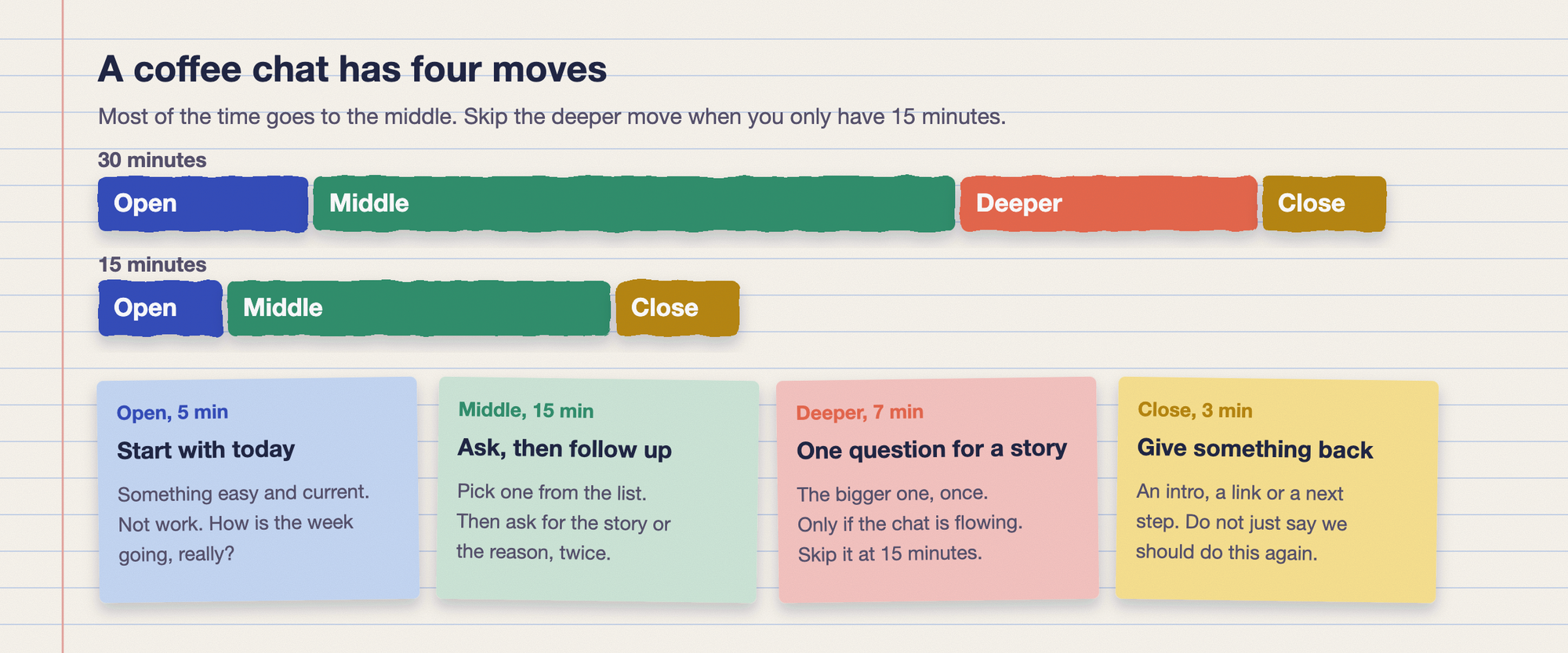
The close is the move people skip, and it's the one that makes the next chat easier. An intro, a link or a next step turns a pleasant half hour into something the other person can use.
Plan your coffee chat
Pick who you're meeting and how long you've got. The planner builds a running order from the question banks on this page, plus a few openers, bigger questions and closers that only live here. Shuffle until it feels like something you'd say. Nothing is sent anywhere.
Coffee chat planner
Choose who you're meeting and how long you have. Press shuffle for a different mix.
Your running order
The timings are our rule of thumb, not research. Two follow-ups are worth having ready for every question: how did that happen, and what would you change.
Coffee chat questions for colleagues you've never met
Cross-team chats are the point of a random pairing. You're trying to learn how another part of the company really works, so ask about the job before you ask about the person.
- What's your role, in the version you'd give a friend rather than on LinkedIn?
- What does a normal Tuesday look like for you?
- What does your team do that the rest of the company doesn't see?
- What's the best thing about working here, and the most annoying?
- Where did you work before this, and what did you bring with you?
- What are you working on right now that you're excited about?
- What do you wish people from other teams knew about your job?
- Who should I be talking to that I'm not?
The last one is the quiet winner. It hands the other person a job they can do, and it usually leads to the next chat.
Coffee chat questions for a new hire
The new hire is the one with all the questions, so these are about giving them room, not testing them. Let them lead, and answer honestly when they turn a question back on you.
- What's been the most surprising thing about your first weeks?
- What did you expect to be hard that wasn't, and the other way round?
- What's one thing nobody told you that you wish they had?
- Who has helped you most so far?
- What's still confusing?
- What did you do before this, and what do you miss about it?
- If you could change one thing about onboarding, what would it be?
- What would make your next month easier?
If you're building the onboarding side as well, our guides to employee onboarding and the onboarding checklist cover the rest of the first month.
Coffee chat questions for your manager or someone you manage
A coffee chat isn't a 1:1 and it isn't a review. Keep it that way: no notes, no action items, no surprises. The questions below are about energy and direction, not performance.
- What's taking more of your energy than it should?
- What's a piece of work you're proud of lately that I might have missed?
- What do you want to be doing more of in six months?
- What's one thing I could do differently that would help you?
- Where are you learning the most right now?
- What would you like to try that you're not sure is allowed?
- How do you like to receive feedback?
- What have you heard this week that I should know about?
Coffee chat questions for teammates you already know
Remote teams know each other's work and not much else. These questions skip the work and fill in the person, which is what the office used to do for you by accident.
- What's your setup like, and what's the one thing you'd upgrade?
- What do you do in the first hour of your day?
- What have you been into lately: a show, a hobby, a recipe?
- What's the best advice you've had about work?
- What are you better at than people would guess?
- What did you want to be when you were 12?
- If you could work from anywhere for a month, where would it be?
- What tool or habit changed how you work?
For a bigger bank of lighter prompts, the icebreaker questions guide has 60, sorted by situation, from remote teams and meetings to new hires and async threads.
Three follow-ups that work on any answer
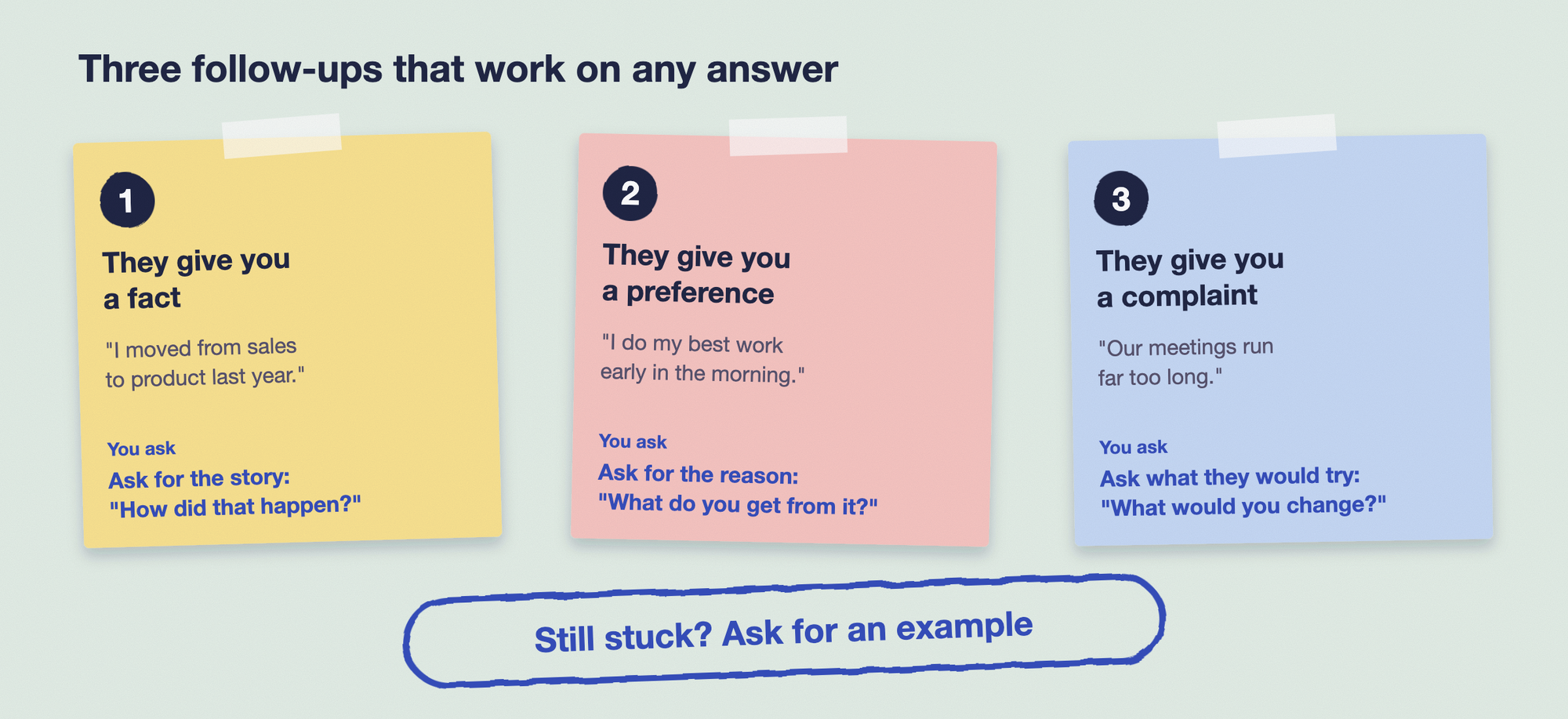
A great first question gets you a short answer. The follow-up is where the conversation starts. You don't need to be clever, you need to listen for what kind of answer you just got and ask for the next layer: the story behind a fact, the reason behind a preference, or the change behind a complaint. Per the research above, follow-up questions are the clearest sign that you're listening.
Questions to skip
Most of these are obvious in the abstract and easy to blurt out in practice. Skip yes or no questions, which end the thread. Skip interview questions in disguise, like where they see themselves in five years. Skip anything that makes someone defend a choice, such as why they left their last job. And leave salary, health, family plans, politics and religion alone unless the other person brings them up. A coffee chat works because it's optional and low stakes. Don't spend that on a question that feels like a test.
Why coffee chats stop happening
The questions aren't the hard part. If you've run a coffee chat programme by hand, you know the cost: someone has to pick the pairs, avoid putting two people from the same team together, check calendars across time zones, send the invites and chase the no-shows, every round. None of it is hard. All of it is admin that nobody owns, and it's the step where good intentions usually stall.
Alfy takes that step away. It pairs people at random on a weekly, bi-weekly or monthly rhythm, posts the match in Slack or Microsoft Teams, and suggests a time and creates the calendar invite. The weighted randomness avoids same-team and repeat pairings, matching is time-zone aware, each channel opts in on its own rhythm, and anyone can snooze a round in one click and be included again next time. If a chat stalls, a rotating icebreaker is there as a fallback, and your best questions are the ones above.
One Head of People and Culture quoted on the Alfy page says it breaks the ice by pairing colleagues for coffee chats. More generally, 1,000+ HR teams use BuddiesHR and it holds a 4.8/5 rating on G2 (BuddiesHR's own figures). Install Alfy free in Slack or Teams: it's free under 10 employees and comes with a 30-day trial, and the pricing page has the current structure.
If you're deciding whether virtual coffee chats suit your team in the first place, read will a virtual coffee chat work for remote workers. For other ways to build connection without adding meetings, see how to help your remote team feel connected and the virtual team building activities library.
FAQ
What are good coffee chat questions to ask a coworker?
Open, specific questions that are easy to follow up, matched to who you're meeting. For someone from another team, ask about their job. For a new hire, ask what has surprised them. For teammates you know, ask about the person outside the work.
How long should a coffee chat be?
Fifteen to thirty minutes. Our rule of thumb: that's long enough to get past small talk and short enough to say yes to. At 15 minutes, skip the deeper question and keep the close.
How do you start a coffee chat with someone you don't know?
Open with something easy and current, like how their week is going, then move to one question about their job. Research on conversations between strangers suggests deeper questions go better than people expect, so you can be a little bolder than feels natural.
How often should coworkers have coffee chats?
Pick the slowest rhythm you'll actually keep. Alfy supports weekly, bi-weekly and monthly rounds, and each team chooses its own, so a monthly round that happens beats a weekly one that dies.