Icebreaker questions: 60 that actually get real answers
A large bank of icebreaker questions for remote teams, standups, 1:1s and new hires, plus the research on why some get real answers.

Every list of icebreaker questions on the internet has the same twenty questions on it. That's not really the problem. The problem is who answers first, who answers at all, and whether the same three people are doing all the talking again this week.
If you run a distributed team, you already know the meeting where nobody unmutes until the third silence. An icebreaker question is supposed to fix that. Most lists just hand you the question and leave the rest to you: who picks it, who posts it, who makes sure it's not the same person answering first every single time. Here's a genuinely large bank of questions, organized by the situation you're actually in, plus the part every other list skips: why some questions get real answers and others get a groan, and how to run this without it becoming one more recurring task on your plate.
What actually makes an icebreaker question work
A good icebreaker question is specific enough to have a real answer and safe enough that there's no wrong one. "What's your favorite productivity hack" invites a performance. "What's on your desk right now that isn't supposed to be there" invites an actual answer, because there's nothing to get right.
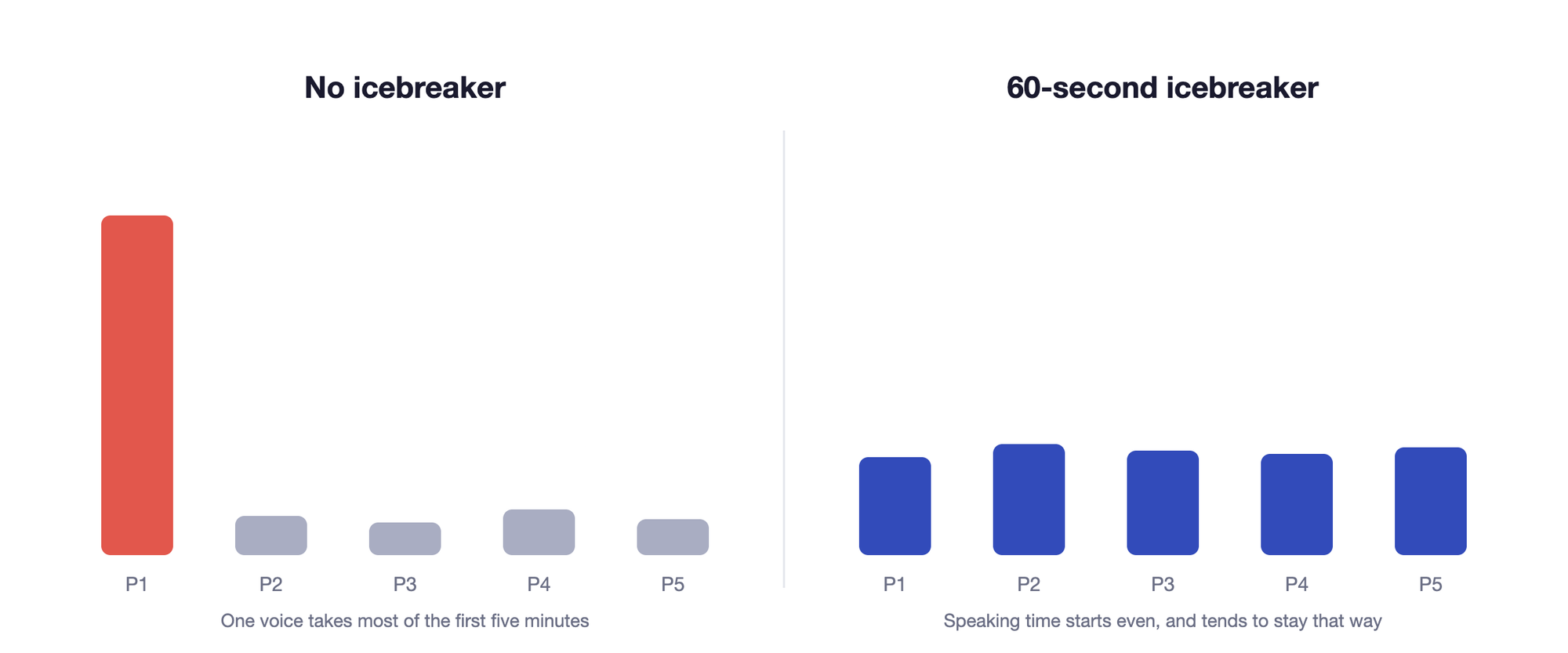
But the question itself is only half of it. Researchers at MIT and Carnegie Mellon found that a team's collective intelligence didn't track with how smart its members were individually. It tracked with how evenly the conversation was split between them: teams where a few people dominated the talking scored worse as a group, regardless of who those people were (Woolley et al., Science, 2010). An icebreaker isn't fun filler bolted onto the start of a meeting. It's the cheapest available fix for a turn-taking problem, and turn-taking is a structural thing, not a "these questions are more fun" thing.
Google's own research on team effectiveness reached a related conclusion from a different angle: of everything they measured across hundreds of teams, psychological safety, whether people believed they could speak up without being punished for it, predicted performance better than any other factor, including who was on the team (Google re:Work, Project Aristotle). A 60-second icebreaker at the top of a call is a small, repeatable signal that it's safe to talk here. That's what it's actually doing, underneath the small talk.
Icebreaker questions for remote and hybrid teams
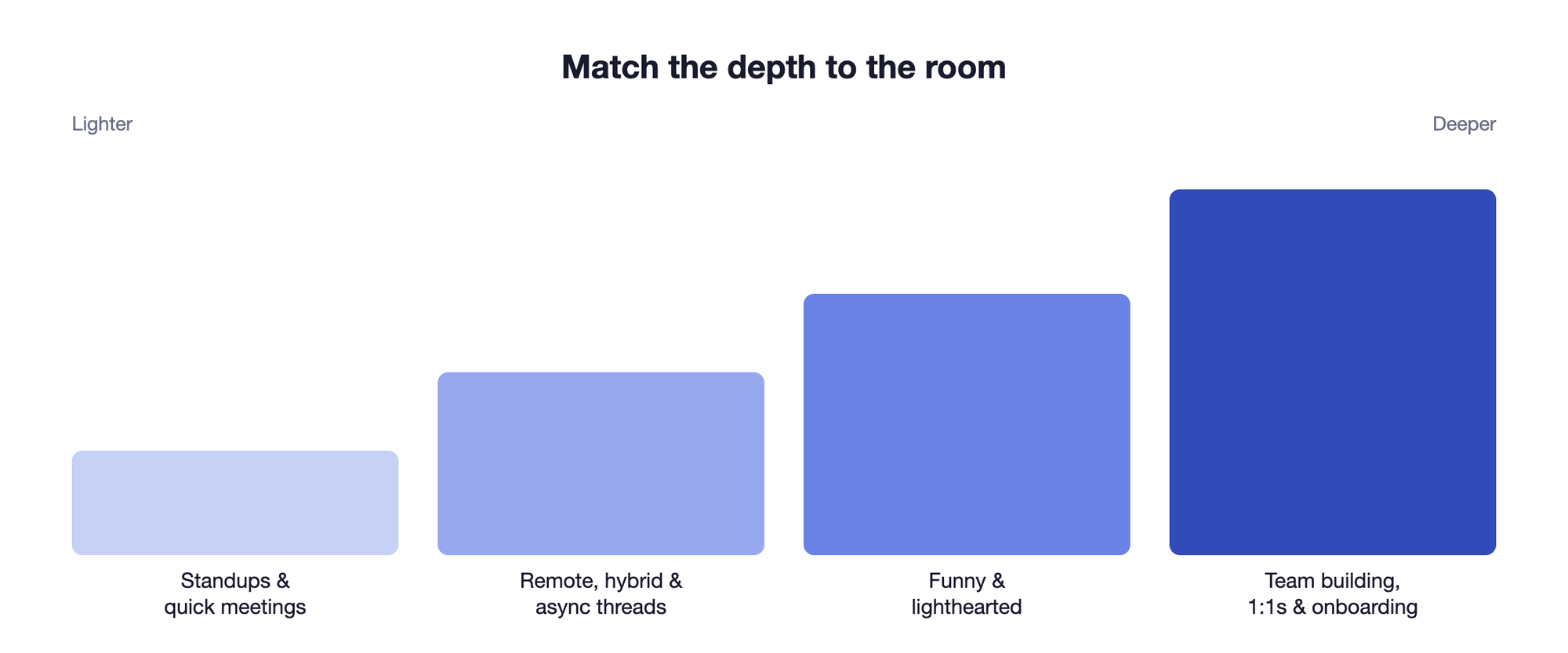
These are built for the reality of a distributed team: different rooms, different backgrounds, no shared hallway to fill in the gaps.
- What does your actual workspace look like right now, camera pan optional?
- What's a sound you hear during your workday that nobody else on this call would recognize?
- What time zone gap on this team still catches you off guard?
- What's the view out of your nearest window at this exact moment?
- What's one thing about working from home that nobody warns you about?
- If your pet or a housemate could join this call, what would they say about you?
- What's the last thing you had to mute yourself for that had nothing to do with work?
- What's a local holiday or tradition where you live that most of this team has never heard of?
- What's your go-to coffee, tea, or nothing-at-all order on a normal work morning?
- What's one app or gadget that makes working from wherever you are noticeably easier?
Icebreaker questions for meetings and standups
For the meetings that happen daily or weekly. Keep these to a single sentence each, thirty to sixty seconds a person.
- One word for how this week is going so far.
- What's the most useful thing that happened since we last met?
- What's one thing you're hoping to finish before the weekend?
- Coffee, tea, or neither this morning?
- What's the last thing you Googled that had nothing to do with work?
- What's a small win from yesterday that nobody else saw?
- If this week had a theme song, what would it be?
- What's the current state of your inbox, honestly?
- What's one thing on your desk that's been there way too long?
- What's a task you're avoiding right now, no judgment?
Deeper icebreaker questions for team building and 1:1s
For a dedicated team-building slot, a retro, or a 1:1 where you actually have five or ten minutes and want more than a one-liner.
- What's a skill you have that almost nobody on this team knows about?
- What's the best piece of career advice you've ever ignored?
- What's something you believed about this job in your first month that turned out to be wrong?
- Who's someone outside of work who shaped how you think about your career?
- What's a project you're proudest of that most people wouldn't consider a big deal?
- What's a work habit you've deliberately built, and why did you build it?
- What would you do for a living if this career didn't exist?
- What's a piece of feedback that changed how you work?
- What's something you're genuinely curious about right now, work or otherwise?
- What's a moment at this company you'd want a new hire to hear about?
Funny and lighthearted icebreaker questions
For when the goal is just to get people laughing before the agenda starts.
- What's the most useless talent you're weirdly proud of?
- What's a food combination you love that other people find disturbing?
- What fictional job would you be terrible at?
- What's the worst gift you've ever received and had to pretend to like?
- If you had a walkout entrance song for meetings, what would it be?
- What's a household item you've used for something it definitely wasn't designed for?
- What's the strangest thing in your search history this month that you're willing to share?
- What cartoon or movie villain do you secretly relate to?
- What's your most controversial food opinion?
- If you had to give a TED talk tomorrow on something you know nothing about, what would you pick?
Icebreaker questions for new hires and onboarding
First weeks are their own category: the goal is making someone feel like a person on the team, not just a new login. For the fuller onboarding picture, see the ultimate employee onboarding guide.
- What made you say yes to this role?
- What's something you're hoping this job will teach you?
- What's a rumor or first impression you had about this company before you joined?
- What's one thing from your last job you hope this one does differently?
- What's a question you're too embarrassed to ask in a bigger meeting?
- What's something outside of work you'd want this team to know about you?
- What's your ideal way to get feedback: written, live, or somewhere in between?
- What's a tool or workflow you're used to that you're worried this team doesn't use?
- What's something small that would make your first month easier?
- Who or what convinced you to actually apply?
Async icebreaker questions for Slack or Teams threads
Not every team can get everyone live at once. These are built to be posted as a message and answered whenever someone gets to it.
- Drop a photo of whatever's within arm's reach right now.
- What's a song you've had on repeat this week?
- What's the last thing you learned how to do?
- What's a productivity tip you swear by that probably wouldn't work for anyone else?
- What's a place you'd move to tomorrow if work weren't a factor?
- What's a show, book, or podcast you're currently recommending to everyone?
- What's one thing you do differently now than you did five years ago?
- What's a small tradition from your team or family that you still keep up?
- What's the best meal you've had recently?
- What's something you're looking forward to this month?
Need one right now? Pick a category.
Pick a category and hit shuffle.
Why the same five people always answer first
If you've run these for more than a few weeks, you already know the pattern: the same two or three people jump in first, every time, and everyone else waits to see what they say. That's not a personality problem, it's what happens by default whenever a question gets asked to a group with no structure for who goes when. The Carnegie Mellon and MIT research above found this exact effect: teams do worse when a few voices dominate, regardless of who those people are, because the rest of the group's thinking never actually gets heard.
The fix isn't a better question. It's taking the "who goes first" decision out of the room entirely, rotating or randomizing it so the answer changes every time. That's a scheduling problem more than a content problem, which is exactly what trips people up when they try to fix it with a better list.
How to actually run these without it becoming your job every week
Here's the part every list above skips: somebody has to remember this exists, pick a question, post it, and read the room when engagement drops off. That's a real, recurring cost, and it's usually the reason a team's icebreaker habit quietly dies after week six.
Alfy runs the same underlying problem, random pairing for coffee chats, natively inside Slack or Teams: it rotates who's matched with whom on a set cadence, avoids repeat pairings, and posts the prompt where the team already works instead of asking anyone to check a separate portal. One distributed design team used it to break down the silos that had built up between people who'd never worked a project together, without adding a meeting or a new tool anyone had to remember to open. BuddiesHR sits at 4.8 out of 5 on G2 with over 1,000 HR teams using it, and the same principle, native delivery, no extra portal, applies whether the rotation is a coffee chat or a Monday icebreaker. It's free to install under 10 employees and takes about a minute to set up.
If you'd rather browse structured activities instead of a straight question list, the team building activities that don't suck covers that ground, and if you want a broader set of remote-specific icebreaker formats beyond just questions, see fun ideas for people who hate team building.
FAQ
How long should an icebreaker take in a meeting?
Thirty to sixty seconds a person for a daily or weekly meeting. Save the longer, deeper questions for a dedicated team-building slot or a 1:1 where there's actual time to sit with the answer.
What if someone doesn't want to answer?
Always allow a pass, and say so out loud the first time you run one. The point is psychological safety, and forcing an answer out of someone undercuts the exact thing the question is supposed to build.
Are icebreaker questions actually useful, or just filler?
The research above ties equal participation to team performance, not to mood. Treat the icebreaker as a turn-taking mechanism and the "is this a waste of time" question mostly answers itself.
What's a good icebreaker question for a large all-hands?
Pick a quick, one-word or one-sentence question from the meetings and standups list and collect answers in the chat rather than out loud. It scales to any size without eating the clock.