The ultimate employee onboarding guide
Understand why onboarding is necessary and the four phases of a 90-day onboarding plan. Learn how to automate and measure an onboarding program with BuddiesHR.

An effective onboarding process is about much more than just a welcome email. The experience a new hire has in the first days and weeks at your company sets the tone for successful integration and high performance.
Furthermore, onboarding programs help your new employee understand how their basic needs will be met while working for you. If you’ve heard of Maslow’s hierarchy of needs, you’ll know what we’re referring to. It’s the sense of security, stability, and belonging that every new hire needs.
In this article, we tell you why this is true and how you can create a highly effective onboarding experience with ease.
Quick Overview
The employee onboarding process describes the focused activities that welcome an employee into the organization. The activities familiarize new employees with the company culture, processes, vision, values, and the responsibilities of their new jobs. It improves confidence and moves the employee from entry to productivity faster and with greater ease.
Table of Contents
- Why you need a solid onboarding process
- What does a successful onboarding program look like?
- The 4 phases of effective employee onboarding
- How to measure onboarding success
- Final Thoughts
- FAQs: Employee Onboarding
Why you need a solid onboarding process

They say ‘First impressions count’ when meeting someone new, and the same is true for the workplace. While the new hire is under pressure to put their best foot forward, so is the company. Here are some surprising statistics1:
- 44% of employees say they have regrets in the first week.
- 70% decide if the job is a right fit in the first month.
- 62% say their first day impressions of the company were accurate.
- Most employers have 44 days to keep a new recruit from leaving.
When researching the reasons for these numbers, it was found that people left so quickly because their onboarding was inadequate, either directly or indirectly. These stats are disappointing when you consider how much time you spend on the hiring process, drafting an attractive employment contract, and helping new employees feel at home.
You don’t have to watch top talent walk away from your business. Keep them emotionally invested in your company by prioritizing onboarding. BuddiesHR offers Slack-first apps that help you automate the entire process, such as:
- Alfy Matching: Help new employees build relationships with virtual coffee chats.
- Clappy Kudos: For promoting culture and company values through recognition.
- Linky Directory: Empower your new hires with the org structure, and find their new colleagues in other departments easily.
- Pulsy Survey: Run polls and an onboarding survey among new workers to check if you’ve still got their interest.
- SimplePerf: Run automated 360 reviews and get AI-driven insights into your employees' performance to track their onboarding progress.
What does a successful onboarding program look like?
A typical formal onboarding program is around 90 days, but it can extend to a full year if it includes the first annual performance review, multiple learnings and mentorship. Organizations that prioritize culture immersion tend to have longer onboarding periods. Include the following in the new employee onboarding experience:
- Pre-boarding tasks (often include new hire paperwork).
- Social integration and team bonding.
- Compliance requirements (employee handbook).
- Job description and task responsibility.
- Role-specific training.
- Culture integration and values promotion.
- Performance expectations, and performance review cycle.
- Continuous coaching, mentoring, and development feedback.
The 4 phases of effective employee onboarding

Onboarding new employees works best when it’s structured and predictable. Take your lead from the HR onboarding checklist, or automate the process through employee engagement software like BuddiesHR.
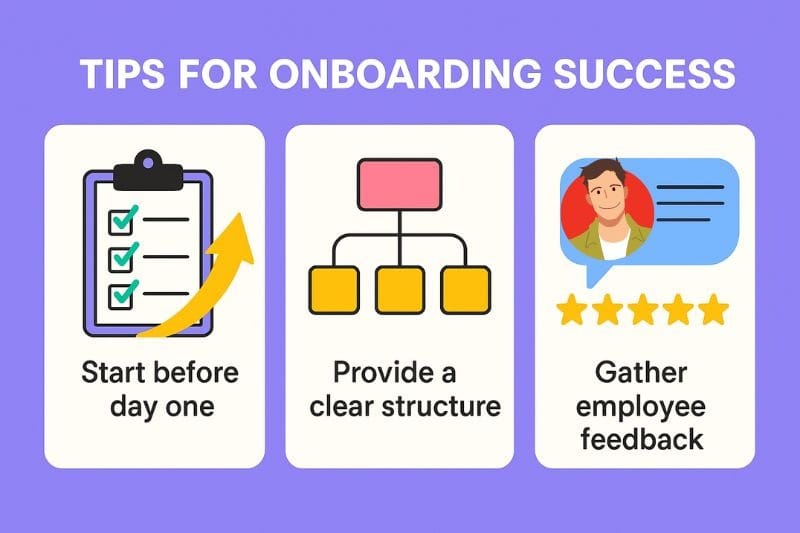
Phase 1: Pre-boarding (before Day 1)
After the recruitment process and job offer are concluded, you can commence with the onboarding journey. This phase is the bridge between the hiring experience and early engagement, and removes the anxiety of starting a new job. Hires feel welcomed, and you won’t lose valuable time completing paperwork.
Pre-boarding checklist
- Send a warm welcome email or a link to the onboarding portal. This can be done by your HR professionals or hiring managers.
- Share the required paperwork, and provide a contact person for returning completed forms, such as Human Resources.
- Increase employee satisfaction before day 1 by sending short ‘welcome’ clips from new team members.
- Provide the name of an onboarding buddy who will discuss the organization’s culture with the new hire.
- Ship new equipment to reach the employee before the first day of work (remote hires).
- Send a welcome gift or company promotional items.
Pre-boarding is critical for employee retention, but is unfortunately overlooked by employers. This is where the employee learns all about the effort the company will make to welcome them, keep them, and support them. It speaks volumes.
Phase 2: Day One (Set the tone)

Time for super smooth integration. They’ve received all the company policies and have some ideas about their ‘go-to person’; now they need to see the work environment in action. Nothing kills excitement faster than being left to fend for yourself the first week or having to deal with access permissions while everyone else goes about their business.
A meaningful first day
- Kick off with an extra special welcome in person, or with a virtual video. The employee needs to see people now and connect with co-workers.
- Introduce direct managers and the HR team (if you have one).
- Provide a deeper understanding of the company culture (how we really do things here).
- Help the employee experience the mission, vision, and values.
- Explain business outcomes and how they are measured.
In his acclaimed book, 21 Irrefutable Laws of Leadership, John Maxwell said, ‘Leaders should touch a heart before they ask for a hand’. When employees get connected from day 1, they stay connected.
Phase 3: The first 30 days
Onboarding new hires is like playing the long game - it takes time, effort, and dedication. One study looked extensively into onboarding practices and found numerous benefits associated with strong onboarding programs, including:
- Mentorship by seasoned employees, providing insider insights that take a new employee months to gain on their own.
- Role-specific training and e-learning.
- Clear performance goals and tracking in the first few weeks.
- Timeous payment of wages and inclusion in company benefits (such as healthcare, vacation allowances, and retirement planning)
Insider Insight: Top 20 employee performance metrics to track. Here, you can discover the top metrics that you, as a manager, should track to boost productivity in the first 30 days.
Phase 4: The first 90 days
This is when the employee begins actively contributing to the company's objectives. The manager’s role shifts from instructional to coaching.
Key elements of a strong 90-day plan
- Continue defining KPIs and the actionable steps to achieve performance goals.
- Conduct a formal 30, 60, and 90-day follow-up meeting to check how well the employee is settling down.
- Provide feedback and progress reports to help the employee stay focused and make things easier each month.
- Begin formulating a long-term career development and growth plan.
The objective by day 90 is for the employee to feel secure in their position, well-equipped to meet performance goals, and a permanent part of the team.
Tips for managers: Learn how to run effective one-on-one meetings and boost trust, communication, and productivity during the first 90 days.
How to measure onboarding success
Measuring the onboarding process provides key insights to refine it and ensure its success in your organization. Measure with:
- New high pulse surveys at day 1, 7, 30, 60, and 90 days.
- Completion rates for onboarding tasks.
- Early turnover rates.
- 360-degree reviews to gather peer and manager feedback.
- Productivity milestones or KPIs.
Successful onboarding feels organic, human and predictable. It takes time for people to adopt new practices, values, ethics, and the company's culture. It takes time to understand their personal value to the company and where they fit in. It also takes time to gather enough feedback to determine whether your onboarding practices are sound and reproducible.
In ‘How to measure employee engagement without surveys’, Fabien Pinel from BuddiesHR discusses how you can spot signs of either low or high employee engagement - critical for onboarding programs.
Final Thoughts
Structured onboarding programs are often neglected by businesses that view them as time-consuming and unnecessary, but nothing could be further from the truth. Studies have shown that employees decide whether to stay or go within a short time period - often a week or a month. Research has found that, in most cases, a lack of onboarding practices is to blame.
Leave nothing to chance in the first 90 days 👉 Start here! With the BuddiesHR employee engagement platform, you will have your onboarding process supporting employee retention in no time.
FAQs: Employee onboarding
1. What is employee onboarding?
Employee onboarding is the structured process of welcoming a new employee into an organization. It can last between 3-12 months, and its focus is to provide employees with the information, support, and resources they need to fit into the culture. Employees make decisions about whether to stay with the company very quickly, so onboarding is a critical step into the business.
2. What are the 5Cs of employee onboarding?
The 5Cs of onboarding is a framework that demonstrates successful onboarding. Widely recognised as compliance, clarification, confidence, connection, and culture. Dr. Talya Bauer formulated these five elements based on her years of experience with onboarding practices.
3. Should onboarding be different for remote workers?
Yes, remote workers have different needs than in-office workers. They need clearer company processes (standard operating procedures) and fast, easy integration into the company communication system (like Slack). Remote workers need structured virtual coffee chats and inclusion in team-building activities to stay connected and feel part of the team.
References