Free OKR template: Set objectives and key results (with examples)
Free OKR template with practical examples to help you set clear objectives, define measurable key results, and track progress easily—without complex software.

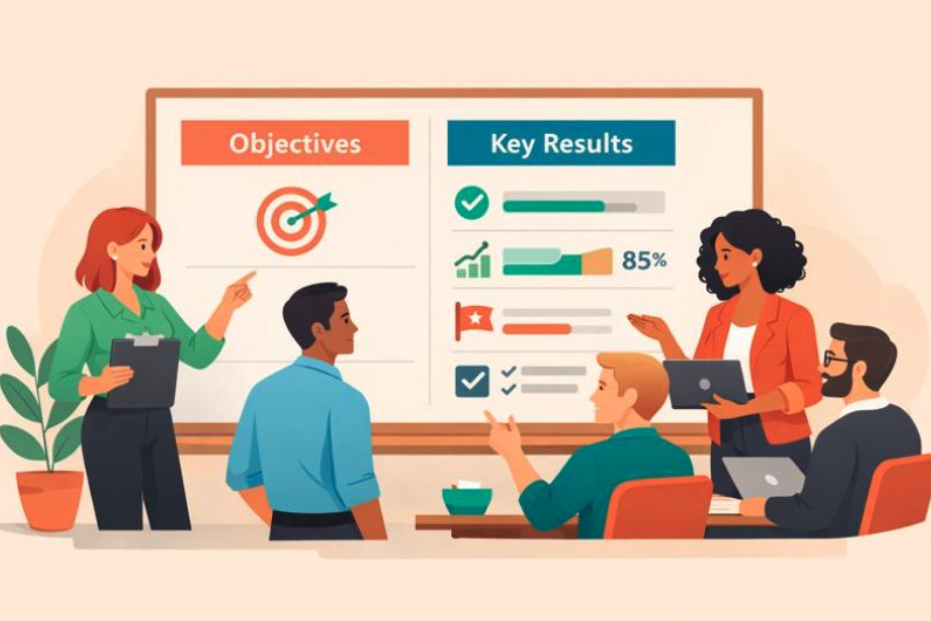
If setting team objectives feels harder than it should be right now, you’re not alone.
The OKR framework has been popular since 1999 when it found its way to Google. It’s been around a while, but it doesn’t mean it has gotten any easier to implement, with some 70% of companies failing at OKR initiatives. [1,2]
Let’s stop you from becoming another statistic, shall we? Our guide will help you to understand company goals better and turn them into measurable key results. Then we’ll look at how you can track progress simply and keep everyone on the same page (without frustrating the entire team).
Quick Overview
An OKR template is a structured document that outlines the objectives and key results a company wants to achieve over a period of time. By documenting OKRs, a business can align daily activities with desired outcomes and measure the success of these activities. Notion, Mira, Google Sheets, and performance review tools are common ways to set up templates.
Table of Contents
- What are OKRs?
- Why use an OKR tracking template?
- How to set OKRs
- Examples of OKR templates
- Conclusion
- FAQs: Free OKR template
What are OKRs
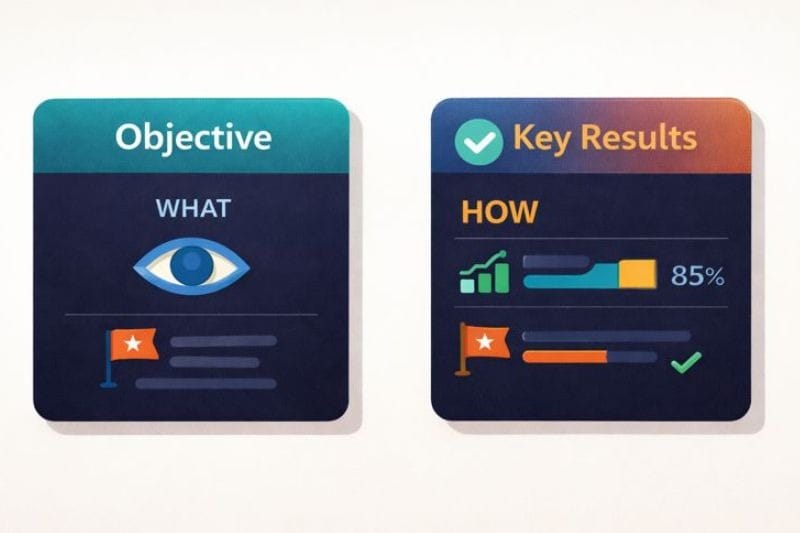
For any framework to be successful, the terms and definitions it uses must be clearly defined and understood. Remember this point because this is the exact place where even a simple OKR template can fall flat. To avoid this mistake, let’s get clear about what OKRs are.
- O - Objectives: Answers the ‘what’, and helps companies verbalize what they want to achieve.
- KR - Key Results: Answers the ‘how’, and defines what measurable actions need to be taken to reach the objective that has been set.
Why use an OKR tracking template
Tracking OKRs will show you whether you are meeting the objectives you’ve set out to achieve, and help you to understand how your team is contributing to reaching company goals. It's really OKRs that set the stage for performance management because they provide the foundation for performance reviews and help employees who need to improve their performance.
A template brings consistency and fairness to the whole OKR measurement process. It also empowers teams to keep track of their own results and amend daily tasks to match OKR intent. With a template (created in Excel or Google Sheets), you can create progress charts and keep everyone involved in business outcomes. Templates are especially helpful with ambitious objectives where progress tracking is critical to delivery.
How to set OKRs
A very effective way of setting OKRs is to gather your whole team and run them through an OKR session. The reason for this is to establish the ‘why’ of goal setting with your team. When discussing strategic initiatives, this is often the missing piece of the puzzle - why are we doing this? Why is it necessary? Why do I need to care about this? These are all the silent questions that don’t get answered soon enough and end up wrecking the effectiveness of the practice.
By getting everyone together in one place, you can formulate company objectives together. When it's ‘team goals’ and not just the manager’s goals, you’re moving in the right direction. Setting up an OKR template in terms of finding a platform to track objectives and key results is relatively easy - you use Google Sheets, Google Docs, MS Excel, or performance review software. It’s the work that happens beforehand that provides the basis for the OKR tracking template and needs to be given careful attention.
Run a successful OKR setting initiative

Allocate around 3-4 hours for this session, and let team members know this is focus time for strategic planning and to create alignment with company-wide goals. Then get everyone around the table, pull up the whiteboard, and start handing out pens and sticky notes. If you’re meeting online, use Slack, MS Teams, Miro, or Openboard to do the same work.
Start by asking: ‘What is the most important thing we have to achieve this year/quarter?’ Let everyone write down what they think on a sticky note, and see what emerges. Do this 5-6 more times, placing the notes on the whiteboard for everyone to see. Now pick the top three choices, and ask the team to vote for the objectives that would provide the biggest win.
Once you have your top three objectives, ask: ‘How will we know that we’ve achieved this?’ Explain that you are looking for a tangible measurement. Once this is done, you’ve got the basic structure for an OKR planning template. Before ending the session, check that:
- Each objective has corresponding key results.
- Key results are measurable outcomes and can be tracked with progress percentages.
- Quarterly objectives align with company OKRs.
- You have defined the OKR cycle and how the OKR template will be used to measure strategic goals.
Now you can use a dedicated OKR tool, free OKR tracking templates, or an OKR scorecard template to document the goals and key results that have been set by the team.
Get help setting employee performance goals. In’ Employee performance goals: Examples you can use right now’, there are practical examples that you can use right now to get objectives and key results streamlined.
Get started right away with your OKR process and a free OKR template by BuddiesHR:
Examples of OKR templates
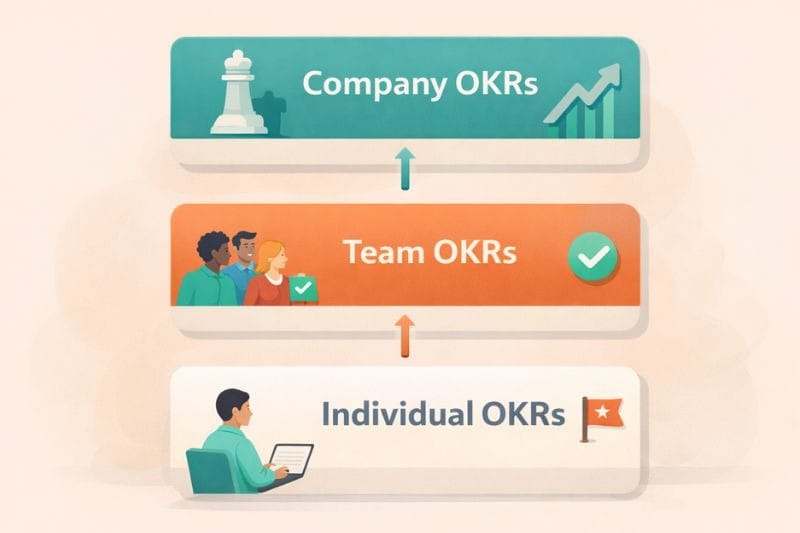
Now that you have a good grasp on the OKR planning process and setting objectives, let’s get practical and break down OKRs at the company, team, and individual levels. To make the OKRs applicable across industries, the examples use generic OKRs.
1. Company OKR template
This kind of template is owned by senior management and sets meaningful objectives for expressing the company’s vision.
2. Team OKR template
Team OKRs translate company objectives into actions that are owned and controlled by the team.
3. Individual OKR template
An individual OKR template makes the broader objectives clear at the level of individual performance and helps each team member measure progress.
If you’re just getting started or have less than 20 employees, keep your templates simple. Focus on clarifying objectives and drafting key results that will measure those objectives. Add a simple way to track OKR progress and have regular check-ins with team members to ensure everything stays on track.
Small teams can translate OKRs into performance reviews with Simpleperf. Designed to customize and run 360-degree reviews, it ensures your OKR process comes full circle with performance feedback and AI-driven insights. Use it in conjunction with your OKR template, or on its own. Bring everything together now with Simpleperf.
Worried about AI in performance reviews? Knowledge is power. Learn more about how automation is transforming feedback in 2026.
Conclusion
An OKR template helps you to set and structure objectives and key results for your company and individual teams. While the OKR framework has been used in top companies around the globe, it is still a challenge for the majority of businesses.
With the correct understanding, free OKR templates, and examples of what OKRs should reflect, you can implement this framework successfully and build your business on solid data. Keep it simple, and track regularly. These are the two golden rules on which the OKR rises or falls.
FAQs: Free OKR template
1. Are OKRs the same as KPIs?
No, they are not the same, but the terms do get used interchangeably. OKRs define what you want to achieve and how you plan to get there over a set period of time (e.g., a month or quarter). KPIs (Key Performance Indicators) track the ongoing performance of existing systems. They can be used to set key results, but they do not communicate what the objectives should be for a company.
2. Do I need to have OKR software to create an OKR planning template?
No, it’s not necessary to have special OKR software to create an OKR tracking template. Many businesses use MS Excel, Google Sheets, and other simple documents to plan and keep track of OKRs.
OKR software can be helpful for managing multi-tiered organisations with many employees and roles. Its primary benefit in this case is to pull all the company’s performance parameters together, creating one cohesive look at performance.
3. Are SMART goals OKRs?
No, SMART goals and OKRs are not the same thing. SMART is a framework for defining measurable targets (specific, measurable, achievable, relevant, time-bound). The OKR framework is designed to set ambitious goals, with measurable results. The two frameworks complement each other in the objective-setting process.
Sources:
1. https://en.wikipedia.org/wiki/Objectives_and_key_results
2. https://muthu16598.medium.com/okr-implementation-backfires-60b69a0f0dbb