New Michigan PTO laws: What employers need to know in 2026
Michigan’s 2025 PTO law mandated earned sick time. See who must comply, accrual rules, rollover limits, and ESTA-covered reasons for taking sick time off.


In February 2025, big changes swept through Michigan's state leave laws. The Michigan Supreme Court ruled that two 2018 initiatives should be put into effect: An increase in the state’s minimum wage and mandated paid sick leave for most types of workers.1
Get ready for the new year with our guide on the new Michigan PTO laws, and learn how you can reduce the admin burden of managing PTO with tools from BuddiesHR.

Quick Overview
Michigan has no state-mandated general PTO laws, but requires employers to provide paid Earned Sick Time (ESTA). This legislation was adopted on February 21, 2025, and affects businesses, state institutions, educational organizations, and nonprofit institutions. The workers who benefit from this change are full-time, part-time, and seasonal workers. Salaried and remote workers are also included.
Table of Contents
- Why has there been a change from the Paid Medical Leave Act (PMLA)?
- Which employers need to comply with the ESTA?
- How does the earned sick time accrue?
- How are payments calculated for paid sick time?
- ESTA covered reasons for the use of accrued sick time
- Employee obligations under ESTA
- How Michigan PTO law changes will impact employers in 2026
- FAQs: Michigan PTO laws
Why has there been a change from the Paid Medical Leave Act (PMLA)?
For five years, Michigan employers have been administering the Paid Medical Leave Act (PMLA), which was an amendment of the original Earned Sick Time Act. This was done in 2019 and represented a limited sick leave program (employers with 50 or more employees). In February 2025, the Michigan Supreme Court reinstated the order made in 2018, replacing the PMLA. The reinstated ESTA applies to all Michigan employers, regardless of the number of workers.
The PMLA also excluded part-time, seasonal (temporary) workers and those excluded under the Fair Labor Standards Act (FLSA), but ESTA includes these workers as earned sick time employees.
Which employers need to comply with the ESTA?
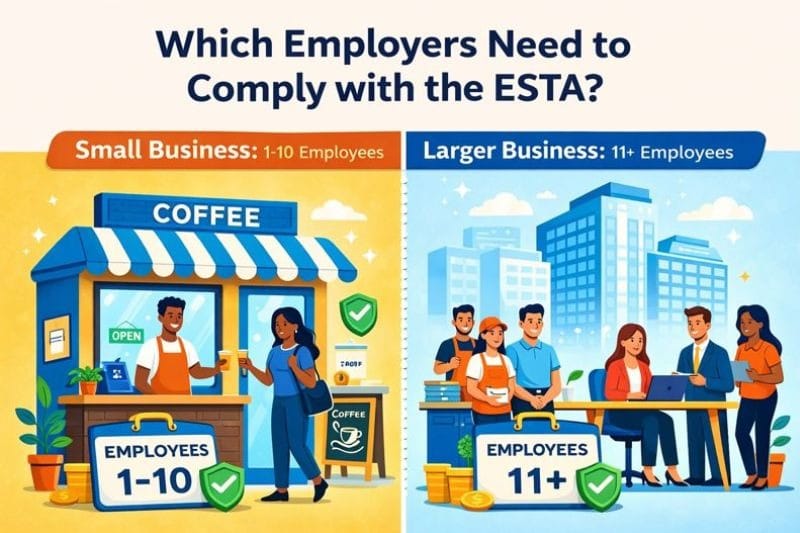
One of the key differences between the ESTA and the PMLA is the wider scope. Previously applicable to employers with more than 50 employees, the new ESTA applies to all employers with one or more employees (excluding the US government). What is important to the ESTA is the definition of small business.
Small business as defined by the ESTA
A small business is defined as one with fewer than ten employees. This includes full-time, part-time, or seasonal workers. Each individual, regardless of the type of employment, is counted.
If any business employs ten or more workers for a period of 20 weeks (or more) during a calendar year, it is not considered a small business according to the ESTA. The Earned Sick Time Act does not specify whether this threshold applies to workers only in Michigan or nationwide. However, Michigan’s Department of Labor and Economic Opportunity (LEO) suggests that the headcount is based on national employee numbers.
Relief for small businesses:
- Businesses with 10 or fewer employees had until October 1, 2025, to comply with ESTA.
- Businesses that did not employ any workers on or before February 21, 2022, will have a grace period of three years to comply with ESTA, from the date they employed the first worker. E.g., John started a small business in November 2024 and hired an employee. He has until November 2027 to meet ESTA requirements.
Michigan’s ESTA requirements don’t have to overwhelm your small business
BuddiesHR automates accruals and approvals, tracks usage, and ensures employees get the protections they’re entitled to.
👉 Explore Palmy Vacation for easy ESTA administration.
How does the Earned Sick Time accrue?
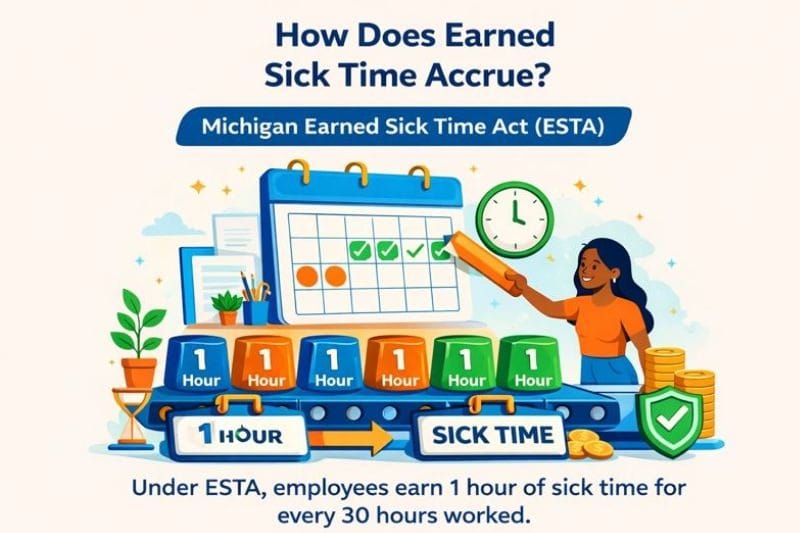
All employers with 1 or more employees must offer paid sick time leave according to ESTA. However, the employer may place certain limits on the number of days that can be used by the employee in one year as follows:
Earned sick leave begins to accrue at the commencement of ESTA (February 21, 2025), or at the start of employment for a new employee. The employer is not obligated to offer paid sick leave beyond the limits set by the Act.
Employers may require new hires to wait for a period of 120 days before using accrued sick time benefits.
Can employers cap sick leave under ESTA?
Unlike the PMLA, the Earned Sick Time Act does not cap sick leave accruals (not even on a rollover basis), however, it does put a cap on annual usage.
Small businesses are permitted to cap annual paid usage to 40 hours per year; however, they must allow accrual of unpaid leave for a further 32 hours per year. ESTA does not require employers to pay out unused sick time on termination of employment; however, the employer may do so in a written notice (PTO policy).
Rollover of earned sick time
Under ESTA, all unused sick leave must roll over to the next year. This carryover obligation applies to all types of workers, even part-time and seasonal workers. For seasonal workers, the carry-over applies as long as employment does not lapse for more than six months.
🔍 Zoom in for more insight: Understanding PTO rollover
Frontloading of earned sick time
ESTA does not deal with frontloading earned sick time, but the Department of Labor and Economic Opportunity (LEO) gives the following guidance: Nothing prevents an employer from frontloading sick time for the year; however, in this case, the employer is not obligated to carry over or payout unused sick leave.
How are payments calculated for paid sick time?
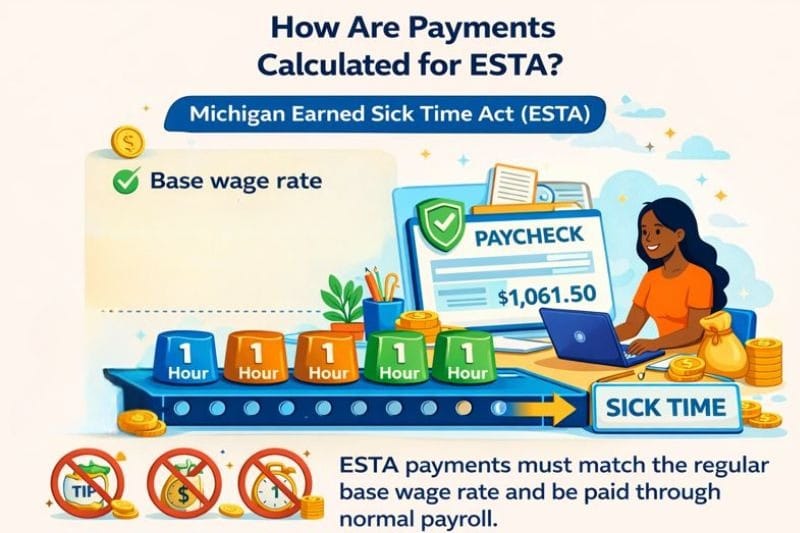
Wage calculations according to ESTA are made on the normal hourly wage or base wage of the employee, at the time the leave is taken. The following payments are exempt from this calculation:
- Overtime pay.
- Holiday pay.
- Bonuses.
- Tips.
- Commissions.
ESTA covered reasons for the use of accrued sick time
An employer must allow an employee to use accrued sick time for the following reasons:
- The employee or the employee’s family member has a mental or physical illness, injury, or health condition (including diagnosis of, treatment of, and management of the illness, injury or condition).
- The employee or the employee’s family member is a victim of domestic violence or sexual assault. This should include medical care, counselling, use of a victim services organization, relocation of housing, to obtain legal services, and participation in criminal proceedings.
- For meetings at a child’s school or place of care related to the child’s health or disability, or the effects of domestic violence or sexual assault on the child.
- For the closure of the employee’s place of business by order of a public official due to a public health emergency. This provision applies to the employee's child and other family members. Employers should check the Department of Labor and Economic Opportunity website for a full list of provisions.
An employer may not require employees to find a replacement worker, penalise, or take retaliatory personnel action against an employee for taking accrued paid time off.
A compliant sick leave policy is essential in 2026. BuddiesHR helps you build, automate, and manage sick time policies that are fully transparent.
👉 See how BuddiesHR simplifies PTO and helps you win employee trust.
Employee obligations under ESTA
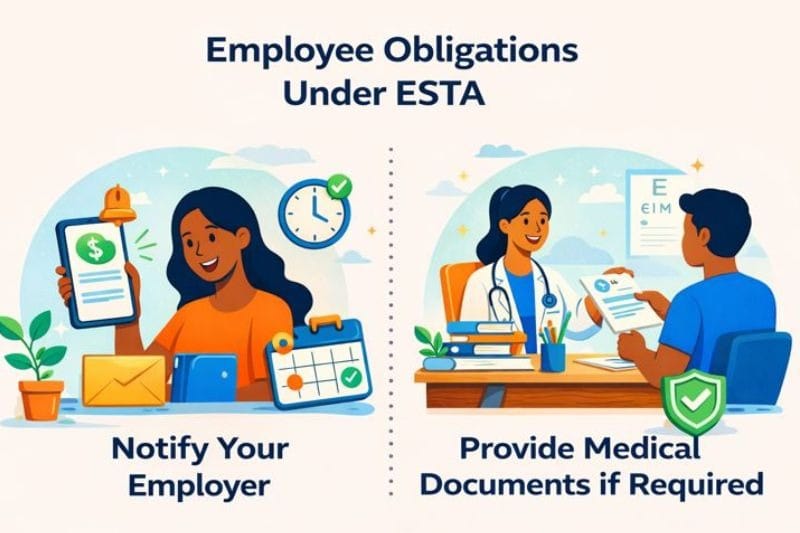
Under ESTA, the employee must comply with certain administrative obligations to prevent the misuse and mishandling of sick time off.
- Carefully study the definition of family member and child under the definitions of ESTA to determine eligibility under ESTA.
- For foreseeable sick time off, a notice period of at least seven days or less is required prior to the commencement of sick leave.
- For unforeseeable sick time off, a written notice to the employer as soon as practical under the circumstances.
- If usage exceeds three consecutive days, employers may request reasonable documentation, which the employee must furnish. This can be a document signed by a medical professional (without disclosing the nature of the illness). If the employer requires medical documentation, they will be responsible for out-of-pocket expenses pertaining to this documentation.
How Michigan PTO law changes will impact employers in 2026
We’ve been discussing the differences between Michigan’s PMLA and ESTA, effective from February 2025. This shift creates several implications for employers:
- More employees are now covered (even in small businesses).
- Employees now accrue more sick leave (up to 72 hours per annum for certain employers).
- Accrual methods, number of paid sick leave hours, and waiting periods must be updated for all employees.
- Policies written under the PMLA must be updated to comply with ESTA.
- Payroll and HRIS systems must be updated to reflect new legislation under ESTA.
By 2026, most businesses in Michigan will have to comply with ESTA requirements. BuddiesHR makes it easy to manage earned sick time, track accrual limits, and meet 2026 compliance requirements—without extra admin.
👉 Get started with BuddiesHR today.
FAQs: Michigan PTO laws
1. What is the new PTO law in Michigan?
Michigan’s new statewide law, effective February 21, 2025, is called ESTA (Earned Sick Time Act). Most employees earn 1 hour for every 30 hours worked, and employers with 11 or more workers must allow their employees to use up to 72 hours per year of paid sick time leave. Employers with 10 or fewer employees must allow for 40 hours of paid sick leave per year, and an additional 32 hours of unpaid leave per annum.
2. Does Michigan require PTO to be paid out?
No. Michigan does not mandate employers to pay out unused leave at termination, unless the employer’s written leave policy specifically promises it. If there are no policy documents or the payout is discretionary, the state of Michigan leaves it to the employer to decide if they want to pay out unused leave.
3. Can employers deny PTO in Michigan?
Yes, employers have the right to deny PTO in Michigan as long as it does not violate any mandated leave, like the Earned Sick Time Act of February 21, 2025. For general PTO, the employer handbook guides the approval of leave and the amount given to employees. Employers may not deny the use of sick leave time under ESTA, but they are allowed to ask for documented proof of medical condition for more than three consecutive days of sick leave.
4. Can you roll over PTO in Michigan?
For general PTO leave, the state of Michigan does not require employers to roll over leave to the next year; however, with ESTA, unused earned sick time must carry over to the next period. Carryover limits cannot exceed the annual cap (72 hours for larger employers, 40 paid/32 unpaid for small employers).
References:
General Requirements Earned Sick Time Act
Earned Sick Time Act: Frequently Asked Questions (FAQ) | Michigan