Software Engineer Performance Review: Step-by-Step Guide with Real-World Examples
Structure a software engineer's performance review with clear competencies, 360-degree feedback, and real-world examples. Run smart 360 reviews with Simpleperf.


Software engineers are a unique bunch. Their minds work differently (because they have to), they see things from a different perspective, and sometimes they even have wild ideas that turn the world on its head. That means performance evaluations for a software engineer probably shouldn’t conform to your standard review structure either.
So what should performance assessments look like for the architects of the tech world? We believe we can help you with that. Come with us as we craft an effective engineer performance review.
Quick Overview
A software engineer's performance review is the process by which both visible outputs (code quality, pull requests, ticket closure) and intangible outputs (architecture decisions, team dynamics, and long-term scalability) are measured. These outcomes are discussed, and constructive feedback is given to help the engineer’s professional development.
Table of Contents
- Why traditional reviews fail modern software engineers
- Defining engineering levels for clarity
- Junior software engineer: Performance review example
- Mid-level software engineer: Performance review example
- Conclusion
- FAQs: Software engineer performance review
Why traditional reviews fail modern software engineers

Fair performance reviews should evaluate both visible outputs and intangible outcomes. Many times, the software engineer review leans heavily towards the evaluation of technical skills, neglecting other important objectives. Common mistakes have included:
- Over importance is placed on the quality of code or ticket volume, at the cost of evaluating more complex outputs, like a problem that improved software performance and scalability.
- The exclusion of soft skills when evaluating an employee’s performance.
- Giving praise and recognition to employees who fix emergency problems, while neglecting those who designed the system and whose technical proficiency may be deeper and broader.
- Concentrating only on how fast an engineer can complete a project, while not measuring collaboration with other teams, documentation, and code reviews.
Performance review templates should prevent these errors by focusing on overcoming technical challenges and on team collaboration. Start by defining each level of engineering role in your IT department.
Defining engineering levels for clarity
An engineer's ability and individual performance cannot be effectively evaluated without setting performance objectives for the different levels of work. A commonly used structure looks like this:
Each level should define the scope of work, level of autonomy, decision-making authority, and levels of complexity required. Soft skills like communication skills, problem-solving abilities, and contribution to team efforts should also form part of effective performance reviews.
Some companies require more levels to adequately represent the software engineering and development team. Instead of a basic structure, it may look like this:
Junior software engineer: Performance review example
At this point, it would be beneficial to discuss what’s missing from this example. While establishing competency frameworks is the starting point of effective performance reviews, they should not stand alone in the review process.
Before you get to one-on-one meetings with your engineers, the ratings should be backed up by data. This data must be gathered from more than one source, and this is when 360-degree feedback becomes valuable.
Using a 360-degree review to evaluate your engineer’s performance
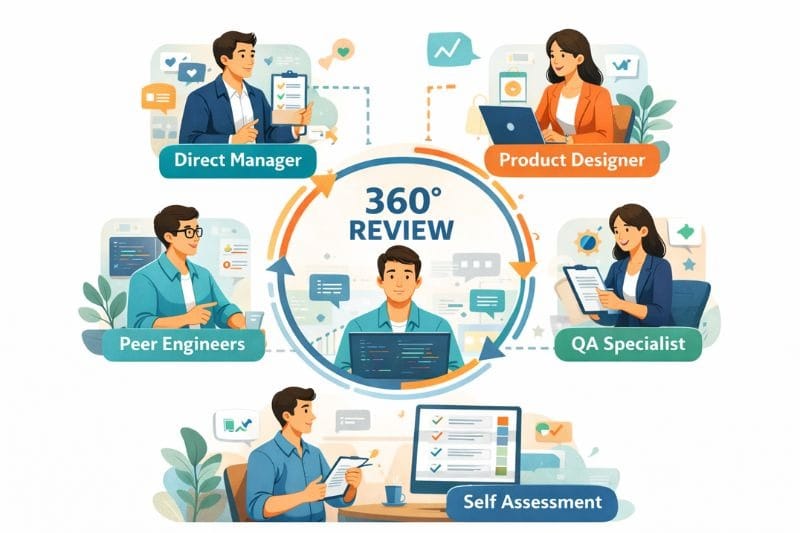
Software engineering and development is collaborative by nature. For this reason, reviews from a single source are often not the complete picture. A 360 review provides a way to gather feedback immediately after projects, task execution, or critical milestones. In this way, the following reviewers can participate in the performance evaluation:
- Direct manager.
- Peer reviews.
- Cross-functional team members or partners.
- Senior developers or engineers.
- Self-review.
Running evaluations can be easily accomplished by using 360 performance review software. Many of these software have been designed to integrate with communication platforms like Slack or Microsoft Teams, allowing feedback to be given where people are already spending their time. Learn how 360 feedback works in minutes by setting up a review in Simpleperf. Smart, lean, and powerful with valuable AI-driven performance insights.
The value of a 360-degree review: It reduces bias, captures recent collaboration experiences, and provides specific examples that encourage detailed feedback to the engineer.
Mid-level software engineer: Performance review example
As with the Junior Software Engineer performance review, a 360 review will gather valuable feedback to help you make ratings more credible. At this level, a written review/report from various stakeholders can give the engineer insight into project nuances they might not otherwise receive. By providing this continuous feedback, the engineer can make incremental improvements from project to project.
Deeper insight: The 360 review process is a simple and effective way to gather feedback, and it works for most teams, but there are times when the environment doesn’t allow for this type of evaluation. Learn about all the pros and cons of the 360 review process.
Running effective one-on-one meetings

Well-run one-on-one meetings follow a predictable flow during every review period. This brings consistency, but also teaches engineers what they can expect and how they can adequately prepare for the review. By breaking the meeting into five steps, you can run the meeting in an hour.
- Set the tone and clarify expectations (5 minutes).
- Presentation of key achievements, challenges, and development areas by the engineer (10 minutes).
- Feedback per competency, evidence gathered, and in-depth feedback by manager (20 minutes).
- Discussion of performance specifics, acknowledge achievements, and give more concrete examples if requested (10 minutes).
- Set 2-3 measurable goals, discuss learning needed, set personal goals, and agree on timelines for the action plan (15 minutes).
A Deloitte Insights report suggested that 75% of organizations could not rate individual performance accurately because outcomes were difficult to measure. Following the process we’ve been discussing aims to change this by creating a way to give speedy and valuable feedback.
Conclusion
A software engineer's performance review should focus on both technical and soft skills. This will provide a more balanced picture of contributions made by the engineer. Start by setting competencies for the different roles in your engineering and development team. Next, implement an easy 360-degree review process to justify performance ratings. Lastly, set a structured approach to one-on-one review meetings. From start to finish, this way of conducting performance reviews is more effective than more traditional approaches.
Running effective evaluations doesn’t have to mean more admin for managers or HR teams. Smart review software that integrates with your communication platform allows you to run reviews in places where people are already working. This streamlines the review process and adds a familiar feel to reviews. Simply: It makes it easy for you to set up and automate.
Try Simpleperf - A lean and yet powerfully smart 360 review tool.
FAQs: Software engineer performance review
1. Is there a difference between a software engineer and a developer?
Technically, there are differences between software engineers and developers, but in the IT industry, they are used interchangeably. The lines can be blurred, and it depends on how each company defines the role. By definition, a software engineer is about defining project scope and creating large-scale infrastructure for programs, while a software developer is focused on coding, algorithm development, and testing. Both roles are usually necessary to complete projects.
2. How do I give negative feedback on a software engineer's annual review?
It is best to give negative feedback in a structured and actionable way. Ground the feedback in evidence and provide valuable insights into how the feedback has come about. Define the problem clearly and help the engineer identify areas of focus that would improve the performance. Specific suggestions will also be helpful with a simple example of what acceptable performance or behavior would look like.
Sources: