Performance Evaluation Customer Service: A Step-by-Step Guide for Managers
Master customer service performance evaluations with our step-by-step guide. Set measurable KPIs, use 360-degree feedback, and drive exceptional service quality.


Your customer service representative is not just an employee who handles customer inquiries. The person is on the front line and, therefore, the face of your company. Performance in your customer service department can make or break your entire reputation.
For this reason, performance reviews need to be powerful and effective in shifting customer service skills towards the right behaviors and outcomes. As Richard Branson once explained, your entire team must set and maintain customer service standards that ‘wow’ customers. In this guide, we help you evaluate employee performance and gain valuable insights to improve customer service.
Quick Overview
A customer service performance evaluation is a structured process for evaluating the key skills of customer service employees. In this evaluation, you both set key objectives and results that drive exceptional customer service, and determine whether the employee has met previous objectives. This leads to valuable discussions about ways to improve performance.
Table of Contents
- How to structure a customer service evaluation
- Key objectives and results for customer service
- Conclusion
- FAQs: Performance evaluation of customer service
How to structure a customer service evaluation
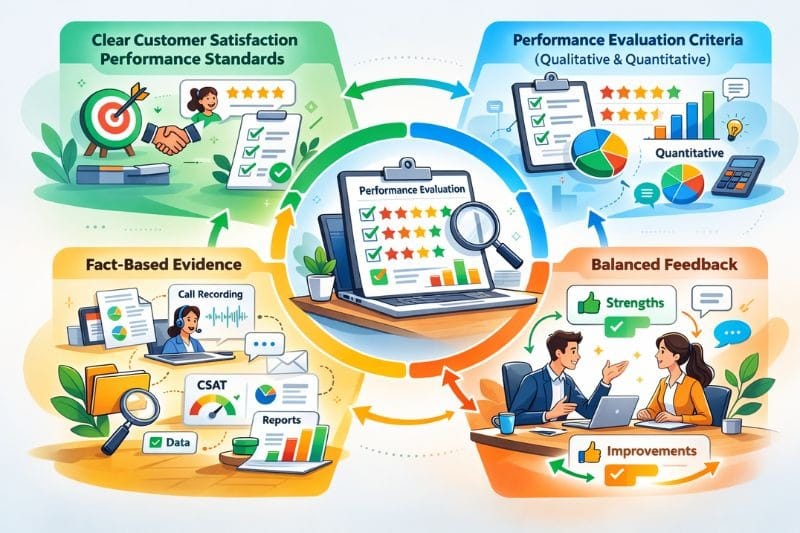
Let’s compare an evaluation to a recipe you want to make to impress family and friends. You need all the ingredients, and you need to follow the correct process. Then and only then does the dish turn out in the way you want it.
A customer service evaluation is the same. You need certain elements to be present in order to get the results you want to see - the ability to provide exceptional customer service. When your customer ‘eats’ what you’ve put together with your employee, you want them to be satisfied.
1. Clear customer satisfaction performance standards
If you haven’t already done this, define what exceptional customer interactions look like in clear terms. From your explanations, it should be easy for the employee to understand which observable behaviors enhance customer satisfaction and which do not. Avoid vague statements like, ‘Answer calls promptly’, rather say, ‘Answer the phone within 5 rings’. Without specific statements, the employee will use their own interpretation of ‘promptly’.
2. Performance evaluation criteria
Set clear objectives and key results for your customer service roles. The basis for these employee performance goals should be customer feedback, customer inquiries, and customer concerns. These elements inform you about customer expectations and how well your team is meeting them. Set objectives and rate your employee according to a ‘performance scale’. This is a rating scale (often 1-5) that helps you quantify a subjective process.
We will discuss more performance objectives soon, but this example shows the broad categories of skills that define customer service roles. The rating scale should not be ambiguous (or open to interpretation). To prevent this, define what each category represents, for example:
1 - Unsatisfactory (Performance consistently fails to meet set requirements).
2 - Below standard (Noticeable gaps in skill and application. Improvement required).
3 - Meets standard (Competently and consistently meets standards and works independently).
4 - Above standard (Demonstrates a consistently positive impact on customer service).
5 - Exceptional (Demonstrates a measurable impact on customers due to mastery of skills).
Write the objectives in such a way that it allows the employee to get feedback from you (manager), peers, cross-functional team members, and even customers. This is called a 360 review process, and is a fairer way to gain valuable insights into employee performance.
If you’re wondering whether this will create a load of extra work (even though it's necessary), that is a normal reaction. The good news is that you can automate this process by using 360 review software. You can customize objectives and set automatic reminders for people to participate in 360-degree feedback. The software will gather feedback and generate reports, leaving you to have meaningful performance reviews, instead of managing the administration of the review process. Try the smartest, leanest tool for 360 reviews.
3. Fact-based evidence
The evaluation process must be supported by fact-based evidence. Without facts, the whole performance management process is subjective, and it becomes difficult to support and justify. If you want customer service team members to exceed customer expectations, there must be evidence to show whether they do or do not.
Gather supporting evidence in the following ways:
- Call recordings
- Email or chat transcripts.
- Mystery shopper calls (where an experienced employee poses as a customer).
- Customer satisfaction scores (CSAT).
- Recent customer issues that have been escalated and customer complaints.
- Net Promoter Scores (measure customer satisfaction).
Gathering detailed and accurate information is key. Think about building a house. You need a strong foundation to keep the house standing. Fact-based evidence is the foundation. From this strong starting point, you can improve employee performance and service quality.
4. Balanced feedback
Your employee’s ability to deliver exceptional customer service relies on the type of feedback they get during the performance evaluation. The goal is always continuous improvement, and this requires a balanced mixture of constructive feedback (areas of development) and positive feedback (what the person does well).
Included in the balanced feedback should be specific skill development initiatives (such as coaching sessions) and training interventions to increase knowledge and practice.
Key objectives and results for customer service
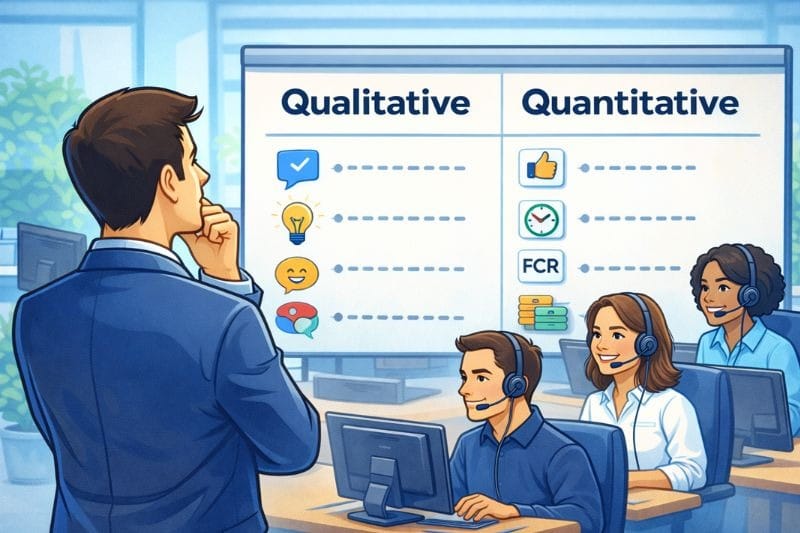
Previously, we mentioned that you should set clear and measurable performance criteria for customer service roles. To help you with this task, we’ve compiled a list of qualitative (measures observable behavior and service quality), and quantitative (measures performance data) criteria. The customer service performance review works better when it includes both aspects.
1. Qualitative criteria
2. Quantitative criteria
While none of these criteria are exhaustive, they do give you a good idea of what balanced employee performance reviews look like. The metrics help you to identify trends and improve service quality at the same time.
Often, it is not just what you say, but how you say it. To help you have more fruitful discussions based on evidence you’ve gathered, here is a list of performance review phrases you can use right now.
- 75 Effective Performance Review Phrases Examples
- Overall performance review comments and phrases you can use right now
Conclusion
An effective performance evaluation for customer service employees requires four key elements, namely:
- Clear customer satisfaction performance standards.
- Performance evaluation criteria (qualitative and quantitative).
- Fact-based evidence.
- Balanced feedback.
By applying these elements consistently, they help customer service employees improve service delivery, and help you to set better customer service strategies. With the help of performance review software, the entire process becomes easier to administer, and the results are more consistent. This gives you the power to speak confidently about what is needed to improve your employees’ performance and customer relationships. Try the leanest, smartest review tool now.
FAQs: Performance evaluation of customer service
1. How often should customer service evaluations be conducted?
Customer service evaluations can be conducted quarterly, provided that you schedule more frequent check-ins (monthly) to evaluate progress on key performance indicators. More frequent feedback ensures continuous focus on what’s important to provide exceptional customer experiences.
2. What are the most important KPIs in customer service reviews?
The most important KPIs in customer service reviews are: Customer Satisfaction Score (CSAT), First Contract Resolution (FCR), Average Response Time (ART), Net Promoter Score (NPS), and SLA adherence. These metrics track the progress of customer interactions over time and provide key insights into where improvements are needed.
Sources: