8 staff recognition software platforms worth trying in 2026
Compare 8 staff recognition software platforms for 2026, from Slack-native BuddiesHR and Bonusly to enterprise tools like Awardco and Workhuman, with pricing, pros, cons and who each one suits best.


Staff recognition software has moved from "nice to have" to a genuine business priority. Companies with effective recognition programs report a 31% lower voluntary turnover rate, and employees who receive recognition at least weekly are 5x more likely to be highly engaged, according to 2024-2025 Gallup-Workhuman research. If you are still relying on a pinned Slack message or a quarterly shoutout email to keep your team feeling valued, the gap between your intent and your impact is probably wider than you think.
The good news is that the market in 2026 offers a wider range of purpose-built tools than ever before, from free Slack-native apps to enterprise platforms with deep analytics. This guide breaks down eight platforms worth evaluating, what each one does well, where it falls short, and who it suits best.
Key takeaways
- Recognition frequency drives retention. Gallup and Workhuman research shows well-recognized employees are 45% less likely to switch jobs two years later. If your program runs quarterly or annually, it is time to shift to a weekly cadence.
- ROI is measurable and fast. Companies with effective recognition programs yield $5 to $7 in ROI, and companies that spend at least 1% of payroll on recognition achieve their business goals 79% more often. Build a simple ROI model before you buy.
- Platform fit matters more than feature lists. A tool that lives inside the apps your team already uses will outperform a richer platform that requires a separate login every time.
- Peer-to-peer recognition outperforms top-down. HBR data shows organizations with highly effective recognition programs report improved productivity (49% vs. 18%), and employees recognized weekly are 4x more likely to feel productive. Look for platforms that enable peer giving, not just manager awards.
- Budget transparency is a shortlist filter. Several platforms hide pricing behind a demo request. If your team is under 200 people, prioritize vendors that publish their rates.
Quick-start prioritization framework
| Platform | Best for | Effort to launch | Time to results |
|---|---|---|---|
| BuddiesHR | Slack-first teams wanting all-in-one recognition | Low | Days |
| Bonusly | SMBs wanting simple peer recognition with rewards | Low | 1-2 weeks |
| Nectar | Mid-market teams needing values-tied shoutouts | Low-Medium | 2-4 weeks |
| Assembly | Teams wanting recognition plus workflow tools | Low-Medium | 2-4 weeks |
| Kudos | Culture-driven orgs prioritizing values analytics | Medium | 4-6 weeks |
| Motivosity | Mid-market teams wanting community + recognition | Medium | 4-6 weeks |
| Awardco | Mid-to-large orgs needing Amazon-integrated rewards | Medium-High | 4-8 weeks |
| Workhuman | Enterprise orgs needing global, analytics-heavy programs | High | 6-12 weeks |
Start here based on your situation:
- Small team on Slack (under 100 people): BuddiesHR or Bonusly, lowest cost, fastest setup, lives where your team already works.
- Mid-market HR team (100-1,000 people): Nectar, Assembly, or Kudos, solid feature sets with published or transparent pricing.
- Enterprise program (1,000+ people): Awardco, Motivosity, or Workhuman, built for scale, global reward catalogs, and deep analytics.
The 8 platforms reviewed
1. BuddiesHR, editor's pick and best for Slack-first teams
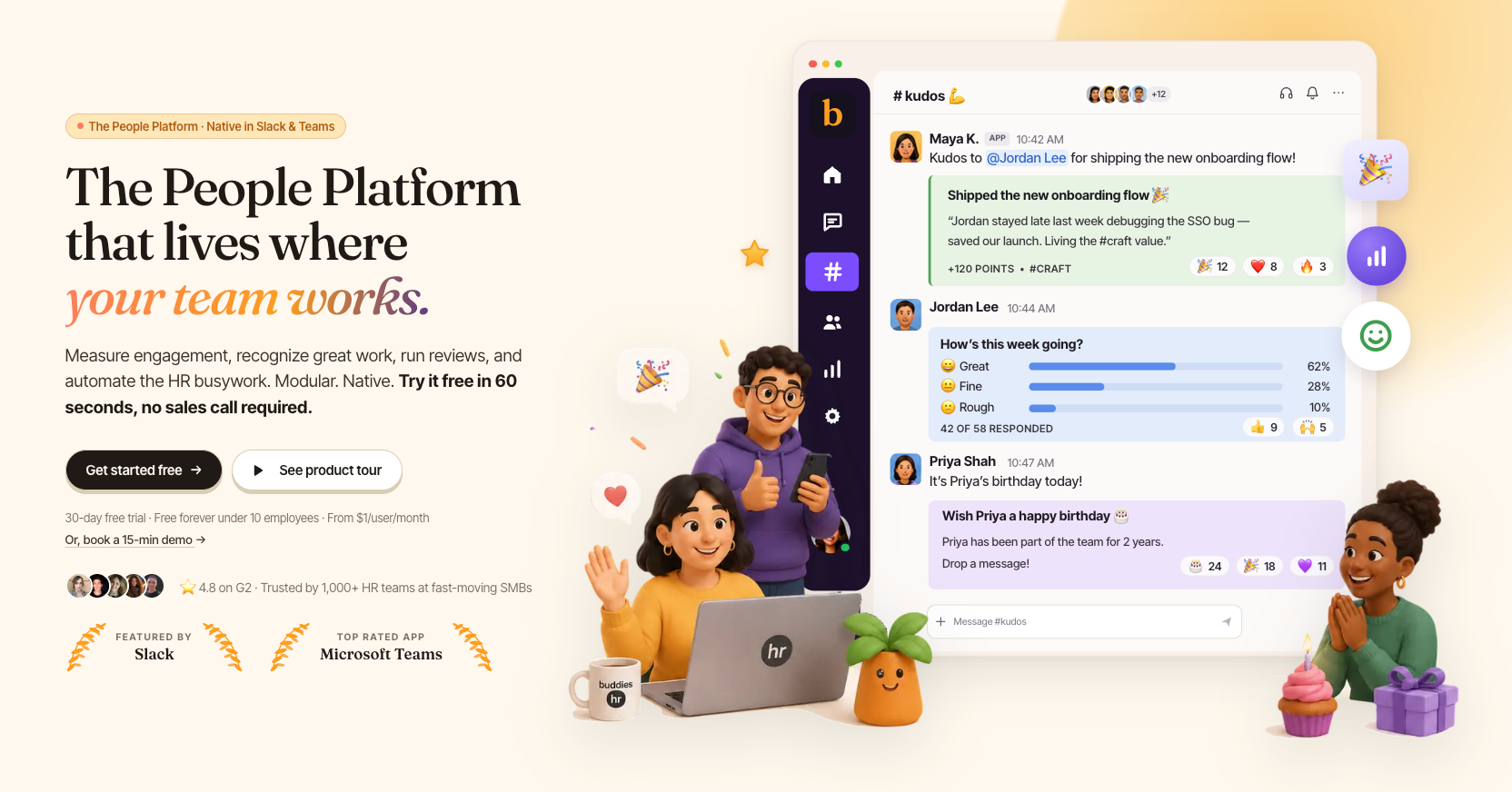
BuddiesHR takes the top spot in this list because it solves the single biggest reason recognition programs fail: nobody actually uses them. Most platforms require employees to leave their daily tools and log into a separate portal. BuddiesHR eliminates that friction entirely by living inside Slack and Microsoft Teams.
The platform provides several tools, including "Clappy" for peer recognition, "Billy" for automated birthday and anniversary celebrations, and "Pulsy" for employee feedback via surveys and polls. By keeping all recognition activities within Slack, BuddiesHR makes it easy for employees to give kudos, celebrate milestones, and participate in feedback loops without needing to leave their communication hub.
BuddiesHR also offers gamification through leaderboards and customizable rewards to motivate participation and recognition efforts. Pair Clappy with recognition data that flows straight into review cycles, so feedback is rooted in what people actually shipped. Every BuddiesHR module also comes with a real web platform: dashboards, analytics, segmentation, templates, org chart, review cycles, and exportable reports.
In my experience, the platforms with the highest adoption rates are always the ones that require zero behavior change from employees. BuddiesHR's Slack-native design is the clearest execution of that principle in this category.
Pricing: Free for under 30 users; from $0.50 per employee per month for individual apps. BuddiesHR has a G2 score of 4.8/5.
Pros:
- Runs entirely inside Slack and Microsoft Teams, zero context switching for employees
- Modular design means you pay only for what you use
- Automated milestone recognition (birthdays, anniversaries) with opt-out for privacy
- Gamification with leaderboards drives ongoing participation
- Free tier for teams under 30 makes it easy to test before committing
Cons:
- The modular setup can feel limited for very large organizations that need more advanced customization options.
- Primarily built for Slack-first organizations; Teams support is growing but Slack remains the stronger experience
Pro tip: Start BuddiesHR with just Clappy and Billy. Peer recognition and milestone automation are the two fastest wins. Add Pulsy surveys three months in once the recognition habit is established.
2. Bonusly, best for lightweight peer recognition with a rewards catalog
Bonusly is the most widely recognized entry-level recognition platform for a reason. By integrating recognition features like peer-to-peer shoutouts and automated milestones, Bonusly drives business results by giving meaningful rewards and keeping employees motivated, connected, and engaged.
Standout features include peer-to-peer recognition, a points-based rewards catalog with 1,200+ rewards in 200+ countries, automated birthday, work anniversary, and new hire celebrations, plus integrations with Slack, Microsoft Teams, and 30+ HRIS platforms.
Bonusly provides a 14-day free trial and three subscription tiers: a Free tier for up to 8 users with core recognition features; a Team tier at $3/user/month (or $30/user/annually) which adds habit-building functionality for growing teams; and an Organization tier (custom pricing) that includes advanced analytics, deeper integrations, and enterprise controls for larger companies.
Pros:
- Large global rewards catalog (1,200+ rewards in 200+ countries)
- Free plan available for teams up to 8 users
- Strong Slack and Teams integration
- Clear, transparent pricing on published tiers
Cons:
- Some advanced features like AI-powered assistance are only available on paid plans.
- Reward costs are separate from the platform subscription, which can add up at scale
3. Nectar, best for values-tied recognition with milestone automation
Nectar is a peer-to-peer employee recognition software best suited for companies with 50-2,000 employees. Its core strength is tying every shoutout to a company value, which turns recognition from a feel-good moment into a cultural data point HR can actually use.
The platform offers HRIS integrations, Slack and Microsoft Teams connectivity, automated recognition triggers for birthdays and anniversaries, nomination-based award programs, and analytics dashboards that surface recognition and engagement trends for HR teams.
I've found that organizations that map recognition explicitly to company values see much faster cultural alignment, and Nectar's mandatory values tagging makes this automatic rather than aspirational.
Pricing is gated behind a quote request, but third-party sources consistently report a Plus plan around $5/user/month and a Premium plan around $6/user/month (billed annually), with a minimum annual commitment of around $4,000.
Pros:
- Values-based recognition creates cultural analytics over time
- Strong automation for birthdays, anniversaries, and milestones
- Broad HRIS integrations reduce admin overhead
Cons:
- Nectar requires a minimum annual commitment of $4,000, and no longer offers a free tier.
- Pricing is not transparent until you request a quote
4. Assembly, best for recognition bundled with workflow automation
Assembly targets HR leaders and managers running remote, hybrid, and in-office teams alike, and backs that up with a free gifting plan sitting alongside its paid recognition tiers.
Assembly's differentiator is breadth. Rather than pure recognition, it folds in workflow automation, internal comms, and lightweight surveys. Assembly is used by 4,000+ companies, and its employee recognition software starts at $3 per user per month (billed annually).
Pros:
- Transparent, affordable per-user pricing
- Integrates recognition with workflow automation and internal comms
- Native Slack and Teams integration
- Free gifting plan for teams testing the waters
Cons:
- Assembly's DoraAI Recognition Writer occasionally alters the recognition recipient's name during the drafting process.
- The breadth of features can feel overwhelming for teams who want pure recognition without the extras
Pro tip: If your team is already using Assembly for internal comms or project updates, turning on recognition costs almost nothing incremental, both in price and in behavior change.
5. Kudos, best for values-based culture measurement
Kudos makes company values visible by requiring employees to tag which value a person demonstrated whenever they give recognition. Over time, this produces a live map of which values are genuinely alive in your organization and which are just on a poster in the break room.
Key features include values-based peer recognition messages, recognition levels and qualities, culture and sentiment analytics, optional points and rewards, and anniversary and milestone recognition.
Kudos uses custom pricing. Independent sources report starting rates around $4 per user per month for mid-market teams, with custom enterprise plans for larger organizations.
Pros:
- Mandatory values tagging on every recognition creates genuine cultural data
- Analytics reveal gaps between stated values and actual employee behavior
- Clean interface with strong UX
Cons:
- Pricing is quote-based for most tiers, limiting upfront comparison
- Less emphasis on points-based rewards compared to some competitors
6. Motivosity, best for community-first recognition with manager tools
Motivosity takes a community-first approach to recognition, combining peer appreciation, manager connection tools, and lightweight engagement features in a platform positioned between the simplicity of Bonusly and the enterprise depth of Workhuman.
Motivosity is an AI-powered employee recognition and rewards platform that combines peer-to-peer recognition, milestone automation, a zero-markup global rewards catalog, and Appreciation Intelligence for surfacing recognition moments and drafting personalized messages.
With Motivosity, employees get a monthly budget to send 'ThanksMatters' dollars to coworkers. Giving even $1 with a thank you gets people to participate in a way that simple kudos alone does not.
Pros:
- Appreciation Intelligence AI helps managers and peers write more meaningful recognition
- Zero-markup global rewards catalog keeps costs predictable
- Strong manager development module links recognition to 1-on-1s and coaching
Cons:
- Motivosity does not publish standard plan prices, making it difficult to compare costs without requesting a quote.
- Minimum annual investment around $3,000 makes it less accessible for very small teams
7. Awardco, best for Amazon-integrated rewards at scale
Awardco supports peer and manager recognition, bulk recognition, values-based and non-monetary programs, automated milestones, nominations, external recognition, and incentive programs. Its most distinctive feature is direct Amazon Business integration, giving employees access to a rewards catalog that practically no other platform can match in size.
With Awardco Engage, employee feedback and recognition data live in the same system, giving leaders clear visibility into participation, budget utilization, sentiment trends, and overall culture impact across the employee lifecycle.
Awardco publishes Standard, Scale and Enterprise plan structures, and qualifying startups and small businesses with 100 employees or fewer can access packages starting at $3,000.
Pros:
- Amazon Business integration gives employees access to millions of reward options
- Comprehensive recognition types covering peer, manager, bulk, values-based, and milestone
- Strong analytics via Awardco Engage dashboard
- 4.9/5 G2 rating from 6,000+ reviews
Cons:
- Can be pricey for smaller companies, some users find customization options limited, and rewards are limited to regions where Amazon Business operates.
- General per-user pricing is not publicly disclosed, requiring a sales conversation for most tiers
Pro tip: If your team is spread across multiple countries, check Awardco's Amazon Business coverage for each region before signing. The catalog depth varies significantly by geography.
8. Workhuman, best for enterprise recognition with workforce analytics
Rather than only tracking participation, Workhuman helps organizations understand employee skills, collaboration patterns, cultural health, inclusion, and performance. This makes it the most analytically sophisticated platform on this list, and the most resource-intensive to implement well.
Workhuman combines peer-to-peer recognition, milestone automation, behavioral analytics, and a global rewards store. Standout features include Workhuman iQ for identifying skills and collaboration patterns, and a Recognition Advisor that helps employees write clearer, more meaningful recognition.
Workhuman uses custom enterprise pricing. It suits organizations with 1,000+ employees that have a dedicated program owner and the internal bandwidth to configure and maintain a sophisticated recognition infrastructure.
Pros:
- Workhuman iQ analytics connect recognition data to workforce insights and business outcomes
- Global rewards store with multi-currency and multi-language support
- Inclusion and diversity features built into the recognition flow
Cons:
- Independent sources report a steeper learning curve compared to simpler platforms.
- Full value requires significant setup time and program management commitment
- Not suitable for small teams or organizations without a dedicated HR program owner
How to choose the right staff recognition software
Match the platform to where your team actually works
The most expensive platform in the world delivers zero ROI if adoption is low. Workhuman research and Gallup data indicate that the key to recognition is frequency and specificity, software that enables daily peer and manager recognition drives the most measurable retention impact. That means the platform your employees open every day beats the platform with the longest feature list.
Check what recognition data you actually need
Recognition software provides organizations with something manual programs often lack: measurable reporting infrastructure. Modern platforms allow HR leaders to track recognition participation rates, recognition frequency by department, recognition-to-employee ratios, reward utilization, and engagement trends over time. Define which of these metrics you need before shortlisting tools.
Set a realistic budget including reward costs
Pricing models vary. Some vendors charge per user (Assembly at $2-4, Nectar at $5-6), while others use annual minimums or package pricing. Always factor in the cost of the rewards budget separately from the platform fee, these are two distinct line items.
Common mistakes to avoid when launching recognition software
- Launching without manager buy-in. If managers do not give recognition, peer recognition alone will not sustain the culture you are trying to build.
- Choosing a platform employees must log into separately. Adoption drops fast when recognition requires leaving the tools people already use all day.
- Setting a rewards catalog so narrow it feels like a chore to redeem. Variety matters: gift cards, experiences, charity donations, and merchandise all serve different motivations.
- Running the program without tracking participation. 65% of HR leaders say their current recognition efforts are "ineffective" or only "somewhat effective." The difference is almost always measurement, set a participation rate target from day one.
Frequently asked questions
What is staff recognition software?
Staff recognition software is a digital platform that enables employees and managers to give and receive appreciation, awards, and rewards in a structured way. Most platforms include peer-to-peer recognition, automated milestone celebrations (birthdays, anniversaries), a points or rewards catalog, and analytics dashboards that help HR teams track engagement.
What features should I look for in staff recognition software?
Look for peer-to-peer recognition, manager recognition tools, automated milestone celebrations, a rewards catalog, integration with the tools your team already uses (Slack, Teams, your HRIS), and analytics dashboards that surface participation and engagement trends. Mobile access is essential for distributed or hybrid teams.
How much does employee recognition software cost in 2026?
Pricing ranges widely. Under about 50 employees, the practical shortlist focuses on platforms that publish prices: Matter at $1-3 per user per month, Bonusly at $3-5, or Assembly at $3. Mid-market options like Assembly, Nectar, and Motivosity start in the $2-6 per employee per month range. Enterprise platforms like Workhuman, Achievers, Terryberry, and Awardco use custom, quote-based pricing that scales into the tens of thousands of dollars annually.
How quickly can I expect to see ROI from recognition software?
Recognition programs deliver measurable ROI within 6 months of implementation. The fastest wins typically show up in participation rates and employee feedback scores within the first 90 days. Turnover reduction, the biggest financial driver, typically becomes visible at the 6-12 month mark.
Is staff recognition software suitable for remote and hybrid teams?
Remote and hybrid teams often benefit the most from dedicated recognition software because informal hallway moments of appreciation do not exist in distributed environments. Celebrating special days of colleagues is loved by people, making recognition software a must-have for remote and hybrid teams. Look for platforms with strong mobile apps and Slack or Teams integration for the best adoption in distributed workplaces.
Can recognition software work for frontline or deskless teams?
Platforms built around desktop portals consistently underperform with shift-based workforces. For frontline teams, look specifically for platforms that offer SMS delivery, kiosk mode, or physical reward cards alongside the standard app experience. Guusto and Awardco both have frontline-specific features worth evaluating.
Does recognition software replace manager feedback?
Recognition software amplifies and structures manager feedback; it does not replace it. Gallup and Workhuman found that praise is most effective when it is authentic, equitable, personalized, embedded in workplace culture, and fulfilling to the employee. Software creates the infrastructure for that praise to happen consistently; the quality still depends on the people giving it.
Final thought
Staff recognition software is one of the highest-leverage tools available to HR teams in 2026. Companies with high employee engagement, directly driven by recognition, are 23% more profitable than average, making recognition programs one of the highest-ROI investments in HR. The platform you choose matters far less than the habit you build around it. Pick a tool your team will actually use, start with peer recognition and milestone automation, measure participation from month one, and iterate from there.
BuddiesHR is the strongest starting point for most small and mid-sized teams on Slack, its modular design, free tier, and zero-context-switching approach remove the most common barriers to adoption.
Sources
- Employee Recognition Statistics in 2026, Blackhawk Network. Key retention and ROI data. https://www.worktango.com/blog/employee-recognition-roi
- BuddiesHR Reviews, G2. User reviews and product details. BuddiesHR Reviews on G2
- BuddiesHR, Official site. Features, pricing, and customer testimonials. https://buddieshr.com
- BuddiesHR ThriveSparrow Competitors Review, MatterApp. Platform comparison including BuddiesHR features and pricing. https://matterapp.com/blog/thrivesparrow-competitors
- BuddiesHR Feature and Pricing Overview, SoftwareFinder. https://softwarefinder.com/hr/buddieshr
- Bonusly Top 10 Employee Recognition Software Platforms 2026, Bonusly. https://bonusly.com/post/top-employee-recognition-software-platforms
- 20 Best Employee Recognition Apps in 2026, SelectSoftwareReviews. https://www.selectsoftwarereviews.com/buyer-guide/employee-recognition-software
- Nectar HR Review 2026, Flaree. Pricing and feature breakdown. https://flaree.app/blog/nectar-hr-review-alternatives
- Best Employee Recognition Platforms 2026, Workhuman. https://www.workhuman.com/blog/employee-recognition-software/
- Best 20 Employee Recognition Softwares in 2026, Engagedly. https://engagedly.com/blog/best-employee-recognition-softwares/
- Awardco Review 2026, Reviews.vc. Pricing and features. https://reviews.vc/review/awardco/
- Why Recognition Could Be the Key to Employee Engagement in 2025, Forbes. Gallup-Workhuman research. Gallup-Workhuman employee recognition research
- Employee Recognition Platform Guide 2026, Rewordin. ROI data and platform pricing. https://www.rewordin.com/blog/employee-recognition-platform-guide
- Employee Recognition Statistics 2026, Rewordin. https://www.rewordin.com/blog/employee-recognition-statistics-2026
- 8 Practical HR Benefits of Employee Recognition Software, Managetrix. https://managetrix.com/resources/hr-employee-recognition-software-advantages/
- The ROI of Employee Recognition Software, Achievers. https://www.achievers.com/blog/employee-recognition-software-roi/
- Top 107 Employee Recognition Software Statistics, 9CV9 Blog. https://blog.9cv9.com/top-107-employee-recognition-software-statistics-data-trends-in-2026/
- Employee Recognition and Communication Platform Guide, HR Cloud. https://www.hrcloud.com/blog/revolutionize-your-workplace-culture-with-an-effective-employee-recognition-and-communication-platform