48 one-on-one meeting questions, sorted by what the 1:1 is for
48 one-on-one meeting questions sorted by what this week's 1:1 is for, a picker that gives you three, and how to keep status out of the meeting.


Most lists of one-on-one meeting questions hand you 80 or 200 options for a meeting that lasts 30 minutes. You need three, and the person you manage should bring at least one of them. These 48 one-on-one meeting questions are sorted by what this week's 1:1 is for, so you can pick three in under a minute and spend the rest of the half hour listening.
Below: why long question lists don't fix a flat 1:1, how to get status updates out of the meeting before it starts, a picker that gives you three questions for this week, the 48 questions in eight groups, and a simple shape for a 30-minute 1:1.
Why most lists of 1:1 questions don't help
The problem with most 1:1s isn't a shortage of questions. It's who does the talking. Organizational psychologist Steven Rogelberg, who studied 1:1s for his book Glad We Met, reports that nearly 50 percent of employees found their 1:1s lacked substance. The biggest predictor of a useful 1:1 was the direct report's active participation, and the ideal balance was the report speaking between 50 and 90 percent of the time. Both managers and reports rated meetings highest when the report created the agenda (Rogelberg, Next Big Idea Club).
So a question bank is only half the job. The other half is leaving room. A manager with 15 prepared questions will ask 15 questions, and the report will answer them. That's an interview, not a 1:1.
It's worth getting right. Gallup found that employees whose managers hold regular meetings with them are almost three times as likely to be engaged (Gallup, 2015). And length matters less than rhythm: Gallup's newer research says 15 to 30 minute conversations have a greater impact than 30 to 60 minute ones if they happen regularly. Yet only 16% of nearly 15,000 employees said their last conversation with their manager was extremely meaningful (Gallup).
Take status out before you start
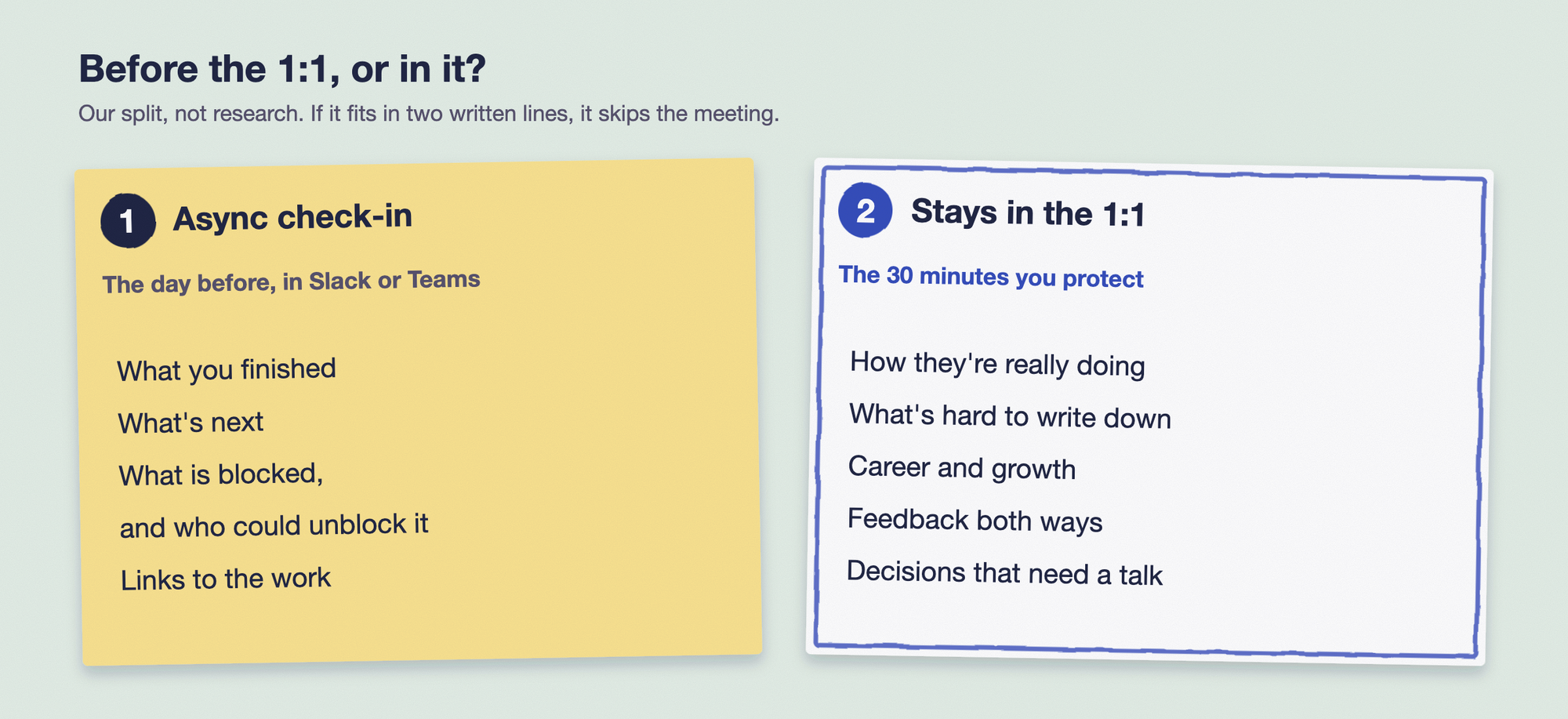
The fastest way to lose a 1:1 is to spend the first 20 minutes on what got done this week. Status is real information. It just doesn't need a conversation. Ask for it in writing the day before, in the chat tool your team already lives in, and the meeting starts where the written update ends.
Plenty of 1:1 tools solve this with a shared agenda inside a separate app. It works for the first month. Then the agenda lives in a tab nobody opens between meetings, and you're back to reading updates aloud. A short async check-in posted in Slack or Microsoft Teams gets answered because it's where people already are.
Pick this week's three one-on-one meeting questions
Choose what this 1:1 is mostly about. You'll get three questions from the lists below and one tip for running it. Shuffle until the three feel right, then paste them into your notes or the check-in thread so your report sees them first.
1:1 question picker
What's this week's 1:1 mostly about?
Your three questions
Nothing you pick is sent anywhere.
Questions for a first 1:1 with a new report
The first 1:1 sets the rules for every one after it. Use it to learn how this person works, not to review their first week.
- How do you like to get feedback: in writing, in the moment, or saved for this meeting?
- What did a past manager do that you'd want me to keep doing?
- What should I never do?
- How will I know you're having a rough week?
- What do you want to be known for on this team a year from now?
- What would make this half hour worth it for you?
Questions for a regular weekly 1:1
Rogelberg suggests opening with What would you like to talk about today? and letting the report's list go first. The rest of these fill the gaps once theirs is done.
- What would you like to talk about today?
- What's on your mind that didn't fit in the check-in?
- What's one thing you'd like my help with this week?
- What's taking more time than it should?
- What decision are you waiting on?
- Is there anything you'd like me to say no to on your behalf?
Questions about workload and wellbeing
"How are you?" gets "fine." A scale or a concrete question gets something you can work with.
- How full is your plate, from 1 to 5?
- What's one thing you could drop without anyone noticing?
- When did you last log off feeling done?
- Which part of the week drains you most?
- Is this pace sustainable through the next quarter?
- What would make next week a little easier?
Questions for when something feels off
Say what you noticed, ask one question, and then wait longer than feels comfortable. If the answers here worry you about the wider team, our piece on psychological safety at work covers how to check whether people feel safe speaking up at all.
- You seem quieter than usual. Is that right, or am I reading too much into it?
- What's changed for you in the last few weeks?
- Is something about the work, the team or me bothering you?
- What would you want me to know that's hard to say?
- What would make you want to stay another two years?
- What's one thing I could do differently starting tomorrow?
Questions about career and growth
Career talk squeezed into the last five minutes of a weekly 1:1 never happens. Rogelberg suggests giving longer-horizon topics 5 to 10 minutes in each meeting, or one meeting in every four. Pick one and protect it.
- Which part of your work do you want more of?
- What skill do you want to be noticeably better at in six months?
- Whose job here looks interesting to you, and why?
- What project would you volunteer for if it came up?
- What's the next step you want, and what stands between you and it?
- What would you want me to say about you in a room you're not in?
Questions for feedback in both directions
Ask for feedback on yourself first. It shows you can take it, which makes yours easier to hear. Feedback that waits for the review cycle arrives stale, which is the case for continuous feedback in one sentence.
- What's one thing I should start, stop or keep doing as your manager?
- Where did I make your week harder?
- Is there feedback you've been holding onto for me?
- What did you do recently that you're proud of and nobody noticed?
- Is there something specific you'd like feedback on today?
- How clear are you on what good looks like in your role?
Questions about the team
Your report sees parts of the team you don't. These questions borrow their view. If you're preparing a skip-level meeting, this group works there too, with the manager's name left out of the answers.
- Who on the team has helped you lately?
- Where are handoffs breaking down?
- Is there anyone you find hard to work with, and what's happening there?
- Which meeting would you cancel if you could?
- What does the team do well that we should protect?
- Who's doing great work that I might be missing?
Questions to ask your manager
If you're the report, these are yours. Bring two to every 1:1 and the meeting stops being something that happens to you. Rogelberg's own example for direct reports is a version of the first one.
- Given what's on my plate, what should I put first, and why?
- What's one thing I could do to make your week easier?
- What does success in my role look like to you this quarter?
- What's coming up for the team that I should know about early?
- Where do you see me adding the most value?
- What feedback have you heard about my work that I haven't?
How to run a 30-minute 1:1
Rogelberg found the science lines up best with a weekly or every-other-week rhythm, and that a plan for the conversation is a strong predictor of a good one. His "listing approach" is simple: each of you keeps a list, and the report's list goes first. Here's how we'd spend the 30 minutes.
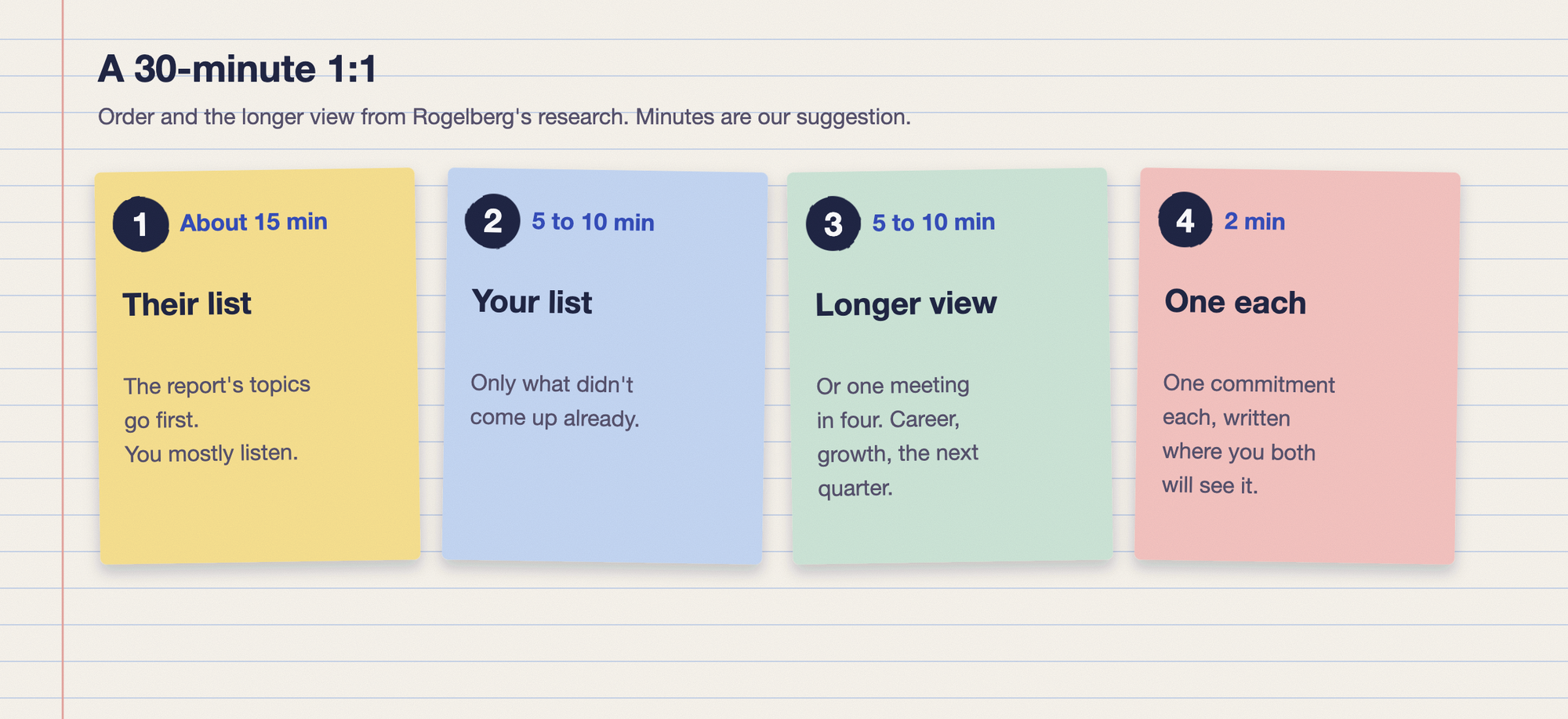
End with one commitment each and write it where you'll both see it. Next week's 1:1 starts by checking those two lines, which takes a minute and tells your report the meeting is worth preparing for. For the agenda templates and the broader case for the meeting, see our guide to one-on-one meetings.
Run the pre-1:1 check-in in Slack or Teams
The async check-in from the first diagram only works if nobody has to remember it. Stany runs daily standups, check-ins or any status update inside Slack or Microsoft Teams, and it works the same in both. According to its product page, the questions are editable, reminders go out at the right time for each person's time zone, anyone can skip a day or snooze, and an end-of-day digest gathers the replies and the blockers in one message. Set up a short check-in with three questions (what you finished, what's next, what's blocked) on the day before your 1:1s, and you'll walk in having already read the status.
Kateryna Morozova, Revenue Operations Commissions Specialist at Ideals, wrote that Stany automatically fills in the previous work progress! and liked getting the mood and blockers summary in one channel message. If your team already runs a daily standup, our standup questions piece has sets you can reuse for the check-in.
When it's time for the review cycle, SimplePerf runs it in the same Slack or Teams workspace, with smart reminders so you're not chasing anyone. Bring what you heard in your 1:1s to it, so the review covers the whole period and not just the last two weeks. If you're weighing a full performance suite, our take on performance review software for small companies is the place to start.
1,000+ HR teams use BuddiesHR and it holds a 4.8/5 rating on G2 (BuddiesHR's own figures). Install Stany free in Slack or Teams. It's free under 10 employees, there's a 30-day trial, and the pricing page has the current structure.
FAQ
How many questions should you ask in a one-on-one meeting?
Three, plus whatever your report brings. That's our rule of thumb, not research. Rogelberg's finding that the report should be speaking 50 to 90 percent of the time leaves little room for a long list, and the picker above gives you three for that reason.
How often should you hold one-on-one meetings?
Weekly or every other week. Rogelberg found the research lines up best with that rhythm, and Gallup found that 15 to 30 minute conversations beat 30 to 60 minute ones when they happen regularly. A short weekly 1:1 beats a long monthly one.
Who should set the agenda for a 1:1?
The report. In Rogelberg's research, both managers and direct reports rated 1:1s highest when the direct report created the agenda. The manager keeps a short list of their own and goes second.
What shouldn't you talk about in a 1:1?
Status that could have been written down. Project updates, ticket lists and what got done this week belong in an async check-in the day before. Keep the meeting for what's hard to write: how someone is doing, where they want to go, and the feedback neither of you has said yet. If you'd like more conversation starters for people you don't manage, try our coffee chat questions.