This or that questions for work: 50 that take two seconds
50 this or that questions for work in five sections, a work-with-me card builder, and a five-minute speed round for Slack or Teams.


The best this or that questions for work take two seconds to answer and still tell you something. Coffee or tea is a snack order. Call or message is a rule for how to reach someone, and most teams have never said it out loud. Every other list gives you a hundred pairs and stops there.
Below you'll find 50 this or that questions for work in five sections, a small builder that turns six of your own picks into a "how to work with me" card, and a five-minute speed round you can run in Slack or Microsoft Teams.
Why run this or that questions at work
One pair takes two seconds. The benefits come from asking a few of them regularly, and they're our view of what a team gets, not proven results.
- Everyone gets a turn. A tap counts as speaking. In a study published in Science in 2010, Anita Woolley and colleagues found that the groups that did best across a range of tasks weren't the ones with the smartest individuals. Collective intelligence was linked to members taking turns to speak more equally, among other things (Woolley et al., Science). The study didn't test this or that questions. Our reading is that a one-tap pair is a cheap way to give the quiet person a turn before the loudest voice sets the tone.
- Working preferences come out in the open. Call or message, short meeting or long one, early start or late finish: most teams follow these rules without ever having said them.
- New joiners catch up faster. A short card of picks tells a new colleague how you like to be reached on day one, not in month three.
- Remote teams get a small moment of connection. Nobody has to share a room or a time zone to answer in a thread, and finding out two people picked the same side gives them something to say to each other.
- It costs almost nothing to repeat. Two minutes in a team channel and no prep beyond choosing the pairs, which is why it can outlast the first week.
What makes a this or that question work at work
This or that is the fastest cousin of would you rather questions. There's no scenario to picture and nothing to justify, only two short options and one tap. That speed is the point. A question you can answer in two seconds is one the quiet person on the team will actually answer.
The format also has a limit. A pick tells you what someone prefers, not why, and it can't tell you what they'd trade away. Treat every result as the start of a conversation, never the end of one.
Build your how-to-work-with-me card
Most this or that lists stay at the level of snacks. Six of the pairs below carry real working preferences, so we turned them into a builder. Choose your side on each, then paste the card in your profile or in a team thread. It takes under a minute, and it gives a new colleague answers they'd otherwise take months to learn.
Work-with-me card builder
Make six picks. You'll get a short card to paste in your Slack or Teams profile, or to share with your team.
Your card
Nothing you pick is sent anywhere.
Light this or that questions for work
Start here with a new team, a big meeting or a Friday channel. Nobody reveals anything, which is the point. Low stakes gets people into the habit of answering.
- Coffee or tea?
- GIFs or emoji?
- Cats or dogs?
- Pizza or tacos?
- Sweet snacks or savory snacks?
- Mountains or beach?
- Dark mode or light mode?
- Podcasts or music?
- Sunrise or sunset?
- Summer or winter?
This or that questions about meetings and messages
This is where the format starts to carry information. Every pair below is a real preference about how people want to be reached.
- A call or a message?
- A 25-minute meeting or a 50-minute meeting?
- Camera on or audio only?
- A written update or a live update?
- A thread or a direct message?
- An agenda sent ahead or an agenda on the spot?
- Reply now or reply later?
- A voice note or a text message?
- Meeting-free mornings or meeting-free afternoons?
- A weekly meeting or a daily check-in?
This or that questions about how you work
These are about rhythm: when people focus, how they handle a plan, how they like to be told they've got something wrong. They make good openers for a team that's about to write down how it works together.
- Deep work blocks or short bursts?
- Plan first or start first?
- A quiet room or a buzzy cafe?
- Big task first or quick wins first?
- Early start or late finish?
- Paper notebook or notes app?
- A hard deadline or an open timeline?
- Feedback right away or feedback in a scheduled slot?
- Working solo or working in pairs?
- A checklist or gut feel?
This or that questions for remote and hybrid teams
Where people work shapes everything else. Ask these when you're deciding on office days, off-sites or how much overlap the team needs. For other ways to build connection across a distributed team, see how to help your remote team feel connected.
- Home or office?
- Fixed office days or flexible office days?
- The same hours as everyone or your own hours?
- An in-person off-site or an online team event?
- Chat or email?
- A home desk or a coworking space?
- A text standup or a video standup?
- A few overlap hours or fully async?
- Two big meet-ups a year or small meet-ups often?
- A virtual coffee or a virtual game?
This or that questions about teams and growth
The most personal set, so save it for a team that's comfortable or for a one-to-one. A coffee chat is a better place for these than an all-hands, and our coffee chat questions follow the same logic.
- Specialist or generalist?
- A mentor or a peer group?
- A course or learning on the job?
- Praise in public or praise in private?
- Leading the project or supporting the project?
- A big team or a small team?
- A stretch role or a steady role?
- A detailed brief or an open brief?
- A quarterly review or ongoing feedback?
- Presenting or writing?
Run a five-minute speed round
The questions are the easy part. What stalls is the running of them. Here's the shape we'd use, and it's ours, not research: six pairs, posted together, read in under five minutes. Six is enough to see a pattern and few enough that nobody skips the last one.
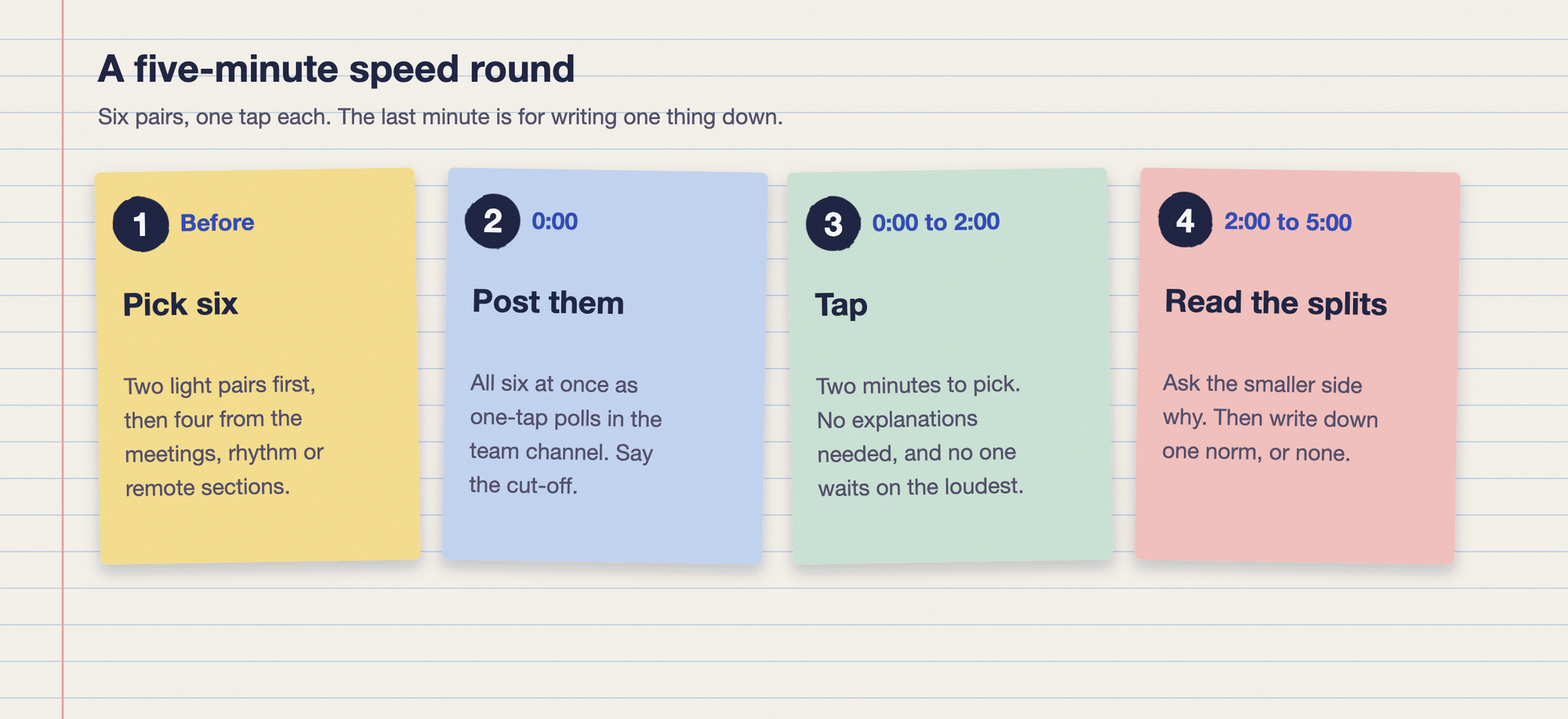
Mix the pairs. Two light ones first so the room warms up, then four from the meeting, rhythm or remote sections. When a pair splits close to evenly, ask each side what they need. When one answer wins by a wide margin, keep it as the default and ask the smaller side what would make it work for them. For a result with one lone voice, check in privately, not in the thread. It may be a quiet concern.
Questions to skip
Skip anything that asks people to rank colleagues, choose who to let go, or trade pay for something personal. Skip pairs that touch health, family plans, religion or politics. Check that no pair assumes everyone can travel, walk to an office or work the same hours. And skip any pair where one side is a joke at someone's expense. A good test: if a person would feel they had to justify their pick to HR, cut it.
For the touchy pairs, such as camera use, working hours and office days, run the poll anonymously and share the split without the names. Our guide to anonymous employee surveys covers when that matters.
Running them without it becoming your job
If you post the pairs by hand, it works for about a month. Somebody has to choose them, post them, remind people and read the result, every week.
Pulsy runs polls inside Slack and Microsoft Teams, so people answer where the conversation already is, with no link to another tool. You set per poll whether answers are anonymous or attributed, people see which before they vote, and results update live. The product page's own example is a two-option poll (mountains or beach for an off-site), which is exactly this format, and it describes weekly one-tap pulses on a cadence you choose. Paste a pair from this page, set it, and the thread does the rest. For a rhythm that doesn't depend on you remembering, Alfy pairs people at random for a coffee chat every week, every two weeks or every month, and these pairs work as openers there too.
1,000+ HR teams use BuddiesHR and it holds a 4.8/5 rating on G2 (BuddiesHR's own figures). Install Pulsy free in Slack or Teams. It's free under 10 employees and comes with a 30-day trial, and the pricing page has the current structure. For more ways to open a meeting, the icebreaker questions guide has 60, and the virtual team building activities library has games for longer sessions.
FAQ
What are good this or that questions for work?
Pairs where both options are easy to defend and neither makes anyone look bad. The best ones are small versions of real choices, such as a call versus a message or a short meeting versus a long one, because the answers tell you how your team likes to work.
How do you use this or that questions in a meeting?
Post six pairs at once as one-tap polls, give people two minutes, then read out the splits and ask the smaller side why. Keep it under five minutes. A poll works better than hands up, because nobody waits to see what the loudest person chose.
What's the difference between this or that and would you rather?
Would you rather sets a scenario and invites a story. This or that is shorter, with no scenario and no explanation needed, so it suits polls and quick rounds. Use would you rather when you want people to talk, and this or that when you want everyone to answer.
How often should a team do this or that questions?
Pick the slowest rhythm you'll keep. One speed round at the start of a monthly all-hands, or one pair a week in a team channel, beats a daily post that fades after a fortnight.