Standup questions: 25 that aren't status theatre
25 standup questions for engineering, support, sales, remote and leadership teams, plus a builder to run them async in Slack or Teams.


The classic standup questions are yesterday, today and blockers, and on a good day they work. On most days they produce a list of tickets nobody asked to hear. These 25 standup questions, grouped by team type, keep the blocker question and swap the rest for prompts a teammate can act on.
Below you'll find why the three classics drift into status theatre, a small builder that turns your team type into a four-question set, the 25 questions in five groups, and how to run them as an async standup in Slack or Microsoft Teams.
The three classic standup questions
Most teams start with the same three: what did you do yesterday, what will you do today, and is anything blocking you. They're the default in most standup tools, ours included. They aren't a rule. The 2020 Scrum Guide describes the Daily Scrum as a 15-minute event for the Developers, says they can select whatever structure and techniques they want, and asks only that it focus on progress toward the Sprint Goal and produce an actionable plan for the next day of work (The Scrum Guide, 2020). So the three questions are a habit, not a requirement.
Why they turn into status theatre
Two of the three ask for a report. Yesterday and today get answered from memory and from the board, and the board already holds the answer. Code Climate makes a version of this argument: the three questions check whether work is progressing, which data can answer, and that leaves the meeting free to ask how the team can move faster (Code Climate). It's a vendor arguing for its own category, so weigh it that way. The diagnosis still matches what we'd say.
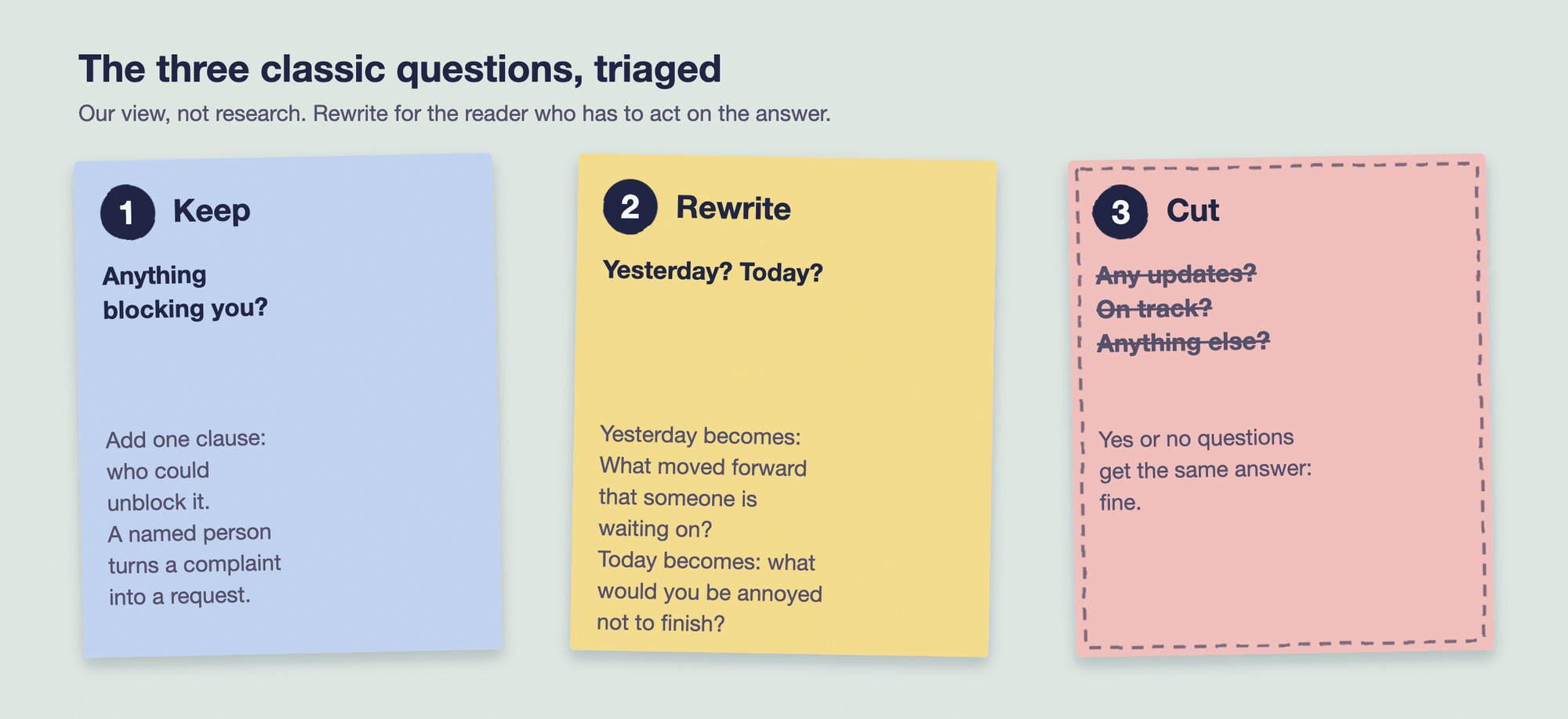
Our view, not research: questions that ask for activity get activity back. Questions that ask for something a teammate can act on get blockers, risks and offers of help. You can tell a standup has drifted when people read out the same lines every day, when replies don't get replies, and when nobody can remember a plan that changed because of something said in it.
Build your standup question set
Pick the team that's closest to yours. You'll get four questions to paste into a standup. The first three come from the groups below, and the last is always the blocker question, because it's the one that earns the standup its place.
Standup question builder
Choose your team type. You'll get a four-question standup to paste into Slack or Teams.
Your standup
Nothing you pick is sent anywhere.
Standup questions for engineering and product teams
These teams already have a board, so skip anything the board can answer. Ask about waiting, review and risk.
- What moved forward that someone else is waiting on?
- What's the one thing you'd be annoyed not to finish today?
- Is anything in review that needs eyes today?
- What did you learn that the team should know?
- Where do you need a second opinion before you go further?
Standup questions for support and ops teams
Queues hide the stuck item. These bring the oldest, the most repeated and the most handed-off work to the surface.
- What's the oldest open issue you're carrying?
- Which customer problem keeps coming back?
- What did you hand off that needs a follow-up?
- What would help you clear your queue today?
- What in our process slowed you down yesterday?
Standup questions for sales and revenue teams
A sales standup that recites pipeline stages repeats the CRM. Ask where help would change a deal.
- Which deal needs help this week, and what kind?
- What did a customer say that the team should hear?
- What's the one conversation you most want to have today?
- Which deal moved, and what moved it?
- What do you need from product, support or finance?
Standup questions for remote teams across time zones
When nobody shares a morning, the standup is a handover. These questions are written for the person who reads them eight hours later. For more on keeping a distributed team in sync, see how to help your remote team feel connected.
- What should the next time zone know before they start?
- What did you hand over, and where is it?
- What decision are you waiting on, and from whom?
- What would you like a reply to by your next morning?
- How's your energy today, from 1 to 5?
Standup questions for leadership teams
A leadership standup is the one most likely to become a round of updates nobody needs. Keep it to decisions, risks and cross-team effects.
- What's the one priority you're protecting this week?
- Where do you need a decision from this group?
- What risk are you watching that others may not see?
- What's changed since we last spoke that affects another team?
- Who on your team deserves a mention?
Run your standup async in Slack or Microsoft Teams
A live standup is the wrong place for most of these questions. People answer from memory, one at a time, while everyone else waits. An async standup lets each person answer in their own morning and costs nobody a calendar slot. It fixes the remote problem too, since nobody has to be online at the same hour. Keep a live call for the days that need a conversation.
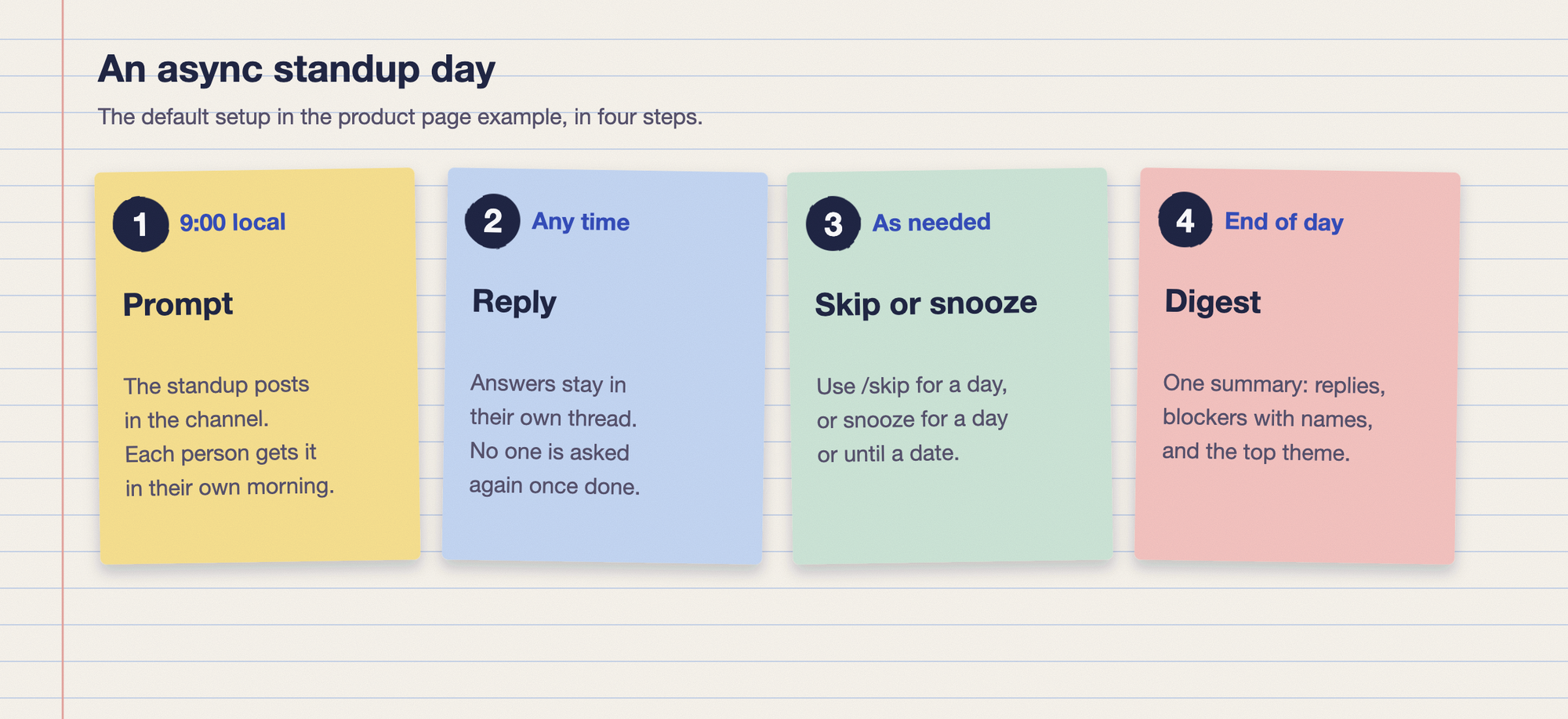
Stany runs this format inside the channel your team already uses, so there's no portal to open and no login to forget. According to its product page, the standup is posted in a Slack or Microsoft Teams channel and each reply stays in its own thread. In the page's example, each person is prompted at 9:00 in their own time zone, anyone who has already replied isn't pinged again, and a day can be skipped with /skip or snoozed. The questions are editable per team, so you can paste a set from this page. With the default questions, yesterday is pre-filled from the previous day's answer to today, so most people edit and send.
The page's example end-of-day digest shows the number of replies, a list of blockers with names and a top theme. Managers can follow along through a reader list without joining the standup, and every standup is stored, searchable and exportable. Kateryna Morozova, Revenue Operations Commissions Specialist at Ideals, wrote that Stany automatically fills in the previous work progress! and liked the single summary message with replies in the thread.
1,000+ HR teams use BuddiesHR and it holds a 4.8/5 rating on G2 (BuddiesHR's own figures). Install Stany free in Slack or Teams. It's free under 10 employees and comes with a 30-day trial, and the pricing page has the current structure. If you're comparing tools first, our roundup of the best standup apps for Slack covers the field, and the standup is one of three recurring jobs we'd automate first in HR automation for a small business.
FAQ
What are the three daily standup questions?
What did you do yesterday, what will you do today, and is anything blocking you. They're a common default, not a rule: the 2020 Scrum Guide leaves the structure to the Developers. If you keep only one, keep the blocker question and ask who could unblock it.
How many standup questions should you ask?
Three to five. This is our rule of thumb, not research. Past five, replies get shorter and more copy-pasted. The builder above gives you four: three tailored to your team and the blocker question.
How long should a daily standup be?
The Scrum Guide sets the Daily Scrum at 15 minutes for the Developers. An async standup has no meeting length, and the useful measure is how long a reply takes. If answering feels like writing a report, the questions are too heavy.
Can a standup be async?
Yes. A thread in Slack or Microsoft Teams does the job when a team spans time zones or has little to settle live. Pair it with a regular one-to-one, such as the format in our one-on-one meeting guide, for the conversations a thread can't carry.