"Would you rather" questions for work: 40 that show work style
40 would you rather questions for work, sorted by what they reveal, with a pair picker and a guide to reading a split vote.


The best would you rather questions for work don't have a right answer, but they do have a point. Choose between a silent room and a busy cafe and you've told your team how you focus. Choose between a call and a 600-word message and you've told them how to reach you. Most lists hand you a hundred random dilemmas and stop there.
Below you'll find 40 would you rather questions for work, sorted by what they reveal about how people work, a picker you can shuffle, a way to read the answers when a room splits, and three ways to run them in Slack or Microsoft Teams without turning it into a weekly chore.
What makes a would you rather question work at work
A good one has two options that are both easy to defend. If one answer is obviously better, nobody learns anything, and if one answer makes you look bad, nobody gives it. The best pairs are small versions of choices people really make every week: when to work, how to communicate, where to be. That's what turns a conversation starter into something your team can use.
There's also a structural reason the format suits a group. In a study published in Science in 2010, Anita Woolley and colleagues found that the groups that did best across a range of tasks were not the ones with the smartest individuals. Collective intelligence was linked to members taking turns to speak more equally, among other things (Woolley et al., Science). Our icebreaker questions guide covers that research in more depth. A would you rather question helps because everyone has a position, including the person who never volunteers. Choosing A or B takes five seconds, and the explanation can come after, on their terms. That reading is ours. The study didn't test would you rather.
Order matters too. In a 1997 paper, Arthur Aron and colleagues had pairs of strangers spend about 45 minutes on tasks that gradually asked for more self-disclosure, and those pairs felt closer afterwards than pairs given small-talk tasks (Aron et al., Personality and Social Psychology Bulletin). That was a lab procedure with strangers, not a team poll. We borrow the principle as a design rule: start light, and get more personal only once the room is warm. The five sections below run in that order.
Pick a pair
Choose a category, then tap an option. The picker suggests a follow-up to ask, because the answer to a would you rather question is the least interesting part of it.
Would you rather picker
Choose a category and tap an option. You'll get a follow-up to ask next.
Would you rather…
or
Pairs come from the lists on this page. Nothing you tap is sent anywhere.
Light and silly would you rather questions for work
Start here with a new team, a big meeting or a Friday channel. Nobody has to reveal anything, which is the point. Low stakes gets people into the habit of answering.
- Would you rather reply to every message for a week with only GIFs or reply to every message for a week with only emoji?
- Would you rather have a cat walk across every video call or have a dog bark through every video call?
- Would you rather have your laptop restart to update in the middle of a presentation or be on mute for the first minute of every presentation?
- Would you rather be the team's snack person or be the team's birthday person?
- Would you rather never make a typo again or always find any file on the first search?
- Would you rather have unlimited free coffee at work or have unlimited free lunch at work?
- Would you rather hold every one-on-one in the morning or hold every one-on-one in the afternoon?
- Would you rather work a four-day week with longer days or work a five-day week with shorter ones?
Would you rather questions about meetings and messages
This is where light questions start to carry information. Every pair below is a real preference about how people want to be reached, and most teams have never said any of them out loud.
- Would you rather replace every meeting with a written update or replace every written update with a meeting?
- Would you rather get a call about something small or get a 600-word message about it?
- Would you rather sit through meetings that run over but end with a decision or sit through meetings that finish on time with no decision?
- Would you rather answer every message within five minutes or check messages only twice a day?
- Would you rather read a thread with 80 replies or sit through a call with eight people talking over each other?
- Would you rather leave your camera on for every call or stay audio only for every call?
- Would you rather get praised in front of the whole company or get praised in a private message from your boss?
- Would you rather present to the whole company once a month or write a company-wide update every week?
Would you rather questions about how you work
These are about rhythm: when people do their best work, how they handle a plan, how much they like to finish before moving on. They make good openers for a team that's about to write down how it works together.
- Would you rather work in complete silence or work with the buzz of a busy cafe?
- Would you rather finish one big task before lunch or clear ten small ones?
- Would you rather start at 7am and finish at 3pm or start at 11am and finish at 7pm?
- Would you rather have a detailed plan you can't change or have no plan and total freedom?
- Would you rather get it 80% right today or get it 100% right next week?
- Would you rather work on one project for a whole year or start a new project every month?
- Would you rather be the person who spots the problems or be the person who fixes them?
- Would you rather think best alone with a notebook or think best out loud with a colleague?
Would you rather questions for remote and hybrid teams
Where people work shapes everything else, and the answers are rarely the ones managers assume. Ask these when you're deciding on office days, off-sites or how much overlap the team needs. For other ways to build connection across a distributed team, see how to help your remote team feel connected.
- Would you rather work from home every day or work from an office with your team every day?
- Would you rather meet your team in person for a week, twice a year or meet your team for a day every month?
- Would you rather have a great chair in a room with no window or have a kitchen table with a great view?
- Would you rather work from a new city every month or keep the same desk for five years?
- Would you rather have a ten-minute commute to an office you like or have no commute and no reason to leave the house?
- Would you rather be on a team in one time zone or be on a team spread across eight, so someone is always online?
- Would you rather spend an off-site on a beach with no agenda or spend it in a workshop with a clear plan?
- Would you rather choose your office days freely or have the company fix them so everyone's in on the same days?
Would you rather questions about career and growth
The most personal set, so save it for a team that's comfortable or for a one-to-one. Nobody should have to answer in front of the whole company if they'd rather not. A coffee chat is a better place for these than an all-hands, and our coffee chat questions follow the same logic.
- Would you rather be the expert at one thing or be good at many things?
- Would you rather move into a bigger role next year, with a steep learning curve or stay in a role you love for two more years?
- Would you rather have a brilliant mentor who's rarely free or have a good mentor who's always available?
- Would you rather know your exact career path for the next five years or have no idea, but plenty of options?
- Would you rather join a startup of ten people or join a company of ten thousand?
- Would you rather hear feedback right after every task or save it all for one conversation a quarter?
- Would you rather learn a new skill from a course or learn it from a mistake on the job?
- Would you rather manage a team of five or be the best individual contributor in the room?
How to read a split
The answers are the useful part. When you run a pair as a poll, the shape of the result tells you something an ordinary meeting wouldn't. Three shapes come up again and again, and each one suggests a different next step. This is our rule of thumb, not research.
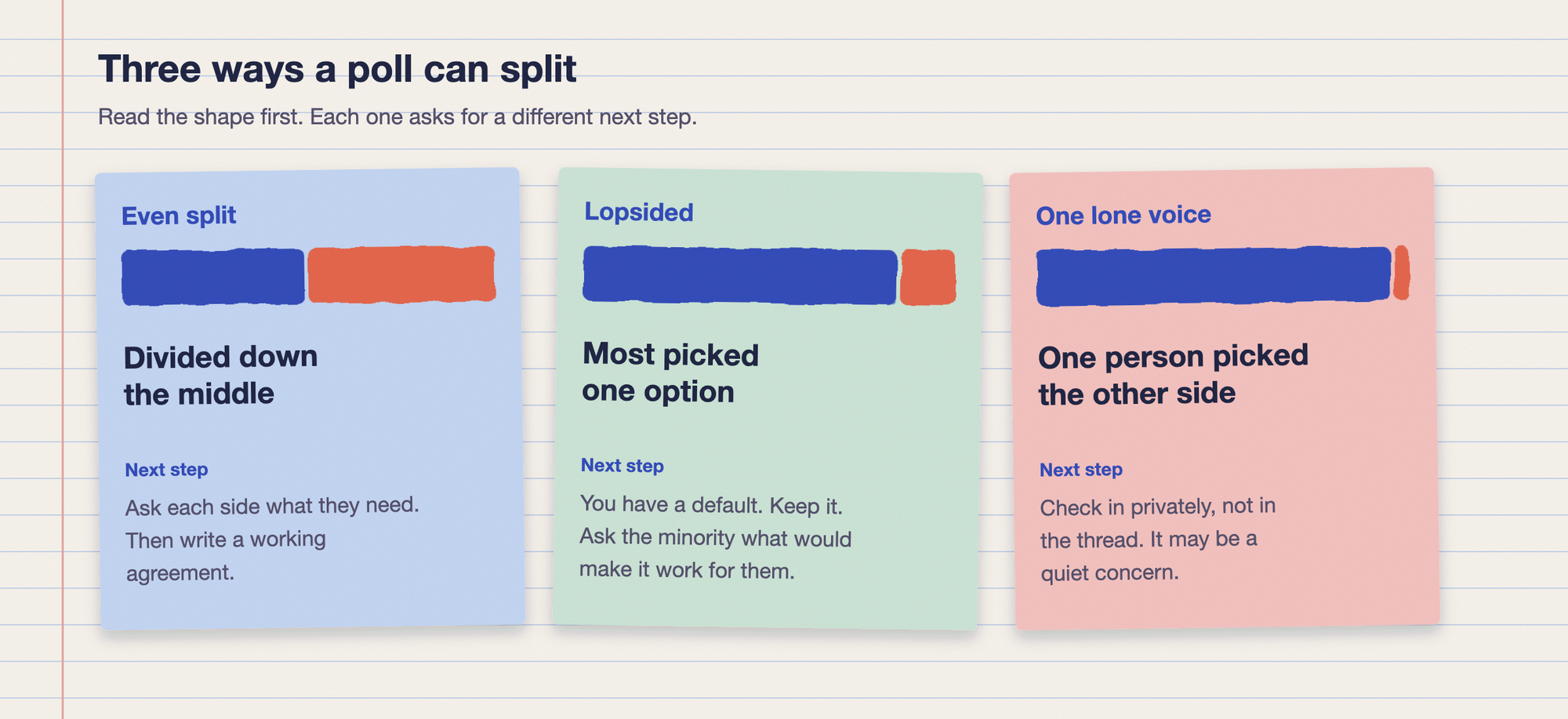
One caution. Don't use a would you rather split to decide something that matters. Twelve people choosing between early starts and late starts is a good reason to talk about hours. It isn't a vote on hours.
Pick the format by the stakes
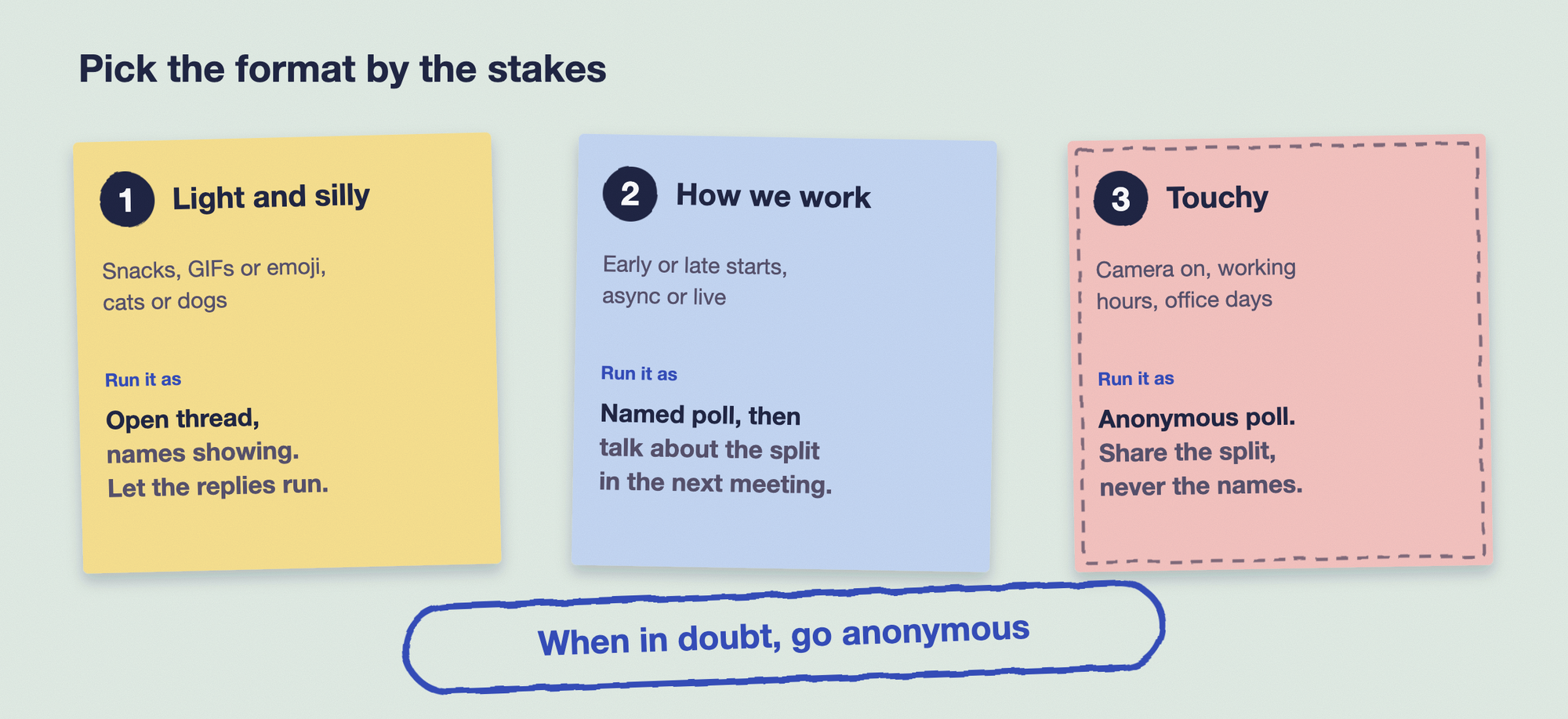
The same question lands differently depending on where you ask it. A pair about cats and dogs on a call can run in an open thread with names showing. A pair about camera use or office days is a different matter: some people will answer honestly only if nobody can see who said what. Our guide to anonymous employee surveys covers when that matters.
Questions to skip
Would you rather is a format that invites extremes, and extremes at work go wrong fast. Skip anything that asks people to rank colleagues, choose who to lay off, or trade pay for something personal. Skip pairs that touch health, family plans, religion or politics. Skip the gross-out classics, which land differently in a room with a manager in it. And skip any pair where one option is a joke at someone's expense. Check that no pair assumes everyone can walk to an office, travel for a week or work the same hours. A good test: if a person would feel they had to justify their answer to HR, cut it.
Running them without it becoming your job
The questions are the easy part. The part that stalls is the routine: somebody has to pick a pair, post it, remind people and read the result, every week. If you do that by hand it works for about a month.
Pulsy runs polls inside Slack and Microsoft Teams, so people answer where the conversation already is, with no link to another tool. You choose per poll whether answers are anonymous or attributed, people see which before they vote, and results update live. Paste a pair from this page, set it, and the thread does the rest. For a rhythm that doesn't depend on you remembering, Alfy pairs people at random for a coffee chat every week, every two weeks or every month, and the questions on this page work in those chats too.
1,000+ HR teams use BuddiesHR and it holds a 4.8/5 rating on G2 (BuddiesHR's own figures). Install Pulsy free in Slack or Teams. It's free under 10 employees and comes with a 30-day trial, and the pricing page has the current structure. For more ways to open a meeting, the icebreaker questions guide has 60, and the virtual team building activities library has games for longer sessions.
FAQ
What are good would you rather questions for work?
Pairs where both options are easy to defend and neither makes anyone look bad. The best ones are small versions of real choices, such as a call versus a long message, or an early start versus a late one, because the answers tell you something about how your team works.
How do you use would you rather questions in a meeting?
Post one pair at the start, give people a minute to pick, ask two or three to say why, then move on. Our rule of thumb is to keep it under three minutes. A poll works better than hands up, because nobody waits to see what the loudest person chose.
Are would you rather questions appropriate for work?
Yes, if you keep them work-safe. Avoid health, family, religion, politics and anything that ranks colleagues. If you're unsure whether a pair is safe to answer in public, run it as an anonymous poll or cut it.
How often should a team do would you rather questions?
Pick the slowest rhythm you'll keep. One pair a week in a team channel, or one at the start of a monthly all-hands, beats a daily post that fades after a fortnight.