AI for Performance Reviews: How Automation Is Transforming Feedback in 2026
Discover the role of generative AI in performance reviews, how you can use it to run great reviews, and how popular AIs can assist you with the review process.

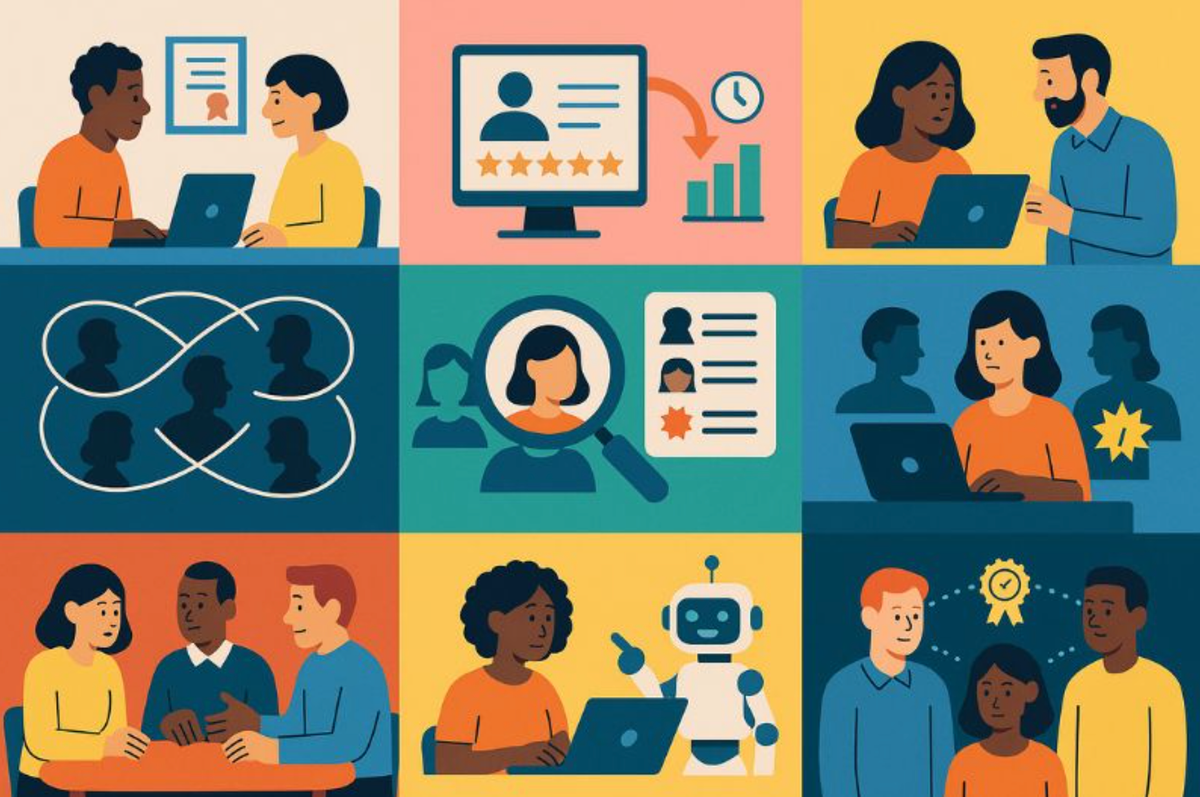
How can we describe the arrival of Artificial Intelligence (AI) on the world scene? Do we say it’s gate-crashed the party? Do we say it’s made a spectacular entrance? Or do we say that we never saw it coming? The truth is, AI was first conceived in 19561, and has been growing ever since, but now that it’s arrived, it's everywhere.
The performance review process has been distinctly human. A space for people to grow and develop together by teaching, coaching, and encouragement. Now the question is: Can AI have a role in improving this process, and if so, what value can it add?
We discuss the answer to this question (and perhaps a dilemma for some) and provide guidance on its responsible use in the review process.
Quick Overview
AI for performance reviews uses artificial intelligence developed platforms to analyze information, giving managers access to structured feedback that can be used to discuss employee performance. Performance review software summarizes feedback, analyzes patterns, and provides data-driven reports that increase the quality of the review.
Table of Contents
- What role can AI play in the performance review?
- The potential of generative AI tools to transform employee development
- Can popular AI tools help you conduct better performance reviews?
- Conclusion
- FAQs: AI for performance reviews
What role can AI play in the performance review?
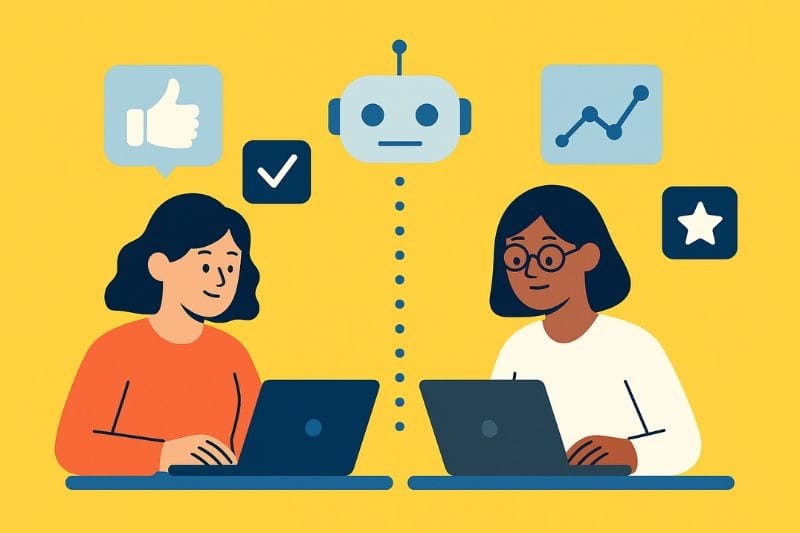
The Challenge
The performance review process hasn’t always gotten positive feedback from managers and employees. According to a Gallup study, only 14% of employees feel that the review process helps them improve their job performance. By any standard, a dismal failure. According to the same study, alternatives haven’t yielded any better results, causing companies to question their validity in performance improvement.2
Part of the challenge has always been getting enough data together about key achievements to run an objective review. Joined with biased feedback and the careless use of opinion-based perceptions, the review has caused many strained relationships. Hoping to revive the process, human development professionals have turned to AI for help, hoping to breathe new life into performance feedback.
If you dread writing performance reviews, find out what you can do next 👇
The Solution
‘AI-driven performance review software’, ‘AI performance review generator’, or ‘Performance review generator’, are all phrases describing a platform that helps companies to manage their performance management process. It does so in the following way:
- Transforms scattered feedback into insights that make sense, supported by data.
- Eliminates opinion-based views by providing a bigger picture of the employee’s performance.
- Identifies patterns, strengths, and blind spots caused by human bias, boosting fairness.
- Automates the time-consuming process of data collection and paperwork. This frees managers to focus on coaching.
- Facilitates transparency and goal alignment by providing insights between performance and company objectives.
- Promotes insight by asking clarifying questions to reviewers. This clarifies ambiguous feedback.
- Identifies high/low performers based on credible productivity data.
Ready to dive into AI-driven performance reviews? Get your first review in minutes with Simpleperf.
🔍 Deeper insight by BuddiesHR: AI in Performance Management: Strategic Use, Not Hype
We discuss the benefits and challenges of AI in performance appraisal.
The potential of generative AI tools to transform employee development

A McKinsey report titled, ‘The economic potential of generative AI: The next productivity frontier provides interesting insights into the future capabilities of AI systems. At the present time, these inferences are subject to unknown variables and rapidly evolving AI capabilities.
Knowledge is power
Knowledge workers spend the majority of their day searching for information to fulfill their job tasks. With AI capable of automating 60-70% of this work, employees are freed up to do strategic work.
With generative AI, performance metrics are quietly collected in the background until the manager asks for a generated review. This provides managers with measurable results instantly, reducing manual work. The quality of the review is no longer dependent on whether the manager has time to collect specific examples and adequate performance data.
Development is personalized
AI's capability to unlock value not only from text but also from multimodal inputs (images, audio, code, workflow logs, and tags) is increasing. These expanded capabilities will provide:
- Personalized annual reviews.
- Predictive insights based on past performance.
- Areas of improvement based on historical data, such as self-evaluation, peer reviews, project-based reviews, and future goals.
- Patterns in communication, customer interaction, and behavior can be analyzed to identify smart goals and areas for improvement in a specific context.
Acceleration in performance and development

As AI improves feedback quality and aligns goals with company values, there is an expectation that key competencies will be gained more easily and in shorter time frames. Specific recommendations that zone in on the real challenges employees are facing will save time, giving managers better goal-setting abilities. When guesswork is eliminated, so is confusion about how to proceed.
Improved communication and feedback
Generative AI can provide actionable feedback by producing performance summaries, identifying behavioral patterns, and offering guidance aligned with communication best practices.
For instance, in customer operations, AI-assistance boosted the performance of a less experienced agent significantly, compensating for performance gaps. With development feedback, it can do the same for managers who struggle to find the right words and way of phrasing difficult feedback.
Increased fairness and bias reduction
While the McKinsey report highlights the benefit of reducing human bias, it stresses the need for human-in-the-loop governance. However, new and unexpected forms of bias can originate as a consequence of the summaries given by the AI tool. As more companies use AI in performance reviews, these biases will become apparent.
Ready to experience the increased efficiencies of AI-driven performance reviews?
Try this simple, guided 360-degree performance review tool by BuddiesHR. First-time managers can set up reviews in minutes. No training required. 👉 Start with Simpleperf.
Can popular AI tools help you conduct better performance reviews?

While we’ve been focusing on AI-driven performance review software, you may be wondering how well existing tools like ChatGPT, Google Gemini, Grok, MS Copilot and others can do the job.
A good way to frame these platforms in the review process is as general-purpose cognitive assistants rather than performance management systems. They are capable of sharpening your writing, structuring your thoughts, and analyzing patterns you feed them, but they don’t inherently know your company's AI policy, culture, values, or context.
Here’s where popular AI platforms can help:
- They turn disorganized thoughts and emotional tones into well-structured and helpful statements.
- They can help you think more clearly by asking probing questions, causing you to reflect on your opinions and understanding.
- They can summarize lengthy inputs and lend professionalism to the feedback.
Here’s where popular AI platforms can fall short:
- They lack organizational context. Without that foundation, their context is limited.
- Where input is insufficient, they will fill in the gaps or hallucinate patterns. This will cause skewed feedback.
- Data will not be protected in the same way as platforms designed to handle sensitive HR information.
- They do not have the same safeguards as performance review software to protect against bias.
In summary, they can improve the writing experience for reviews, but they cannot run your performance management process.
Get the best of both worlds with a dedicated performance review system.
Simpleperf by BuddiesHR is designed for small teams, providing fast, reliable, and accurate performance insights.
Conclusion
AI for performance review is a powerful way for companies to get accurate data, track patterns, and receive help writing review reports. It provides a way for even the smallest company to participate in an effective review process, improve employees' performance, and facilitate individual growth.
AI does not replace manager-employee interactions or the need for in-person feedback. It should be viewed as a helper for the growth of human relationships, not a replacement for them.
Ready to make performance reviews great?
If you’re eager for a review process that actually works, and has fewer hassles 👉 Start here with BuddiesHR.
Related insights by BuddiesHR:
- Performance reviews for small companies: Best practices that work
- People Ops picks: The best performance review software for small companies
FAQs: AI for performance reviews
1. How does AI make performance reviews more accurate?
Artificial intelligence can analyze multiple data points and large volumes of information quickly and accurately. What would take the average human being a long time to do manually, AI can accomplish within minutes, even seconds. This increased use of relevant information provides the manager with objective data to provide review feedback.
2. Will AI replace the manager's feedback?
No. AI does not replace the manager’s feedback. It is a powerful tool for summarizing information, analyzing patterns, and providing insights that can be missed due to human biases. Therefore, it enhances human capability to have valuable conversations. It cannot replace the human-to-human connection.
3. Is AI safe to use for sensitive HR data?
Modern HR platforms use strong encryption, access controls, and compliance protocols to protect sensitive information. It's important to choose tools that follow GDPR, POPIA, SOC 2, and other global standards. When used, these protocols protect data as well as, and perhaps better than, traditional methods.
4. Can small companies use AI performance review software?
Yes! Small companies will benefit from using AI in the performance review process because it lightens the load of drafting review templates, tracking completion rates, compiling information, and compiling actionable development plans. This makes an efficient review process possible for companies that don’t have an HR department.
5. Will AI review make the process less human?
It will only be ‘less human’ if the company approaches the process this way. AI takes the burden of collecting and analyzing information off the manager's shoulders, but face-to-face conversation is still necessary for connection and trust building.
References:
1. https://en.wikipedia.org/wiki/History_of_artificial_intelligence