5 Culture Amp alternatives worth exploring before you commit
Culture Amp is powerful but quote-based and pricey for smaller teams. Compare five alternatives (BuddiesHR, 15Five, Lattice, Leapsome and Workleap Officevibe) on pricing, fit and adoption before you sign.

Employee engagement has quietly become a crisis. U.S. employee engagement fell to 29% in the third quarter of 2026, its lowest level since 2011. Meanwhile, Gallup's *State of the Global Workplace 2026* estimates the global cost of disengaged employees at about $10 trillion a year in lost productivity. If your organization is trying to close that gap, the platform you pick matters far more than most leaders realize.
Culture Amp is often the first name that comes up. The Melbourne-founded employee experience platform has 6,500+ customers, including Salesforce, Etsy, and Canva. Its research-backed surveys, predictive analytics, and benchmarking data have earned it a loyal following, especially among mid-to-large companies with dedicated People Ops teams. The problem? Culture Amp does not list pricing on its own page. Third-party purchase data puts the median deal at about $22,180 a year, ranging from $7,700 to $57,793. For organizations without an enterprise budget, or those that want simpler, faster deployment, that price tag can be a dealbreaker.
This guide covers five Culture Amp alternatives worth a close look before you sign anything. Each has a distinct profile, real pricing data, and honest pros and cons. No manufactured rankings, just the information you need to make a confident decision.
Key takeaways
- Engagement is an urgent business problem: Low engagement costs the world economy roughly $10 trillion annually, or 9% of global GDP, per Gallup. Every month you delay picking the right tool is a month of measurable productivity loss.
- Culture Amp's price ceiling surprises buyers: Enterprise-level Culture Amp pricing can reach $118 to $122 per user per month. If your team is under 200 people, comparable features are available at a fraction of that cost.
- Platform fit beats feature lists: The best tool is the one employees and managers actually open. BuddiesHR lives inside Slack and Microsoft Teams, which solves the adoption problem before it starts.
- Modular pricing is now the norm: Among vendors that publish a per-seat price, engagement plans start at $4 per user per month, covering Lattice Engagement, 15Five Engage, and Leapsome Engagement Surveys, as checked in October and November 2026. Use that as your budget floor, not Culture Amp's quote-based model.
- Know your use case first: A continuous check-in tool (15Five), a lightweight Slack-native suite (BuddiesHR), and a full people platform (Leapsome) all solve different problems. Matching tool to use case saves months of re-implementation.
Quick-start prioritization framework
| Platform | Best for | Effort level | Time to results |
|---|---|---|---|
| BuddiesHR | Teams on Slack or Microsoft Teams wanting zero-login engagement | Low | Days |
| 15Five | Manager-driven continuous performance and check-in culture | Medium | 2-4 weeks |
| Lattice | Mid-market teams connecting performance reviews to engagement | Medium-High | 4-8 weeks |
| Leapsome | Multi-module people platforms with global distribution | High | 6-12 weeks |
| Workleap Officevibe | Simple pulse surveys for small or mid-size teams | Low-Medium | 1-2 weeks |
Start here if you are:
- A small team or startup: BuddiesHR, lowest cost, fastest setup, highest adoption because it runs inside tools employees already use daily.
- A growing company (50-500 employees): 15Five or Lattice Engagement, transparent per-user pricing, strong analytics, manageable rollout.
- An enterprise or multi-national: Leapsome, deep localization, compliance depth, and a connected module stack that scales.
- Already on Slack or Teams: BuddiesHR, the platform that runs where your team already works, without asking anyone to open a new portal.
1. BuddiesHR, editor's pick and best for Slack-native engagement
If you have watched your engagement survey response rate hover in the single digits, the problem is almost always the same: employees have to leave their workflow, remember a URL, and log into yet another platform. BuddiesHR is built around eliminating that friction entirely.
What makes it different
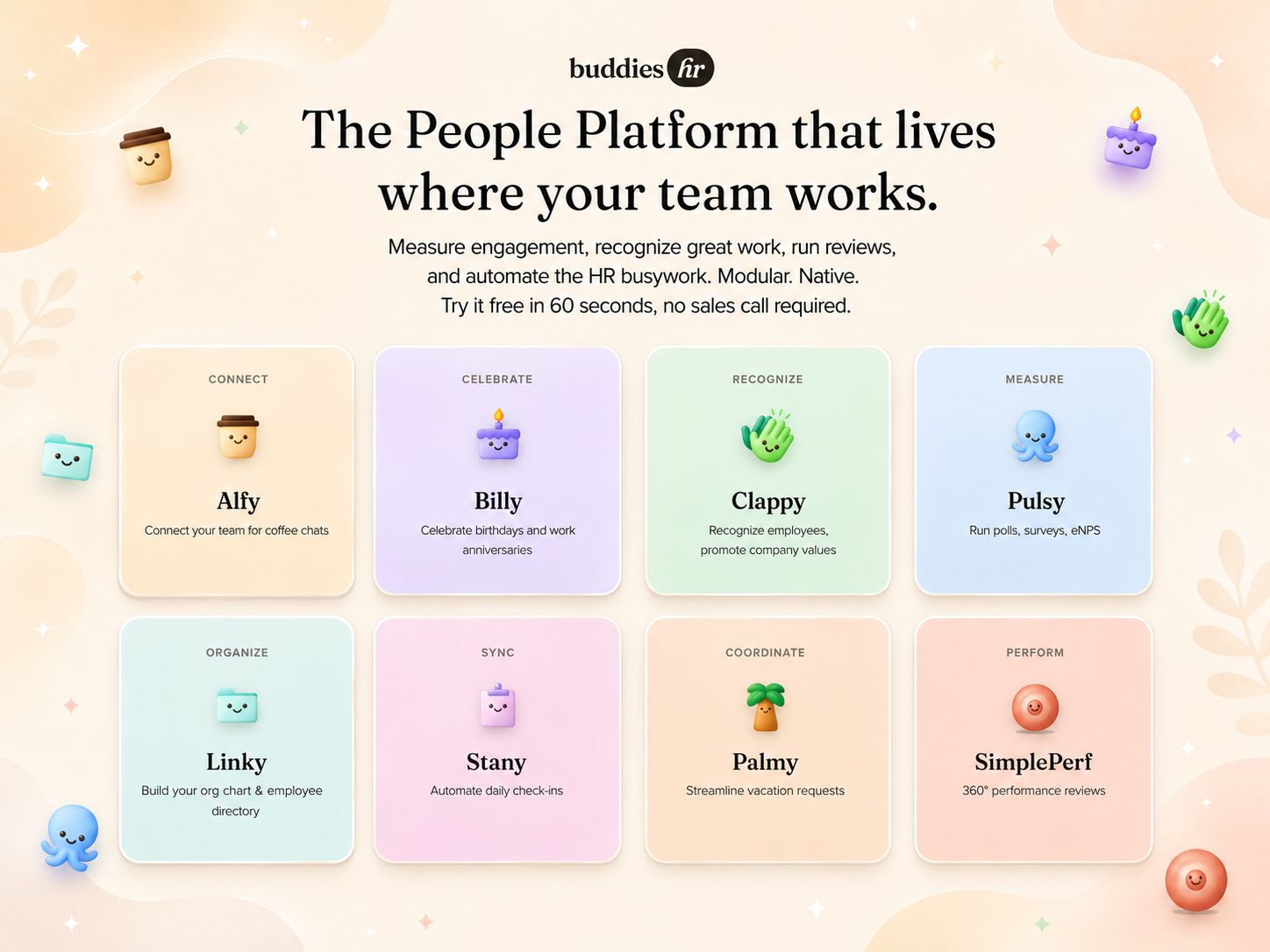
BuddiesHR lets teams celebrate birthdays, send kudos, run surveys, and manage PTO, all inside Slack and Microsoft Teams, making it an all-in-one people platform. The modular design means you can start with one app and expand as your needs grow. BuddiesHR is a suite of modular Slack apps designed to strengthen company culture and engagement without requiring separate logins or platforms, with each app focusing on a different area of team interaction, from recognition and surveys to birthdays and coffee chats.
In my experience, the platforms that stick are the ones that live where people already spend their day. BuddiesHR's insight is that forcing employees to open a separate browser tab is a tax on participation, and participation is the whole point of an engagement program.
The platform covers the full cultural operating system: connecting the team, making sure employees know company values, recognizing good work and contributions, celebrating wins and important dates, gathering feedback, monitoring employee satisfaction, and visualizing the organization structure.
By installing the Pulsy Survey Slack app from BuddiesHR, HR teams can send surveys to employees easily, with ready-to-go templates and easy setup for recurring surveys with automated reminders. That means eNPS, pulse surveys, and custom feedback forms appear directly in Slack, where people are already checking messages.
Pro tip: Use BuddiesHR's Alfy app to schedule random coffee chats between colleagues who would not otherwise interact. Research from Gallup and Workhuman found that employees who lack meaningful connections at work are up to nine times more likely to be disengaged, and automated coffee matching is one of the cheapest interventions available.
Pricing
BuddiesHR is $1 per employee per month for any one app, $2 for all seven culture apps, or $3 with Growy Perf reviews included, billed yearly (BuddiesHR pricing, checked November 26, 2026). It’s free for teams under 10 employees, and teams of 200 or more can ask for flat yearly enterprise pricing. That makes it, by a wide margin, the most accessible option in this comparison for small teams.
Pros:
- Runs natively inside Slack and Microsoft Teams, no new portal, no password resets
- Modular design lets you buy only what you need
- Covers celebrations, kudos, surveys, coffee chats, org chart, standups, and vacation tracking in one suite
- Free forever for teams under 10, then $1 per employee per month for Pulsy, billed yearly
- Every BuddiesHR module comes with a real web platform including dashboards, analytics, segmentation, templates, org chart, review cycles, and exportable reports
Cons:
- Requires Slack or Microsoft Teams, not suitable for organizations on other communication platforms
- Lighter on enterprise-grade analytics than Culture Amp or Leapsome
- Performance review module is newer and less feature-complete than dedicated review tools like Lattice
Best for: Any team already on Slack or Microsoft Teams that wants engagement to actually happen, not just be measured.
2. 15Five, best for manager-driven performance cultures
15Five has built its identity around a simple but powerful philosophy: engagement does not improve because you measured it once a year. It improves because managers and direct reports build a consistent rhythm of communication.
What makes it different
15Five is a performance management platform built around weekly check-ins, OKRs, and continuous feedback between managers and employees. Where Culture Amp excels at deep analytics on annual or quarterly surveys, 15Five replaces the survey cadence with an ongoing conversation layer. The Total Platform tier adds manager microlearnings on top of continuous performance management, weekly check-ins, continuous feedback, 1:1 agendas, and OKR alignment as an ongoing practice rather than an annual review cycle.
15Five is best for organizations that want to improve manager effectiveness and build more consistent employee-manager conversations. That is a meaningfully different problem than what Culture Amp primarily solves, and understanding that distinction will save you from buying the wrong tool.
I've found that check-in cadence only works if managers are genuinely bought in. 15Five's strength is its manager coaching layer, the platform actively teaches managers how to use the data they're seeing, not just how to run a survey.
Pro tip: If you buy 15Five, start with the Engage tier at $4/user/month before committing to Total Platform. Run a 90-day pilot to confirm that managers actually use weekly check-ins. The platform is only as valuable as the conversation habits it creates.
Pricing
15Five offers three pricing tiers: Engage ($4/user/month for engagement surveys only), Perform ($11/user/month for performance reviews and OKRs), and Total Platform ($16/user/month for the full suite including manager training). 15Five combines $4 to $16/user/month annual pricing with AI-powered manager coaching, differentiating from competitors' opaque enterprise models. Pricing is published and billed annually.
Pros:
- Transparent, published per-user pricing across all three tiers
- HR Outcomes Dashboard ties engagement to business metrics, which is category-unique at this price point
- Strong free trial available for evaluation
- Weekly check-in model drives regular manager-employee contact
- Well-suited to remote and hybrid teams building new communication habits
Cons:
- 15Five focuses on performance and engagement but does not include compensation planning, advanced calibration tools, or broader talent lifecycle management
- The most consistent criticism in user reviews is that the weekly check-in cadence can feel like busywork if managers do not actively engage with responses
- Analytics reporting is less robust than enterprise alternatives like Culture Amp or Qualtrics at the higher end
- Pricing is per user per month billed annually, with a minimum seat count that makes it most cost-effective for teams of 50+
Best for: Organizations prioritizing manager effectiveness and wanting a tool that builds consistent weekly habits rather than just running surveys.
3. Lattice, best for performance-led teams connecting reviews to engagement
Lattice is a performance management and engagement platform built for people teams that run real review cycles, goals, and surveys, typically at companies from 50 to 5,000 employees. If Culture Amp's core appeal for you is the connection between engagement data and performance outcomes, Lattice is the most direct like-for-like alternative.
What makes it different
Lattice is best for fast-growing teams managing performance and employee development. Its OKR management, cascading goal-setting, and engagement survey modules all sit in one connected system, which is the same value proposition as Culture Amp's Perform + Engage bundle, at a more transparent price point.
Lattice's engagement surveys measure key drivers of employee satisfaction and commitment, with the platform including pulse surveys, eNPS tracking, and custom survey builders.
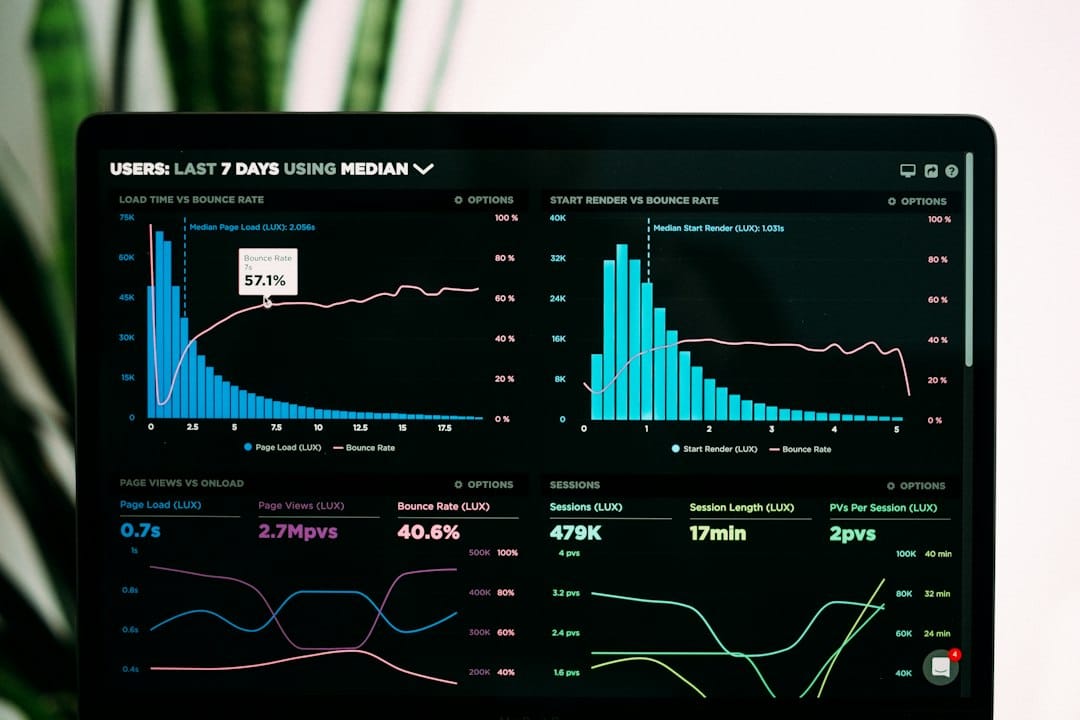
The practical difference between Lattice and Culture Amp comes down to depth versus breadth. Culture Amp goes deeper on engagement science, its benchmarks draw on data from over 6,000 organizations. Lattice goes broader on the people platform, reviews, goals, compensation, and engagement in one connected UI.
Pro tip: Lattice's $4,000 annual minimum means that for very small teams (under 30 people), the per-seat price is not the real constraint, the minimum contract is. Run your math against that floor, not the per-seat headline rate, before comparing it to BuddiesHR or 15Five.
Pricing
Lattice's pricing structure is fully modular. Per Lattice's official pricing page, the entry point is Goals and OKRs at $8/seat/month, Engagement at $4/seat/month, and Performance at $10/seat/month, with a bundled Foundations package at $13/seat/month. If you use Talent Management Engagement, Grow, and Compensation together, the price can reach $25 per employee per month.
Pros:
- Modular pricing, pay only for the features you need
- Strong OKR and goal-setting tools that sit alongside engagement data
- Published pricing, no forced sales conversation to get a number
- Strong fit for 100 to 2,000 employee tech companies wanting integrated reviews plus engagement plus career growth
- Large ecosystem of HRIS integrations including Workday, BambooHR, ADP, and Rippling
Cons:
- $4,000 annual minimum spend applies regardless of seat count
- In practice, the base price looks reasonable but total cost rises quickly once you add multiple modules
- Mobile app experience draws consistent criticism in user reviews
- Compensation module costs an additional $6/seat/month on top of base plans
Best for: Mid-market companies (50 to 2,000 employees) that want performance reviews, OKRs, and engagement measurement in a single connected system with published pricing.
4. Leapsome, best for globally distributed teams running multiple HR workflows
Leapsome is a people enablement platform that includes goals and OKRs alongside performance, engagement, and learning workflows. Of all the platforms in this list, it comes closest to being a full HR platform replacement, which makes it the most capable option and also the most complex to implement.
What makes it different
Leapsome is a strong fit for international workforces requiring deep localization and compliance. If your company operates across multiple countries and needs engagement, performance, learning, and compensation in one place, Leapsome is designed for exactly that stack. Leapsome is best for engagement combined with reviews and learning, a combination that neither Culture Amp nor 15Five handles natively.
Leapsome prices each module per employee per month, in euros: Engagement Surveys at €4, Performance Reviews at €7, Goals and OKRs at €4, Learning at €4, Compensation at €3, Time Tracking at €3, and Recruiting at €5 (checked November 26, 2026). That granularity means you can design a custom stack rather than paying for a bundle that includes features you do not need.
What actually works for global teams is the ability to run surveys, reviews, and learning paths in the same system where employees track their goals. Leapsome's integration of those workflows is tighter than most competitors.
Pro tip: Leapsome's Foundation HRIS tier is currently listed at $7 per employee per month, with a $0 offer available when you buy a Talent Suite module by December 31, 2026. If you are evaluating Leapsome now, that promotion dramatically changes the total cost calculation, confirm it directly on their pricing page before your quote expires.
Pricing
Leapsome’s pricing page lists per-module prices in euros and a 14-day free trial, and doesn’t state a minimum spend or term. Confirm both in your quote, because costs add up quickly once you stack several modules.
Pros:
- Deepest module library of any platform in this comparison
- Strong compliance and localization for multi-country teams
- Modular pricing, mix and match only the workflows you need
- Engagement, performance, learning, and compensation in one connected system
- Pricing is modular, meaning you can pick only the features your team actually needs, like performance reviews, engagement surveys, or goals
Cons:
- Several users say Leapsome can feel overwhelming or "too feature-heavy" for smaller teams
- Leapsome does not offer a native iOS or Android app, users must access via mobile browser
- Quote-based pricing means you cannot compare costs without a sales conversation
- Implementation is a substantial project, this is not a tool you set up in an afternoon
- Costs add up quickly once you stack several modules
Best for: Companies with 100+ employees operating across multiple countries that want to consolidate engagement, performance, learning, and compensation into one platform.
5. Workleap Officevibe, best for simple pulse surveys without enterprise complexity
Workleap Officevibe is an AI-powered employee engagement platform for small businesses, offering pulse surveys, anonymous feedback, performance reviews, goals, action plans, and peer recognition. It was one of the original lightweight engagement tools before being acquired by Workleap, and in some ways, that heritage is both its greatest strength and its current limitation.
What makes it different
Its automated weekly pulse surveys, anonymous feedback channel, and built-in recognition and goal tools deliver continuous engagement measurement. The interface is clean and the setup time is short. Team members can share their thoughts without fear through anonymous feedback, promoting honest communication that builds trust within the team.
The honest reality is that Officevibe's simplicity is exactly what many smaller teams need. Culture Amp's depth becomes a liability if you do not have a dedicated People Ops team to interpret the data and act on it. Officevibe gives managers clear, actionable signals without requiring an analyst.
That said, the 2026 pricing shift has created real tension. In early 2026, Workleap replaced per-seat pricing and the free tier with flat annual platform tiers: $4,999 Standard and $11,999 Pro. The $4,999/yr platform floor is now the top complaint, the affordable per-user Officevibe that small teams originally chose is gone.
If you are a 25-person team that previously paid $3.50/user/month, that change is significant. If you are a 150-person team, the flat-fee model may actually work in your favor compared to per-seat alternatives.

Pricing
Workleap Standard starts at $4,999 USD per year plus $32 per manager per month, billed annually. Workleap Pro starts at $11,999 USD per year plus the same $32 per manager per month, as captured in October 2026. Enterprise pricing is custom for organizations above 250 employees.
Pros:
- Clean, manager-friendly interface with a low learning curve
- Pulse surveys are quick, easy, and customizable to fit team-specific needs
- Anonymous feedback channel genuinely encourages honest responses
- Integrates with Slack and Microsoft Teams
- Flat-fee model is cost-effective for larger teams (150+ people)
Cons:
- Reporting and analytics are limited, unclear filtering and dashboards that cannot slice by tenure or location the way Culture Amp can
- Flat-fee model penalizes small teams: $4,999/year is expensive for a 20-person company
- Performance management features (reviews, competencies) are separate Workleap products at additional cost
- Loss of the original free tier removes an important entry point for budget-constrained teams
- Insights stop at surface sentiment, without the deeper diagnostic capability of Culture Amp or Leapsome
Best for: Mid-size teams (roughly 75 to 250 employees) that want automated pulse surveys and anonymous feedback without the complexity of a full people platform.
What engagement survey tools cost at 50 and 200 people
Every tool in this list prices differently: per seat with a minimum, per user, per module in euros, or a flat platform fee plus a per-manager charge. Here’s the survey and engagement piece of each, for a whole team, at list price, as of November 2026.
| Tool | 50 people, per year | 200 people, per year |
|---|---|---|
| Pulsy (BuddiesHR) | $600 | $2,400, or flat yearly enterprise pricing |
| Lattice Engagement | $4,000 (minimum applies) | $9,600 |
| 15Five Engage | $2,400 | $9,600 |
| Leapsome Engagement Surveys | €2,400 | €9,600 |
| Workleap Officevibe (Standard) | $4,999 plus $32 per manager per month | $4,999 plus $32 per manager per month |
| Culture Amp | Quote only | Quote only |
List prices from each vendor’s own pricing page, checked November 26, 2026: Pulsy $1 per employee per month billed yearly; Lattice Engagement $4 per seat per month billed annually, $4,000 minimum; 15Five Engage $4 per user per month billed annually; Leapsome Engagement Surveys €4 per employee per month; Workleap Standard $4,999 a year plus $32 per manager per month, billed annually. Product names are trademarks of their owners.
The gap is widest for small teams, where minimums and platform fees do most of the damage. A 50-person team pays Lattice’s $4,000 minimum for Engagement alone, and Workleap’s Standard platform fee before a single manager seat. Pulsy runs in Slack today. On Microsoft Teams it’s marked as coming soon, so check that before you plan a Teams rollout.
Engagement survey cost calculator
Yearly cost for your whole team at list price, checked November 26, 2026.
Leapsome prices in euros and is left out of the dollar comparison. Nothing you enter is sent anywhere.
Head-to-head comparison: Culture Amp vs. the five alternatives
| Platform | Best for | Starting price | Transparent pricing | Free plan | Slack/Teams native |
|---|---|---|---|---|---|
| BuddiesHR | Slack-native engagement | $1/employee/mo | Yes | Yes (under 10) | Yes |
| 15Five | Continuous performance and check-in culture | $4/user/mo | Yes | No (free trial) | Partial |
| Lattice | Performance + engagement, mid-market | $4/user/mo (Engagement) | Yes | No | No |
| Leapsome | Multi-module global teams | €4/employee/mo (Engagement) | Partial | No | No |
| Workleap Officevibe | Simple pulse surveys, mid-size teams | $4,999/yr flat | Yes | No | Yes |
| Culture Amp | Deep analytics, enterprise | ~$22K/yr median | No | No | No |
The clearest pattern here is that Culture Amp's opaque pricing and enterprise minimums starting at approximately $4,500 per year make it inaccessible for small teams or those wanting to trial the platform without a sales conversation. If that describes your situation, every alternative in this list offers a faster path to a working engagement program.
Common mistakes to avoid when switching platforms
Choosing on features instead of adoption
The most expensive mistake in HR tech is buying a platform that employees ignore. Engagement programs can turn into a 12% response rate when surveys live on a portal that employees have to remember to open. Before you sign a contract, ask yourself where your employees actually spend their day, and choose the platform closest to that environment.
Underestimating implementation time
Culture Amp's strength comes at a real cost, in dollars and in the weeks of setup and change management it takes to get full value from it. The same is true of Leapsome and, to a lesser extent, Lattice. If you need results within 30 days, a Slack-native tool like BuddiesHR or a lightweight pulse platform like Officevibe will serve you better than a full people platform that takes a quarter to roll out.
Pro tip: Always run a 30 to 60 day pilot with a subset of your team before committing to an annual contract. The platforms that offer free trials, 15Five, BuddiesHR, and Workleap Officevibe, give you the most flexibility to validate fit before you buy.
Buying more platform than you need
Culture Amp is best for companies with 200+ employees focused on building a strong culture. If you have 40 people and no dedicated HR analyst to interpret dashboard data, you will pay for capabilities you cannot act on. Match the platform's depth to your team's current ability to absorb and respond to data.
Pro tip: Start with the engagement module only, even if you plan to add performance management later. Getting employees accustomed to a feedback rhythm first makes the performance conversation much easier to introduce in year two.
Frequently asked questions
What is the main reason companies look for Culture Amp alternatives?
The most common driver is cost and pricing opacity. Culture Amp does not publish pricing, and all plans require a sales conversation, which is standard for enterprise HR tools but frustrating for smaller buyers. Additionally, Culture Amp's minimum seat requirements, typically 50 to 100 employees, price out smaller teams entirely. Teams also look for alternatives when they want lighter implementations, Slack or Teams integrations, or simpler interfaces that managers will actually use.
How much does Culture Amp actually cost in 2026?
Culture Amp does not list pricing on its own page; you need to request a quote. Third-party purchase data puts the median deal at about $22,180 a year, ranging from $7,700 to $57,793. Per-user estimates for Culture Amp range from $9 to $14 per month for a basic plan, and enterprise configurations go higher.
Is BuddiesHR a true Culture Amp alternative or just a recognition tool?
BuddiesHR is a full engagement platform that happens to live inside Slack and Microsoft Teams. It measures engagement, recognizes great work, runs reviews, and automates HR busywork. It covers surveys and eNPS, kudos and recognition, coffee chats, birthday and anniversary celebrations, standups, org chart, and vacation tracking. The key difference from Culture Amp is depth of analytics rather than breadth of features, BuddiesHR prioritizes participation and habit-building over enterprise-grade people analytics. For teams under 500 people, that trade-off almost always favors BuddiesHR.
Which Culture Amp alternative has the most transparent pricing?
15Five and BuddiesHR both publish their pricing clearly. 15Five offers transparent per-user pricing across all three tiers: $4, $11, and $16 per user per month, billed annually. BuddiesHR's pricing starts at $1 per employee per month with a free tier for small teams. Lattice also publishes its per-seat rates, though the $4,000 annual minimum adds a floor that changes the small-team math.
Can I use more than one of these tools at the same time?
Yes, and many teams do. A common pattern is to use BuddiesHR for day-to-day recognition, celebration, and pulse surveys inside Slack, and then layer a dedicated performance review tool on top for quarterly or annual cycles. The key is to avoid tool overlap in the same functional area, which creates survey fatigue and confusing reporting. Map your use cases clearly before adding a second platform.
How do I evaluate whether an engagement platform will actually be used?
Look for three things: where the tool lives (portal vs. embedded in existing apps), how employees are prompted to participate (email reminders vs. in-app nudges), and how long a typical interaction takes. Since 2020, the U.S. workforce has 8 million fewer engaged employees, and that number continues to slide. Participation rate is a leading indicator of whether your platform is working. If your survey response rate is below 60%, the tool is part of the problem, not the solution.
The bottom line
Culture Amp earns its reputation for research-backed surveys and enterprise analytics. Its surveys are designed by organizational psychologists and validated against data from over 6,000 organizations. For a 1,000-person company with a mature People Ops function and the budget to match, it may still be the right choice.
But for most teams reading this article, the tradeoffs land differently. The platform you need is the one employees will open without being nagged, that managers will act on without needing an analyst, and that fits a budget you can defend in a quarterly review.
BuddiesHR earns the top spot here because it eliminates the single biggest failure mode in engagement programs: nobody opens the platform. By living natively inside Slack, with Microsoft Teams rolling out app by app, it removes the portal login barrier and lets engagement happen in the channels employees already check every hour. The free tier for teams under 10 and the $1 per employee per month entry point make it the easiest place to start, and often the easiest place to stay.
If your priority is manager-led continuous performance, 15Five is the strongest specialist. If you need performance reviews connected to engagement at a mid-market scale, Lattice is the most capable published-pricing alternative. If you are running a global organization and want one platform for the entire HR stack, Leapsome is built for exactly that. And if you want the simplest possible pulse survey without enterprise complexity, Workleap Officevibe delivers that for teams of 75 or more.
The worst outcome is spending two months evaluating platforms and signing a contract with a tool your team ignores by month three. Pick the platform that matches your team's current size, communication tools, and HR capacity, then revisit the decision when those things change.
Sources
- State of the Global Workplace 2026, Gallup. Global employee engagement benchmarks and economic cost of disengagement. https://www.gallup.com/workplace/697904/state-of-the-global-workplace-global-data.aspx
- Employee Engagement Falls to Lowest Level in 15 Years, Gallup. Q3 2026 U.S. engagement data showing 29% engagement rate. https://www.gallup.com/workplace/716117/employee-engagement-below-30-first-time-years.aspx
- Employee Engagement Remains Flat as AI Adoption Accelerates, Gallup. First-half 2026 U.S. engagement data. https://www.gallup.com/workplace/712433/employee-engagement-remains-flat-adoption-accelerates.aspx
- Employee Engagement Statistics: 2026 Benchmarks and Costs, Workhuman. Compiled Gallup benchmark data and cost analysis. https://www.workhuman.com/blog/employee-engagement-statistics/
- Culture Amp Review 2026: Real Pricing, Pros, Cons and Alternatives, ThriveSparrow. Third-party pricing and feature analysis. https://www.thrivesparrow.com/blog/culture-amp-review
- Culture Amp Pricing 2026: Plans, Hidden Costs and Alternatives, FeedbackPulse. Pricing comparison and customer cost analysis. https://feedbackpulse.com/resources/culture-amp-pricing
- Culture Amp Review (2026): Pricing, Features and Honest Verdict, MakerStack. Independent pricing and feature review. https://makerstack.co/reviews/culture-amp-review/
- BuddiesHR, Official Website, BuddiesHR. Product features, pricing, and use cases. https://buddieshr.com
- Measure Engagement in Slack, BuddiesHR. Pulsy survey app documentation. https://buddieshr.com/use-cases/measure-engagement
- BuddiesHR Review 2026, Research.com. Independent feature and pricing review. https://research.com/software/reviews/buddieshr
- 15Five Pricing 2026, StackScored. Verified pricing tiers and add-on cost analysis. https://www.stackscored.com/pricing/employee-engagement/15five/
- 15Five Review 2026: Is It Worth It?, WorkTech Desk. Pricing, features, and competitive analysis. https://www.worktechdesk.com/blog/15five-review-2026/
- Lattice Pricing Tiers and Costs (Updated for 2026), People Managing People. Official pricing breakdown by module. https://peoplemanagingpeople.com/tools/lattice-pricing/
- Lattice Review 2026: Features, Pros, Cons, and Alternatives, HeartCount. Independent pricing and feature analysis. https://heartcount.com/blog/lattice-review/
- Leapsome Pricing 2026: Module Costs by Team Size, FeedbackPulse. Module-by-module pricing with worked examples. https://feedbackpulse.com/resources/leapsome-pricing
- Leapsome Review 2026: Performance Management, HRIS, Pricing, Pros, and Cons, HR.software. Expert review with pricing benchmarks. https://www.hr.software/reviews/leapsome
- Workleap (Officevibe) Pricing 2026: Plans, Per-Manager Fees and Alternatives, FeedbackPulse. Official pricing with per-manager fee breakdown. https://feedbackpulse.com/resources/workleap-pricing
- Officevibe Reviews (2026): Is It Worth It?, TeamPredict AI. User review compilation and pricing change analysis. https://www.teampredict.ai/officevibe-reviews
- Employee Engagement Software Pricing: 12 Vendors (2026), FeedbackPulse. Cross-vendor pricing comparison with worked examples. https://feedbackpulse.com/resources/employee-engagement-software-pricing
- 8 Best Culture Amp Alternatives in 2026, Small Improvements. Use-case-based alternative rankings. https://www.small-improvements.com/blog/8-best-culture-amp-alternatives/