360 feedback questions: 37 examples
360 feedback questions for peers, direct reports, managers and self reviews, and why five per form beats 40. Includes a free form builder.

Most lists of 360 feedback questions hand you 50 or 100 options. Put even 20 of them on a form and every rater answers all 20, for every person they review, in the same week. These 37 questions are sorted by who's answering (peers, direct reports, managers and the person themselves), and the advice is to pick five per form. Fewer questions, more people answering them.
Below: why long 360 forms backfire, the arithmetic nobody does before launching a cycle, a builder that gives you five questions per rater type and counts the load, the questions themselves, and how to write rating questions that measure the person being reviewed rather than the person filling in the form.
Why most lists of 360 feedback questions are too long
Ask the vendors how long a 360 form should be and you'll get four answers. Lattice suggests seven to 10 questions per review (Lattice). PerformYard says as few as two and as many as six (PerformYard). Qualtrics says not to go past 30 to 40 (Qualtrics). Then most of them publish 50 to 100 questions underneath that advice.
The disagreement goes away once you stop thinking about one form. A 360 isn't one survey. It's the same form filled in by several people, about several people, at the same time. That's what makes it worth running, and it's also what makes a long form collapse.
It's worth getting the form right, because feedback isn't automatically good for people. In a classic review of the research, Avraham Kluger and Angelo DeNisi looked at 607 effect sizes and found feedback improved performance on average, but over 1/3 of the feedback interventions they studied made performance worse (Kluger and DeNisi, Psychological Bulletin, 1996). Vague, rushed answers from tired raters are a good way to land in that third.
Every question is multiplied
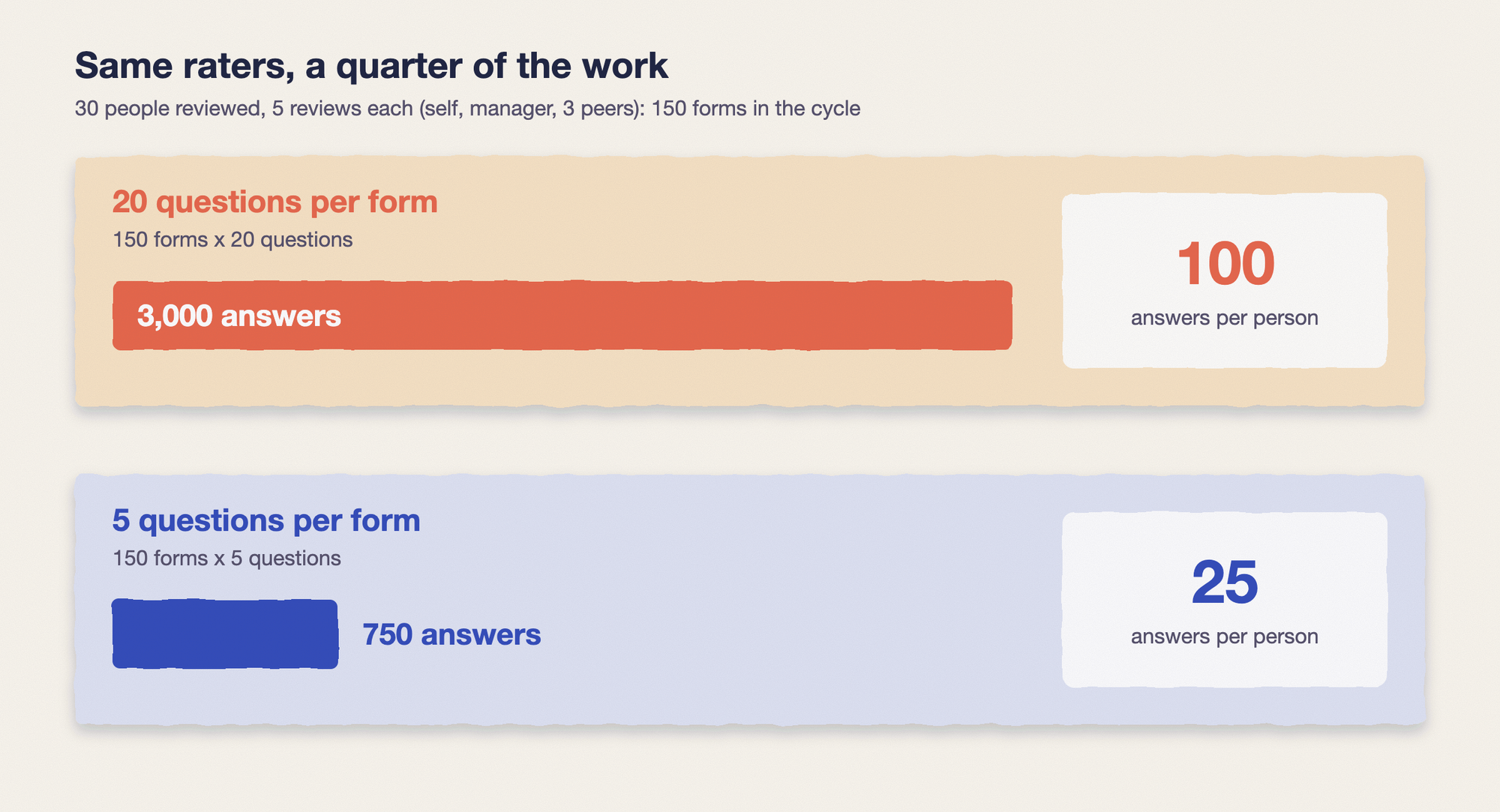
Here's the sum to do before you launch. Take a 30-person team where everyone gets a 360: a self review, a manager review and three peer reviews each. That's five forms per person, so 150 forms in the cycle. With 20 questions per form, the company is being asked for 3,000 answers in two weeks, and the average person writes five reviews (their own plus four about colleagues), which is 100 answers each. Cut the form to five questions and it's 750 answers, 25 each.
The tempting fix is to cut raters instead. That's the wrong lever. The point of a 360 is that several people's views average out into something more reliable than one manager's opinion. Psychologist Kenneth Nowack told the APA's Monitor on Psychology that eight to 10 raters maximizes reliability, and that two or three people isn't enough for a full perspective (APA Monitor, 2012). On a small team you won't always reach eight. You can still keep every rater you have and cut the form.
Build your 360 form
Pick who's answering, set the size of your cycle, and you'll get five questions for that form plus the total load the cycle puts on your team. Shuffle until the five feel right, then paste them into whatever runs your reviews.
360 form builder
Who's filling in this form?
Your five questions
How big is the cycle?
Assumes everyone reviewed is also a reviewer, so the writing is shared evenly. Nothing you enter is sent anywhere.
360 feedback questions for peers
Peers see the day-to-day work a manager misses: the handoffs, the help, the meetings that went sideways. Ask about those moments, not about general qualities. Every question below can be answered with an example, which is the test for a good peer question.
- What's one thing they did this period that made your work easier?
- Think of a project you worked on together. What did they do that you'd want them to keep doing?
- When did you last go to them for help, and how did it go?
- What's one thing they could do differently that would help you most?
- Think of a disagreement you were both part of. How did they handle it?
- When they hand work over to you, what do you usually have to chase or fix?
- What are they good at that the team doesn't use enough?
- If you were starting a hard project tomorrow, would you want them on it? Why?
360 feedback questions for direct reports reviewing their manager
Upward feedback is the part of a 360 people are most nervous about, so keep it concrete and keep it short. These questions ask what the manager did, not what kind of leader they are, which makes them easier to answer honestly and easier to act on.
- What's one thing your manager did this period that helped you do your best work?
- When you were stuck, how quickly could you get a decision or an answer from them?
- How clear are you on what's expected of you right now? What made it clear or unclear?
- What's one thing they should start doing?
- What's one thing they should stop doing?
- When did you last get useful feedback from them, and what was it about?
- How comfortable do you feel raising a problem with them? What makes it easier or harder?
- What do they do in your 1:1s that you'd like more of?
If the answers to the last two worry you, the fix usually starts in the 1:1 itself. Our one-on-one meeting questions are sorted by what the meeting is for.
360 feedback questions for managers
The manager review is the one most likely to drift into a summary of the last two weeks. Ask for contributions across the whole period, and ask the manager to look at their own part in the result too.
- What were their two most important contributions this period?
- Where did they grow most since the last review? Give one example.
- What's one thing that would make the biggest difference to their work next period?
- What did you see them do that goes beyond what the role asks for?
- Where did you have to step in, and why?
- What support do they need from you that they aren't getting?
- What should they be able to do in six months that they can't do today?
- Are they ready for more scope? What have you seen that tells you so?
The last question is one you may want to keep private from the person reviewed. More on that below.
Self review questions for a 360
The self review works best when it's written before the person reads anything anyone else said. It gives the manager a view of what the person thinks mattered, which is often not the same list.
- What are you most proud of this period, and what was your part in it?
- If you could redo one project, what would you do differently?
- Where did you get stuck, and what got you unstuck?
- Which skill improved most, and how do you know?
- What feedback did you get this period that changed how you work?
- What do you want to be doing more of next period?
- What do you need from your manager or the team to get there?
- What did you do that you think nobody noticed?
If people struggle to put their answers into words, our list of performance review phrases gives them somewhere to start.
Ask what they saw, not what they think
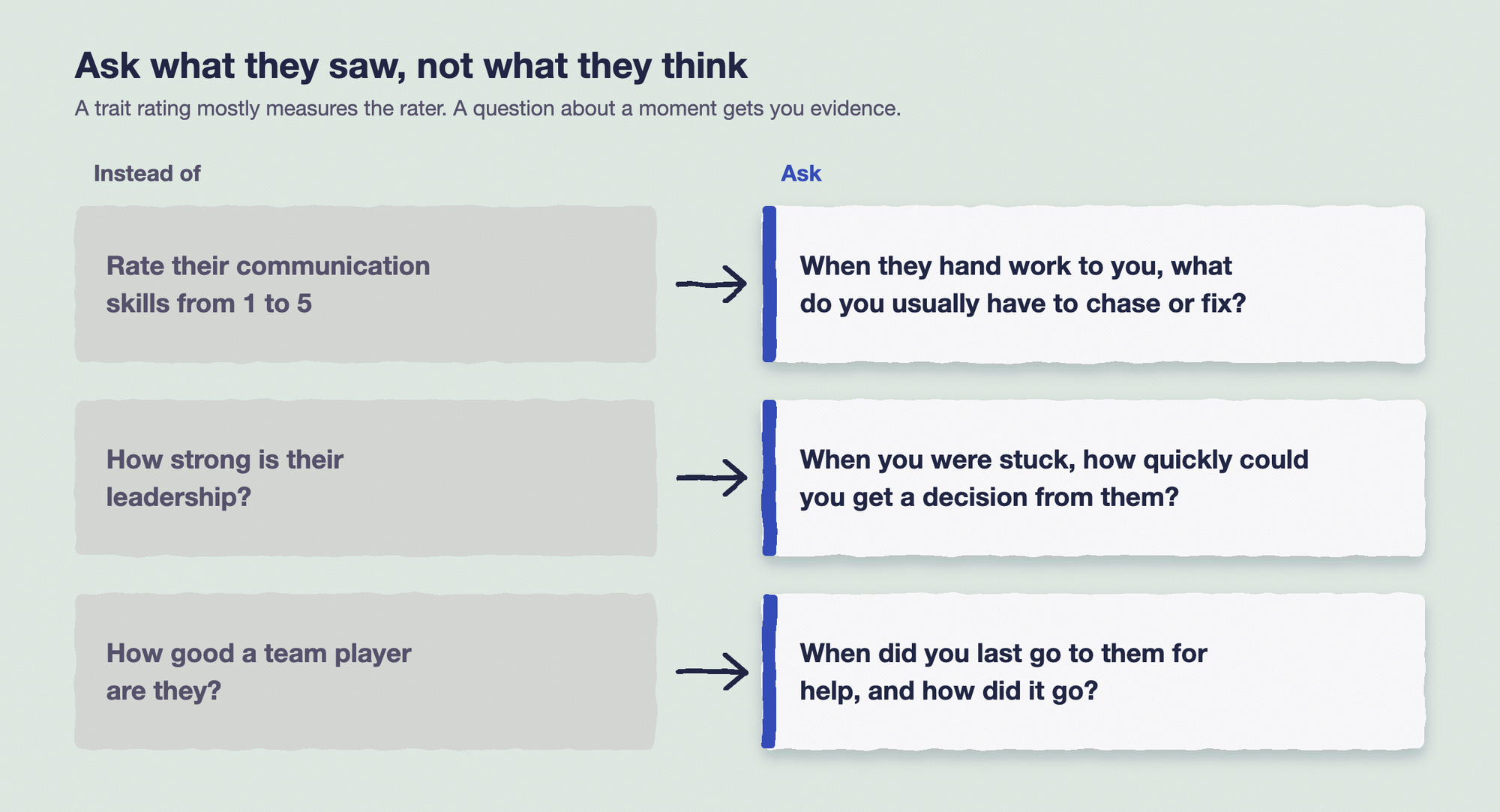
Most 360 templates are full of rating questions like "Rate their communication skills from 1 to 5." The trouble is what that number measures. In a study of two samples of managers (2,350 and 2,142 people), each rated by seven raters, Scullen, Mount and Goff found that idiosyncratic rater effects accounted for 62% and 53% of the variance in the ratings. The performance of the person being rated accounted for 21% and 25% (Scullen, Mount and Goff, Journal of Applied Psychology, 2000). In plain terms, a rating says more about the person giving it than about the person getting it.
Marcus Buckingham and Ashley Goodall built their HBR piece "The Feedback Fallacy" on the same finding: more than half of your rating of someone else reflects your characteristics, not theirs. Their alternative is to share your own reaction instead of judging someone's abilities (Buckingham and Goodall, HBR, 2019). People are unreliable judges of other people's traits. They're much better witnesses of what happened in front of them and how it affected their own work.
So rewrite trait questions as observation questions. It's the single change that most improves a 360 form.
Rating questions worth keeping
Rating questions still earn a place: they're quick, and they let you compare across a team. Keep two or three, and write them about how often something happened or about the rater's own experience. Always give a "haven't seen enough to say" option, so nobody has to invent a number about work they never saw.
- How often do they deliver what they said they would, by when they said? (Rarely, sometimes, usually, almost always, haven't seen enough to say)
- When you needed help from them, how often did you get it?
- How often does work they hand over need rework before you can use it?
- I know what they're working on without having to ask. (Strongly disagree to strongly agree)
- I'd want to work with them again on a hard project. (Strongly disagree to strongly agree)
The last one is the Buckingham and Goodall move in a single line. It doesn't ask the rater to judge anyone. It asks about the rater's own reaction, which is the one thing they know for certain.
Named or anonymous 360 feedback
Most guides treat anonymity as a given. On a small team that's often a polite fiction. If someone has two direct reports, both of them know who wrote the upward review, and so does the manager. Promising anonymity you can't deliver is worse than not promising it.
Questions about specific moments hold up well with a name attached, because they ask for something the rater saw rather than a verdict on someone. Where a question really does need protection, protect that question rather than the whole review. Promotion readiness is the usual one. For feedback that truly has to be anonymous, a separate anonymous employee survey run across the whole team is a better tool than a 360 with three raters.
Run the 360 without turning it into a project
A 360 shouldn't need a quarter of planning, and it shouldn't need a per-seat performance suite priced for features you'll mostly never open. Growy Perf is its own module, so you pay for reviews and nothing else. Here's how the cycle runs in Growy Perf, our review app, according to its help center:
- Four review types. Self, peer, upward and manager reviews, in any mix. Each form comes pre-filled with suggested questions you can cut down to your five, and you can add open-ended, rating or multiple choice questions.
- A sensible rater count. You pick each person's manager, peers and reports. The help center's own advice is to keep peer reviews to two or three peers per person, which keeps the peer load in check while the manager, upward and self reviews round out the picture.
- Private questions, not a private review. Reviewees see who wrote each review, and any single question can be set to "Hide answers from the reviewee". Their manager and admins can still read it.
- Reminders that do the chasing. By email or in Slack, at half time, at three quarters and one day before the deadline. People who've finished get nothing.
- Managers can go last. An option holds the manager review until the self, peer and upward reviews are in, and reviews can be held until the manager releases them, for example after a 1:1.
- Help with the writing. An AI coach suggests how to make an answer more specific, and suggests clearer wording for questions while you build the form.
Reviews open in a web app, with notifications in Slack. You can run a test cycle on yourself first to see exactly what your team will get. When the cycle ends, follow up: Nowack's line to the APA was that "follow-up is everything," and a 360 that ends in a PDF nobody discusses is how you end up in Kluger and DeNisi's third.
One thing that makes peer answers better: give raters something to look back at. Roo, a fully remote veterinary marketplace that grew from 40 to 120+ employees in 12 months, runs its kudos channel, #roohoo, through BuddiesHR in Slack (Roo case study). A channel like that is a year of small, specific moments, written down at the time, which is exactly what a peer needs before answering "what did they do that made your work easier?"
1,000+ HR teams use BuddiesHR and it holds a 4.8/5 rating on G2 (our own figures). Start Growy Perf free: it's free under 10 employees, each app has a 30-day trial, and the pricing page has the current structure. For the wider case for running 360s, see our guide to 360-degree feedback, the pros and cons of the 360 review process, and our take on performance review software for small companies.
FAQ
How many questions should a 360 feedback form have?
Five per form is our rule of thumb, and it isn't research. Vendor advice ranges from two to six (PerformYard) to seven to 10 (Lattice). What matters is the total: every question is answered once per rater per person reviewed, so a 30-person cycle with five reviews each turns 20 questions into 3,000 answers.
How many raters should a 360 review have?
As many as you can get without overloading anyone. Psychologist Kenneth Nowack told the APA's Monitor on Psychology that eight to 10 raters maximizes reliability and two or three isn't enough for a full perspective. On a small team, a self review, a manager review, two or three peers and any direct reports is a realistic set. Cut questions before you cut raters.
What are good 360 feedback questions for peers?
Questions that can be answered with an example. "What's one thing they did this period that made your work easier?" works. "Rate their teamwork" doesn't, because most of a rating reflects the rater, according to Scullen, Mount and Goff's study of more than 4,000 managers.
Should 360 feedback be anonymous?
Only if you can actually keep it anonymous. With two or three raters per group, people can usually guess who wrote what. Write questions about specific moments that work with a name attached, and protect individual sensitive questions, such as promotion readiness, rather than the whole review.