Employee engagement survey: set 3 numbers before you send
An employee engagement survey needs three numbers set before you send: target response rate, smallest reportable group and days to a visible change.

An employee engagement survey is easy to send and hard to learn from. Writing the questions takes an afternoon. What decides whether the results mean anything is settled earlier: how many people will answer, how small a team you're willing to report on, and how soon something visibly changes afterwards. Gallup puts global employee engagement at 20% in 2025, down from 23% in 2022 and 2023 (Gallup, State of the Global Workplace). That's the backdrop. Your own number is the one you can act on.
This guide covers what the survey is, how often to run it and the three numbers to set before you send. Then it covers why people don't answer, what to do with the results and how to keep the whole thing from becoming a yearly ritual. There's a free planner in the middle that turns your headcount and launch date into a calendar.
What an employee engagement survey is
It's a set of questions sent to everyone in the company to measure how connected and motivated people are, and what's getting in the way. The score matters less than the pattern: which themes are weak, whether teams differ, and whether the number moves between rounds. If you want the questions themselves, they live in our employee engagement survey questions guide. This page is about everything around them.
Annual, twice a year or pulse: choosing a cadence
Gallup recommends semiannual engagement surveys for deeper analysis, with quarterly or monthly pulse surveys in between to track progress (Gallup, Employee Surveys). Most small companies start with one full survey a year, and that's fine. The rule of thumb is ours, not research: don't add a second round until you've acted on the first one. Asking again before anything has changed teaches people that answering is pointless.
When you do add the short version, read why a pulse survey gets fewer answers than the annual one first. It has the same problem in a sharper form.
Set three numbers before you send
Most guides start with the questions. Start with three numbers instead. Once they're written down, you can't talk yourself into a flattering reading of the results afterwards.
1. Your target response rate
Simpplr, a vendor, says engagement surveys typically land between 60% and 80% participation and treats anything below 50% as a red flag. It doesn't state a sample for those ranges, so use them as a rough guide (Simpplr, survey benchmarks). Pick a target and write it down. Then decide in advance that a response rate under 50% is a delivery problem to fix, not a finding about morale. If half the company didn't answer, you haven't measured the company.
2. The smallest group you'll report on
Gallup says results should be aggregated until a minimum number of responses is reached, for example five or more, to protect people's anonymity. The arithmetic matters for a small company: divide five by your response rate. At 70%, a team needs about eight people before its result can be shown on its own. Pulsy applies the same floor, keeping groups under five private in its breakdowns.
3. Days to the first visible change
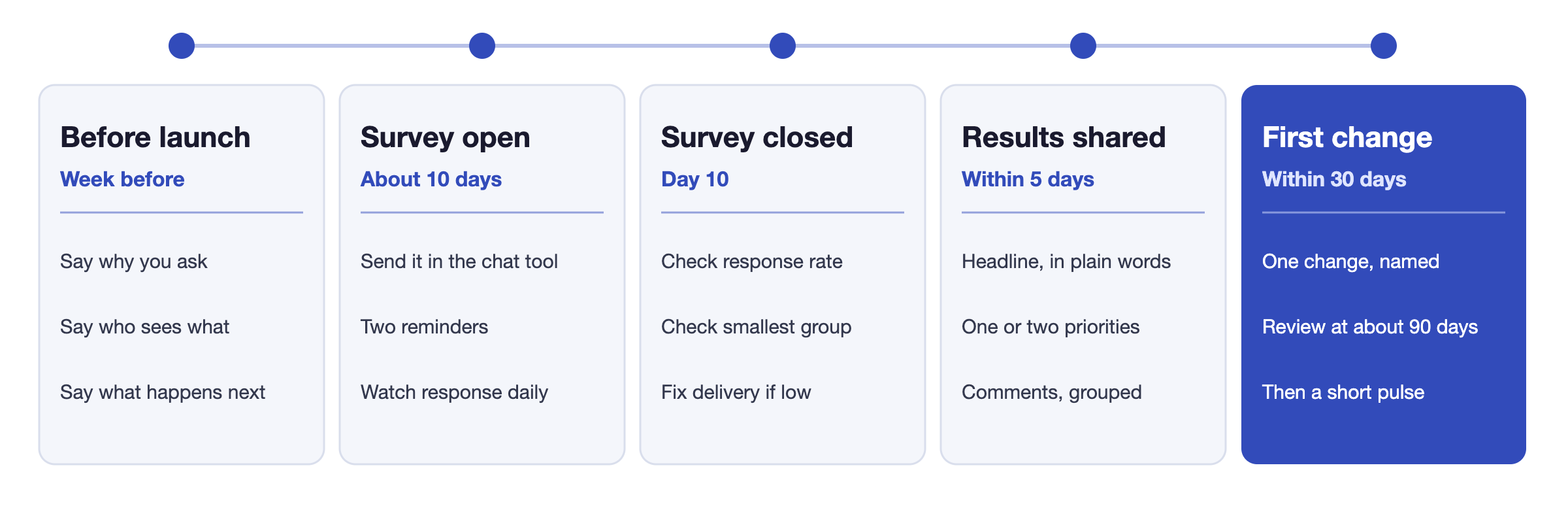
Homebase, which publishes a guide on running these surveys, advises aiming for at least one visible change within 30 days and reviewing progress around 90 days (Homebase, employee engagement survey guide). We'd take the same clock and start it on the day you share the results. Gallup adds that analysis should happen within days or weeks, while the feedback still feels current.
Here's the calendar those three numbers produce. The dates are our suggested schedule, so move any of them to fit your company.
Plan your survey before you send it
Enter your headcount, the response rate you're aiming for and your launch date. Nothing is sent anywhere.
Engagement survey planner
Change any input and the results update.
Answers you need to hit your target
42
The range is a rough 95% interval for a percent-favourable result near 50%, the widest case, with a correction for surveying a small fixed group. It assumes the people who didn't answer feel like the people who did. Results are shared five days after closing, the first change lands 30 days after that and the review 90 days after sharing. That schedule is ours, adapted from published guidance, so adjust it.
With the defaults, 60 people at a 70% response rate give you 42 answers, a rough range of plus or minus 8 points on a result near 50%, and a smallest reportable team of eight. That arithmetic is ours and it's deliberately rough. It's there to stop you reading a three-point move as news.
Why people don't answer
The usual advice is to keep the survey short. It's not wrong, but it isn't the main lever. Lattice reports that its surveys with 50 to 59 questions averaged an 84% response rate, which is the opposite of what the short-survey advice predicts (Lattice, engagement survey guide). It's one vendor's data, so don't build a policy on it. It does suggest that length isn't what decides participation. Two things seem to matter more.
Friction at the door
An email with a link, a new tab, a sign-in, then the questions: every one of those steps loses someone who was willing to answer at the start. That's portal fatigue: the people who skip it aren't apathetic, they just never got as far as question one. A survey delivered as a message in Slack or Microsoft Teams, answered in the thread, removes most of the steps. Pulsy works that way, and its smart notifications and reminders drive an 80%+ response rate. That figure is BuddiesHR's own product data, not independent research.
Trust in who sees the answers
Gallup is blunt that perceived anonymity matters: employees need to trust the process, not just the promise. Say before people answer whether the survey is anonymous, what the smallest reported group is, and who sees the comments. In Pulsy the anonymity setting is chosen per survey and employees see it before they answer. For the deeper version of this argument, see psychological safety at work.
Reading the results without over-reading them
Start with the whole-company number and the weakest theme, not the best-looking team. Then look at the comments, which are usually more useful than the scores in a small company. If you include a single recommend question, our eNPS guide explains why one person can swing a small team's score.
Resist the urge to rank teams. In a 60-person company, a team of six with five answers is one bad week away from a different result. Use team cuts to start a conversation, not to settle one.
After the survey: one change in 30 days
Gallup says managers account for 70% of the variance in team engagement, which is why they need to see their own results and have room to act on them. It also warns that leaders who run a survey and take no action are likely to see engagement fall and turnover rise. Perceptyx, another vendor, reports that 74% of organisations that acted after a survey saw engagement improve, against 8% of those that didn't (Perceptyx, What is an employee pulse survey, 8 January 2026). Neither vendor says how they measured it, so read both as direction. The mechanism is easy to see though: people answer the next survey if the last one did something.
So make it small and make it owned. One company-level priority that someone senior names in public. One change per team that its manager picks. A message to everyone saying what's changing, and what isn't, and why.
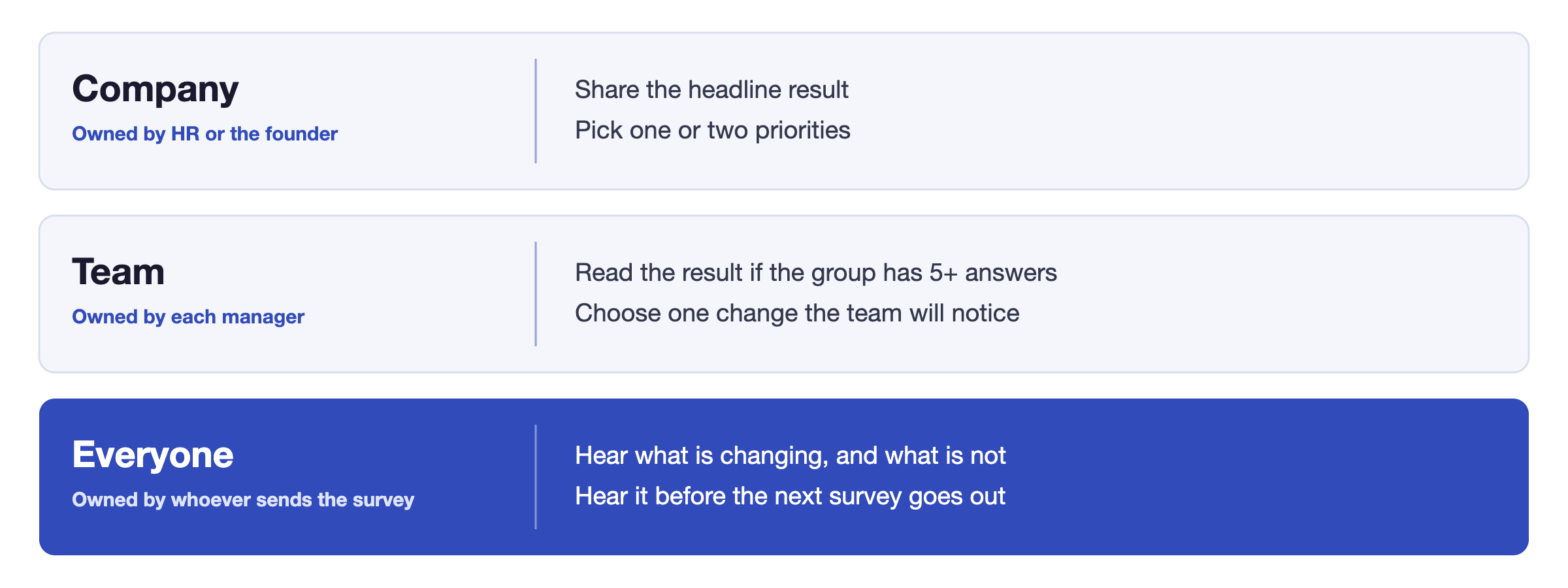
The last step is the one that gets skipped. Say what you're not going to change as well. Silence on a theme reads as a no, and a plain no is better received than silence.
Running the survey in Slack or Teams
You can run an engagement survey in a form tool with an email blast, and plenty of teams do. It works until the next round, when whoever owns it has moved on and the results are sitting in a spreadsheet. Pulsy sends surveys as a Slack or Microsoft Teams message, collects answers in the thread and shows results in a web dashboard with segmentation and exports. It includes a question bank and pre-built templates, and it's free under 10 employees. 1,000+ HR teams use BuddiesHR, which has a 4.8/5 rating on G2.
Install Pulsy free and send your first survey this week. The measuring engagement page has the use-case view, how to create a survey in Slack has the step-by-step, and if you doubt people will answer honestly at all, how to measure employee engagement without surveys covers the signals that don't depend on one.
FAQ
How often should you run an employee engagement survey?
Gallup recommends semiannual engagement surveys with quarterly or monthly pulses in between. A small company can reasonably start with one a year. Don't add a second round until you've acted on the first.
What is a good response rate for an employee engagement survey?
Simpplr puts typical engagement survey participation at 60% to 80% and treats under 50% as a warning sign, though it doesn't state a sample. Below 50%, fix delivery and trust before you interpret the scores.
Should an employee engagement survey be anonymous?
Usually, and people should see the setting before they answer. Gallup advises reporting only when a minimum number of responses is reached, for example five or more, so a small group can't point to one person.
What should you do after an employee engagement survey?
Share the headline within days, pick one or two priorities, let each manager choose one change, and tell people what's changing before the next survey. Aim for one visible change within 30 days and a review at about 90.