eNPS: why one detractor swings a small team's score
What eNPS is, how to calculate it, and why a small team should read the score as a range. Includes a free calculator with margin of error.

eNPS is the shortest survey you can run: one question, one number, a few minutes of everyone's time. That's why every HR team ends up trying it, and why so many get a score they can't interpret. A drop from +25 to +15 sounds like a morale problem. On a 20-person team it's often one person having a bad week.
This guide covers the parts every eNPS explainer covers, what it is, how to calculate it and what a good score looks like. Then it covers the part they skip: what the score means when your team is small, and what to do about it. There's a free calculator in the middle that shows the range your number really sits in.
What eNPS is
eNPS stands for employee net promoter score. It borrows the question from the customer version of the metric, which Frederick Reichheld introduced in The One Number You Need to Grow (Harvard Business Review, December 2003): would you recommend this company to a friend? For employees, the question becomes "On a scale of 0 to 10, how likely are you to recommend us as a place to work?"
Answers fall into three buckets:
- Promoters answer 9 or 10.
- Passives answer 7 or 8. They count in the total number of responses but not in the score.
- Detractors answer 0 to 6.
The score runs from -100 (everyone is a detractor) to +100 (everyone is a promoter). Most teams add one open follow-up, "What's the main reason for your score?", because the number tells you that something moved and the comments tell you what.
How to calculate eNPS
Subtract the percentage of detractors from the percentage of promoters. Ignore the percent sign when you report it.
Say 20 people answer. Nine are promoters, seven are passives and four are detractors. That's 45% promoters and 20% detractors, so your eNPS is +25. The seven passives don't appear in the formula, but they still sit in the denominator, which is why a team full of "7s and 8s" scores near zero even though nobody is unhappy.
eNPS calculator with a margin of error
Enter how many people gave each kind of answer, and your headcount. Nothing is sent anywhere.
Your eNPS
+25
The range is a rough 95% interval with a correction for asking a small, fixed group. It assumes the people who didn't answer feel like the people who did, which is the part a low response rate breaks.
What a good eNPS score is
You'll find a table of bands on every competing page, and they don't agree. Lattice calls +30 to +50 strong and anything over +50 exceptional (Lattice). Personio treats 30 as the minimum standard for a successful eNPS (Personio). HiBob calls 30 to 50 above average, and its own page says benchmarks vary widely across industries without naming a source for its bands (HiBob). These are editorial bands, not measurements.
The honest answer is that the best benchmark is your own previous score, collected the same way, from a similar share of the team. A +20 that used to be +5 is better news than a +40 you've never been able to repeat.
One more correction while we're here. Some eNPS explainers attach Gallup's absenteeism, turnover and profitability numbers to "eNPS above 50". Gallup's figures compare business units in the top and bottom quartile of employee engagement: 78% less absenteeism, 21% less turnover in high-turnover organisations, 51% less in low-turnover ones and 23% higher profitability.
That's Gallup's engagement research, and the page doesn't mention eNPS at all. eNPS can be a useful signal. It hasn't earned those numbers.
Why one answer can swing a small team's score
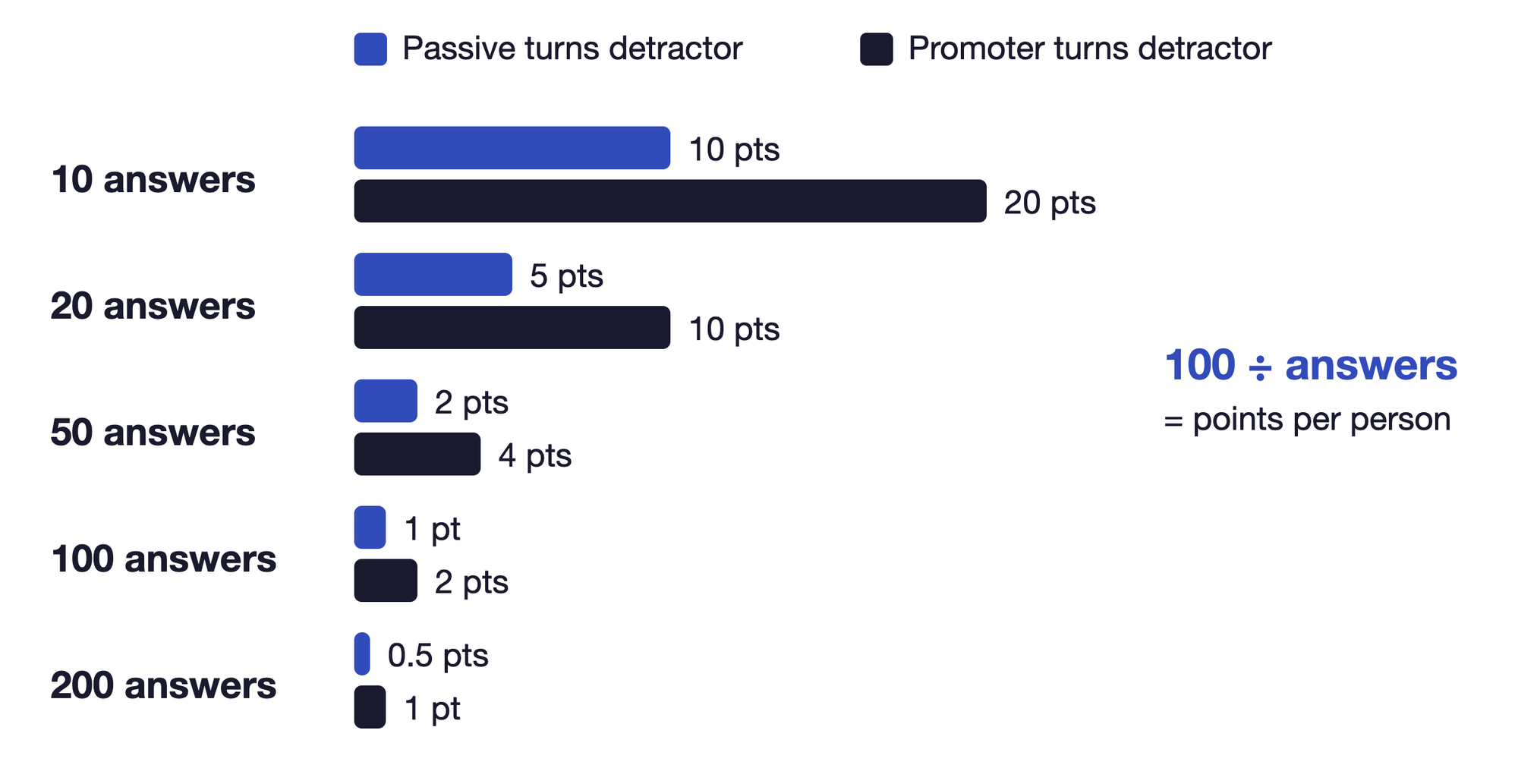
Here's what the glossaries leave out. Every respondent carries a fixed share of the score, and that share is 100 divided by the number of people who answered. With 200 answers, one person moving from passive to detractor shifts your eNPS by half a point. With 20 answers, the same move is worth five. A promoter turning into a detractor is worth double that.
Take the earlier example, nine promoters, seven passives and four detractors, +25. If one passive has a rough Thursday and scores a 6 next time, you're at +20. If one promoter does it, you're at +15. Nothing about the team changed. In both cases someone changed a number by a notch or two.
Headcount moves the meaning of the score as well. Roo, a fully remote team, grew from 40 people to more than 120 in twelve months. If everyone answers, a single response was worth 2.5 points at the start and under one point by the end. Compare a score from the first year with one from the second and you're comparing two different instruments.
This is also why splitting a small company's score by team backfires. A 50-person company cut into five teams gives you groups of ten, and some of those groups will have six answers. Segmentation is a real feature for larger organisations. Below a handful of responses it mostly produces anecdotes with a percent sign on them. Pulsy keeps groups under five private in its breakdowns.
How to read a score as a range
The calculator above does the arithmetic. Using the same 20 answers from a 50-person company, 40% of the team replied, and the score is +25 give or take 26. That's a plausible truth anywhere from about -1 to about +51.
If 40 of the 50 had replied with the same mix, the score would still be +25, but the range would tighten to roughly +14 to +36. Same number. Very different amount of information.
The formula behind it is standard: 1.96 times the square root of (promoter share plus detractor share minus the squared difference between them), divided by the number of answers, then corrected for asking a small fixed group. That's our own arithmetic, shown in full so you can check it, and it's a rough guide rather than a statistical test.
For a decision, we'd use a simple rule of thumb. It's ours, not research:
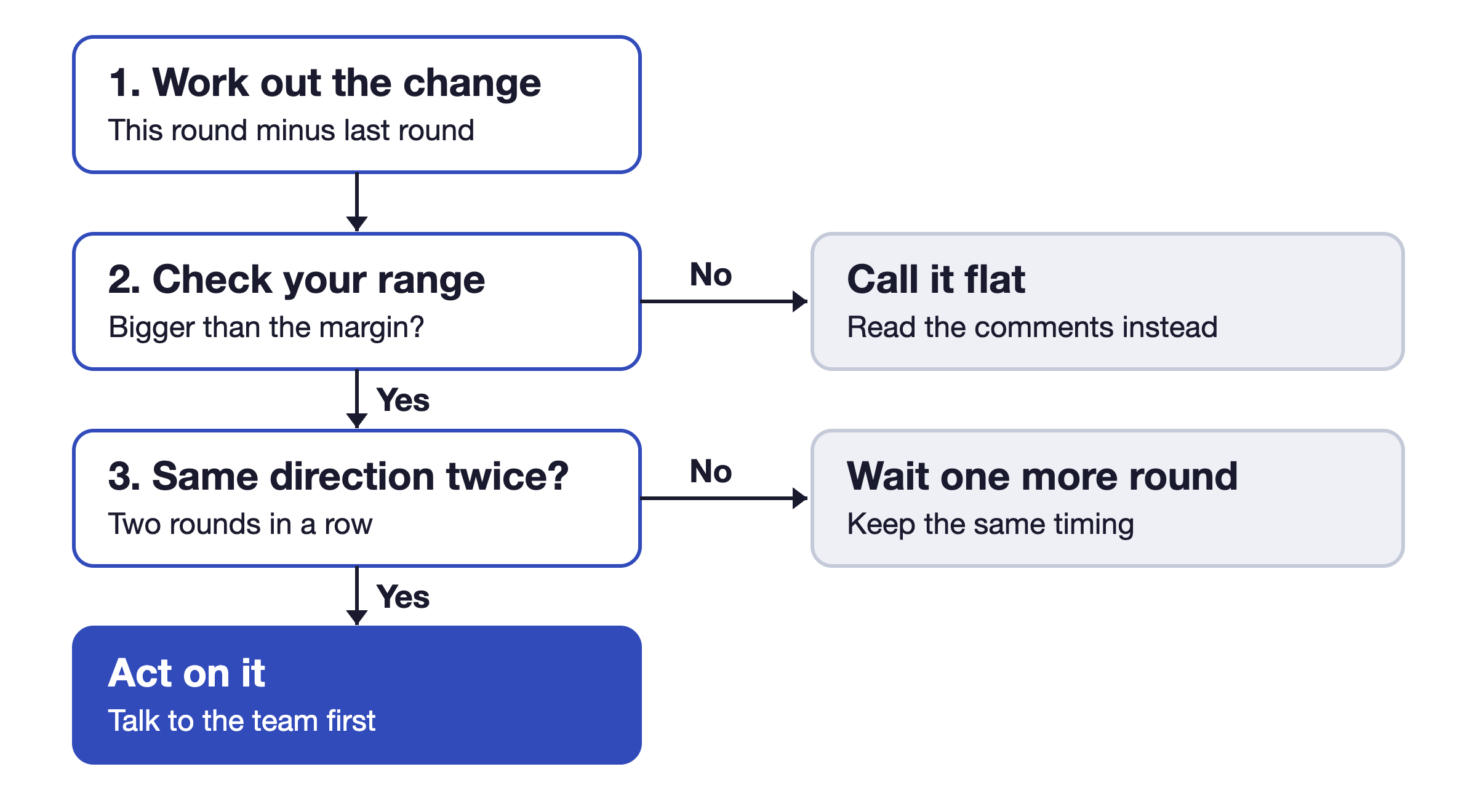
- Work out how much the score moved since the last round.
- Compare it with your range. If the move is smaller, call it flat and spend your time on the comments.
- If it moved the same direction two rounds running by more than the range, act on it.
Why response rate matters more than the benchmark
On a small team, the cheapest way to tighten your range is to get more of the team to answer. Going from 20 answers to 40 out of 50 cut the range in the example above by more than half. It also shrinks the bigger risk the formula can't see: that the people who stayed silent feel differently from the people who replied.
That makes this an architecture problem rather than a communications one. A survey that lives in a portal asks people to remember a login, open a tab and answer something that isn't part of their day. Few do. A survey delivered as a message in the place they already work gets answered in the thread. Pulsy's smart notifications and reminders drive an 80%+ response rate, which is BuddiesHR's own figure from our product data, not independent research.
Trust matters as much as convenience. Gallup puts it directly: "Perceived anonymity matters. Employees need to trust the process, not just the promise of anonymity" (Gallup, Employee Surveys). In Pulsy the anonymity setting is chosen per survey, and employees see it before they answer. If your team doesn't believe the answers are anonymous, your detractors become passives, and your score drifts upward for the wrong reason.
Running eNPS in Slack or Teams
You can run eNPS in a spreadsheet and a reminder email, and plenty of teams do. The failure is the third round, when the person who owns it is busy and the reminders stop. Pulsy sends the question as a Slack or Microsoft Teams message on a schedule you set, collects the answers in the thread and tracks eNPS over time in the web dashboard, with exports when you need to show leadership. Setup is a few minutes, and it's free under 10 employees.
Install Pulsy free and run your first round this week. If you want the step-by-step version, see how to run eNPS in Slack. For the wider picture, start with employee engagement survey questions for what to ask beyond the one number, or how to measure employee engagement without surveys for signals that don't depend on anyone answering. If you're asking whether people feel safe giving honest answers at all, psychological safety at work is the place to start.
FAQ
What is a good eNPS score?
Vendors disagree, with strong starting anywhere from +30 to +50, and none of the bands comes from a named study. Track your own score against your own last round, collected the same way, and treat a move smaller than your margin of error as flat.
How many responses do you need for eNPS?
There's no minimum that makes the number reliable, only a range that narrows as more people answer. Below about ten answers, read the comments instead of the score. Above that, check the range in the calculator before reacting to a change.
Should eNPS be anonymous?
Yes, for most teams. Anonymity is what lets detractors say so, and Gallup notes that perceived anonymity is what drives honest responses. Tell people the setting before they answer, and don't report groups so small that individuals can be guessed.
What's the difference between eNPS and NPS?
The scoring is identical. NPS asks customers how likely they are to recommend a product or company. eNPS asks employees how likely they are to recommend the company as a place to work, so it measures sentiment inside the company instead of loyalty outside it.