Improve survey response rate: three leaks, three fixes
Low survey response rate? Find out whether people never saw it, didn't start it or gave up, with a free leak finder and the fix for each.


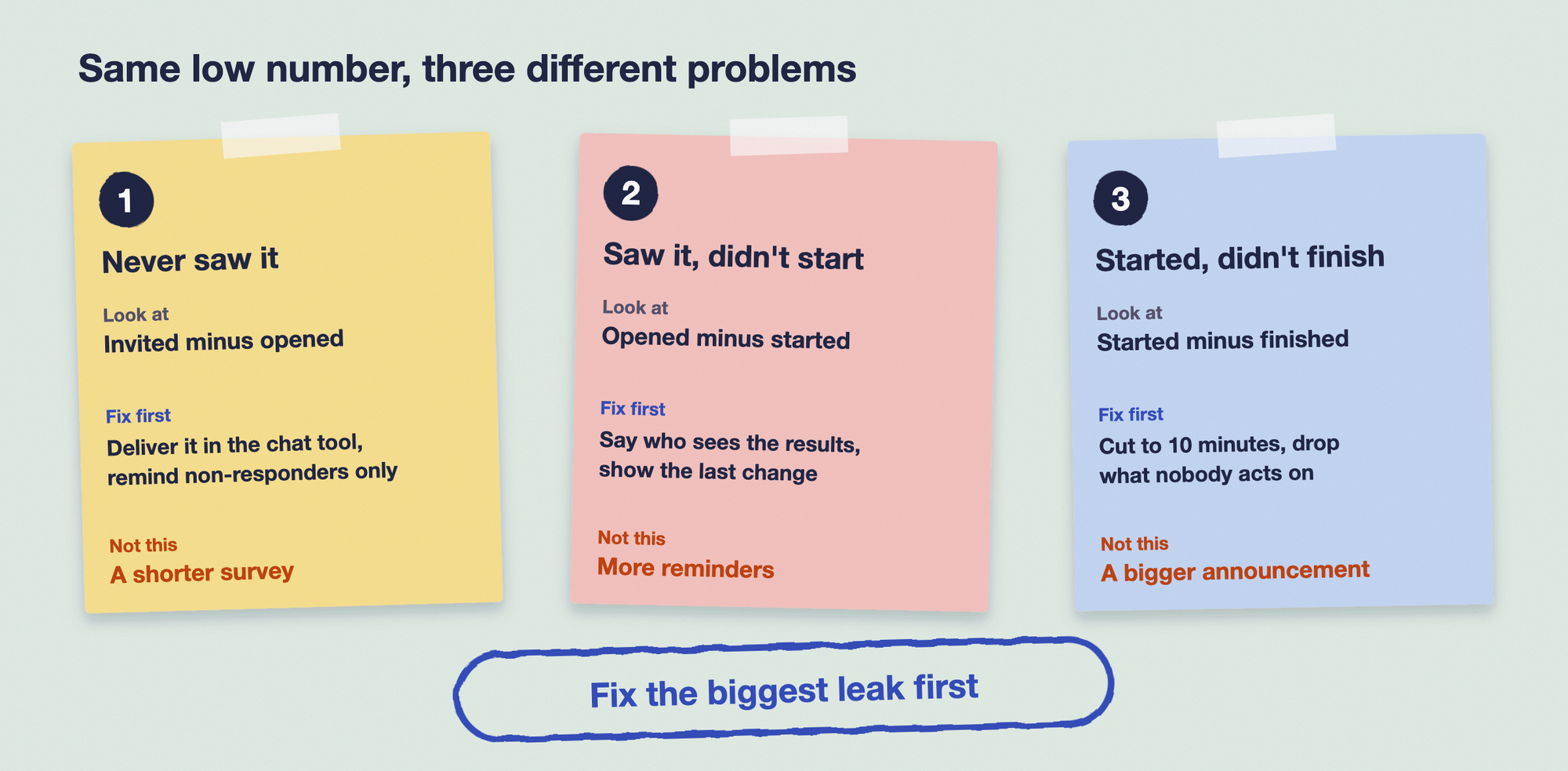
To improve your survey response rate, start by working out where people drop out. A low number looks like one problem, and it's three: people who never saw the survey, people who saw it and didn't start, and people who started and gave up. Each needs a different fix, and the usual advice, send more reminders, only helps one of them.
This guide covers what a good response rate is, how to find your leak with a free tool, the fix for each leak, and why survey fatigue is mostly about the last survey you sent rather than how many you send.
What counts as a good survey response rate
Vendor guides give ranges, not targets. Culture Amp calls 65 to 85% typical for staff surveys, with 80 to 90% for companies under 50 people, about 70 to 80% at around 500 people and 65 to 80% at 1,000 or more (Culture Amp, What is a good employee survey response rate). Quantum Workplace puts organisations over 500 people at 70 to 80% and smaller ones at 80 to 90% (Quantum Workplace, How to improve survey response rates). Danny Nelms of Work Institute told TechTarget to aim for 50% at minimum, with 65 to 70% ideal (TechTarget, 10 April 2024).
None of them states a sample, so treat the numbers as rules of thumb. They agree on the shape: smaller companies answer more, and 65 to 90% is the zone worth aiming for. Culture Amp adds that 100% isn't the goal either. It can signal coerced or uniform answers, and returns diminish above 85 to 90%. Our reading, not theirs: below 50%, you're mostly hearing from people with strong feelings.
Find your leak before you pick a fix
Your survey tool almost certainly reports four numbers: how many people were invited, how many saw the survey, how many started and how many finished. The gaps between them are the leaks. Enter yours below. Nothing is sent anywhere.
Response leak finder
Enter the four counts from your last survey. Change any number and the reading updates.
Response rate
45%
The biggest leak is the stage that loses the most people, which is our rule of thumb, not research. The 65 to 85% range is Culture Amp's typical range for staff surveys. If your tool doesn't report who saw the survey, set "Saw it" equal to "Started". The first two leaks then merge into one, and the third still shows.
With the defaults, 90 of 200 invited people finish, a 45% response rate, and the biggest gap is the first one: 50 people never saw the survey. Now change "Saw it" to 190, "Started" to 120 and "Finished" to 110. The rate rises to 55%, but the biggest gap moves to the second stage: 70 people saw the survey and didn't start. Similar numbers, different problem, and a different fix.
Leak 1: people never saw it
This is the delivery leak, and it's where portal fatigue lives. A survey that arrives as an email with a link to a separate tool competes with everything else in the inbox, then asks people to click through to somewhere new. Quantum Workplace recommends delivering invitations and reminders where employees already work, such as Slack and Microsoft Teams, and by SMS for people away from a desk.
Our view, not research: every step between the message and the first answer costs you people. So send the survey where the conversation already is, and send reminders to non-responders only. Nobody who has answered should be nagged. Pulsy delivers surveys as a Slack or Microsoft Teams message that people answer in the thread, and its smart reminders drive an 80%+ response rate. That figure is BuddiesHR's own product data, not independent research.
Leak 2: they saw it and didn't start
This is the trust leak, and it's the one most guides bury under tips. People decide in a few seconds whether answering is worth it. Three things move that decision.
Who sees the answers
Gallup says what matters isn't only whether a survey is anonymous but whether employees believe their answers are confidential. Results are usually held back until a minimum number of people have answered, and Gallup's example is five (Gallup, Employee surveys). Say who sees what in the invitation itself. If you promise anonymity, be sure you can keep it: anonymous employee survey shows how people still get identified, and psychological safety at work covers why people hold back when they don't feel safe.
Whether anything changed last time
Gallup also warns that asking for feedback and not acting on it can backfire, with engagement likely to fall. Perceptyx, a survey vendor, reports that 74% of organisations that acted on survey results improved engagement, against 8% of those that didn't (Perceptyx, What is an employee pulse survey). It's a vendor figure with no stated sample, so read it as a direction. Open the invitation with what changed since the last survey, even if it's small.
Whether it's allowed
Quantum Workplace suggests setting aside dedicated survey time that doesn't eat into lunch or personal hours, and having managers say plainly that it's fine to take it. Put that sentence in the manager's script. It costs nothing and removes a reason to skip.
Leak 3: they started and didn't finish
This is the length leak, and the data behind it is old but clear. SurveyMonkey analysed 100,000 surveys, 2,000 for each length from 1 to 50 questions, deployed between January 2009 and September 2010. The sharpest rise in drop-off came with each extra question up to 15, and each question after that cost less, up to 35 (SurveyMonkey, Survey questions and completion rates). The early questions are the expensive ones, which is why a three-question pulse and a fifteen-question survey behave like different products.
Culture Amp suggests keeping a staff survey to 10 minutes or less. Cut any question nobody is ready to act on, put open text last, and let people skip. For the short, recurring version, see pulse survey. For a question bank organised by theme, see employee engagement survey questions.
Survey fatigue: the last survey matters more than the count
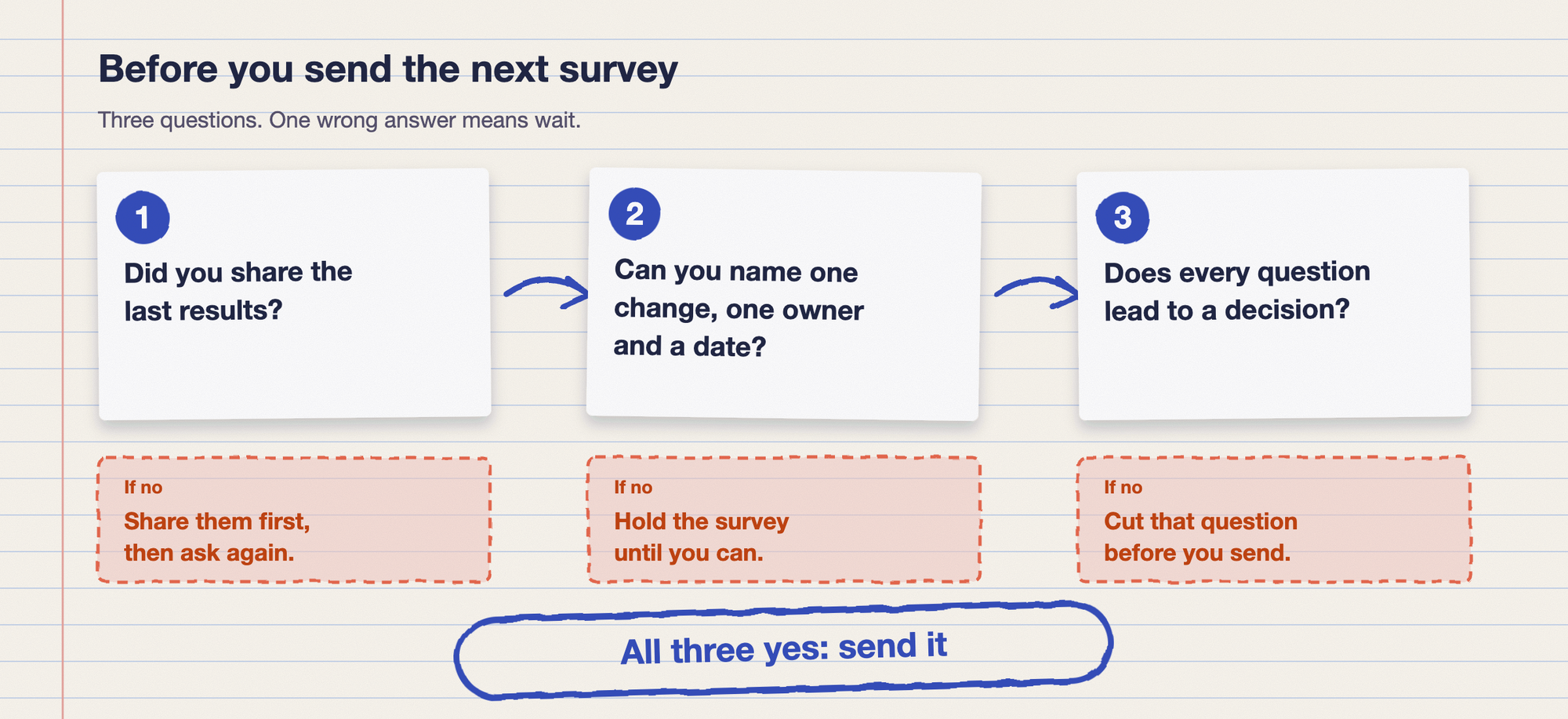
Survey fatigue is what all three leaks look like when they widen over time. Gallup's guidance is to survey often enough to show trends, but not so often that results go unused or employees get fatigued. Notice the order: unused results come before fatigue. Vantage Circle's advice is blunt and worth borrowing: if the last survey's loop isn't closed, or you aren't ready to act on this one, don't send it (Vantage Circle, Survey fatigue).
The diagram below turns that into three questions to ask before every send. Our view, not a finding: a team that gets a three-question pulse each month and sees a change each quarter is likelier to keep answering than a team that gets one long survey a year and hears nothing back.
The same logic applies to your overall engagement programme. The employee engagement survey guide covers how to set the response target and who owns the changes before you send anything.
Running it in Slack or Teams
The first two leaks are mostly about where the survey lives and what people believe about it. Pulsy sends pulse surveys as a Slack or Microsoft Teams message that people answer in the thread. It includes pre-built survey templates, an anonymity setting per survey that people can see before they answer, groups under five answers kept private, segmentation in the web dashboard and exportable reports. 1,000+ HR teams use BuddiesHR, which has a 4.8/5 rating on G2, and Pulsy is free under 10 employees.
Install Pulsy free, send three questions this week and enter the counts into the finder above. The use-case view is on the measuring engagement page, and the setup steps are in how to create a survey in Slack.
FAQ
What is a good survey response rate?
For staff surveys, vendor guides put 65 to 85% as typical, higher in small companies and lower in large ones. Work Institute's Danny Nelms suggests 50% as a minimum. None of the figures states a sample, so use them as rough guides and compare against your own last round.
How do you improve employee survey response rate?
Find which of three leaks is biggest: people who never saw the survey, people who saw it and didn't start, or people who started and didn't finish. Fix delivery, trust or length accordingly, rather than sending more reminders to everyone.
What causes survey fatigue?
Mostly surveys that lead nowhere. Gallup says to survey often enough to show trends but not so often that results go unused. If people can't see anything changing after the last survey, they stop answering the next one.
Does anonymity increase response rate?
Belief in anonymity does. Gallup says employees need to trust the process, not just the promise, and that doubts about confidentiality make people less likely to answer honestly or at all. Say who sees the results and hold small groups back.