Lattice pricing: what the $4,000 minimum costs a small team
Lattice pricing, November 2026: $4 to $13 per seat, billed annually, with a $4,000 minimum. See which one sets your bill, and what you can swap for less.


As of November 2026, Lattice lists Performance at $10 per seat per month, Goals & OKRs at $8 and Engagement at $4, with Performance and Goals bundled as Foundations for $13. Everything is billed annually in US dollars, and there's a $4,000 minimum per year (Lattice pricing page). That minimum is the number that decides what a small team pays. Buy Engagement alone for 50 people and the bill is $4,000, not $2,400.
Below: the current price list with the billing rules next to each number, the headcount where the minimum stops applying for each module, a calculator for your own team, what companies actually end up paying, and which parts of Lattice you can replace for less (and which you can't).
Lattice pricing, as of November 2026
Lattice sells three base products and two add-ons. Every base product includes its manager tools (1:1 meetings, weekly updates, feedback and Q&A boards), plus analytics, the AI agent and integrations. Here's the list, read from Lattice's own pricing page on November 26, 2026.
| Product | List price | What's in it |
|---|---|---|
| Performance | $10 per seat per month | Reviews, succession planning, promotions, PIPs, talent reviews, calibration |
| Goals & OKRs | $8 per seat per month | Cascading goals, progress updates, Salesforce and Jira integrations |
| Engagement | $4 per seat per month | Pulse and full surveys, eNPS, onboarding and exit surveys, action planning, AI analysis |
| Foundations | $13 per seat per month | Performance and Goals & OKRs together |
| Compensation (add-on) | +$6 per seat per month | Benchmarks, comp bands, cycle management, statements |
| Grow (add-on) | +$4 per seat per month | Competencies, development plans, career tracks |
| Enterprise | Custom quote | Priced on seats, complexity and scale |
Billing rules from the same page: all contracts billed annually, in USD only, with a minimum annual agreement of $4,000. Prices checked November 26, 2026.
Check the date on any Lattice price you read elsewhere. Some guides still list plans that aren't on Lattice's page any more, such as a Talent Management plan at $11 and an HRIS at $10 (People Managing People). If a number doesn't appear on lattice.com/pricing today, don't budget on it.
What the $4,000 minimum does to a small team
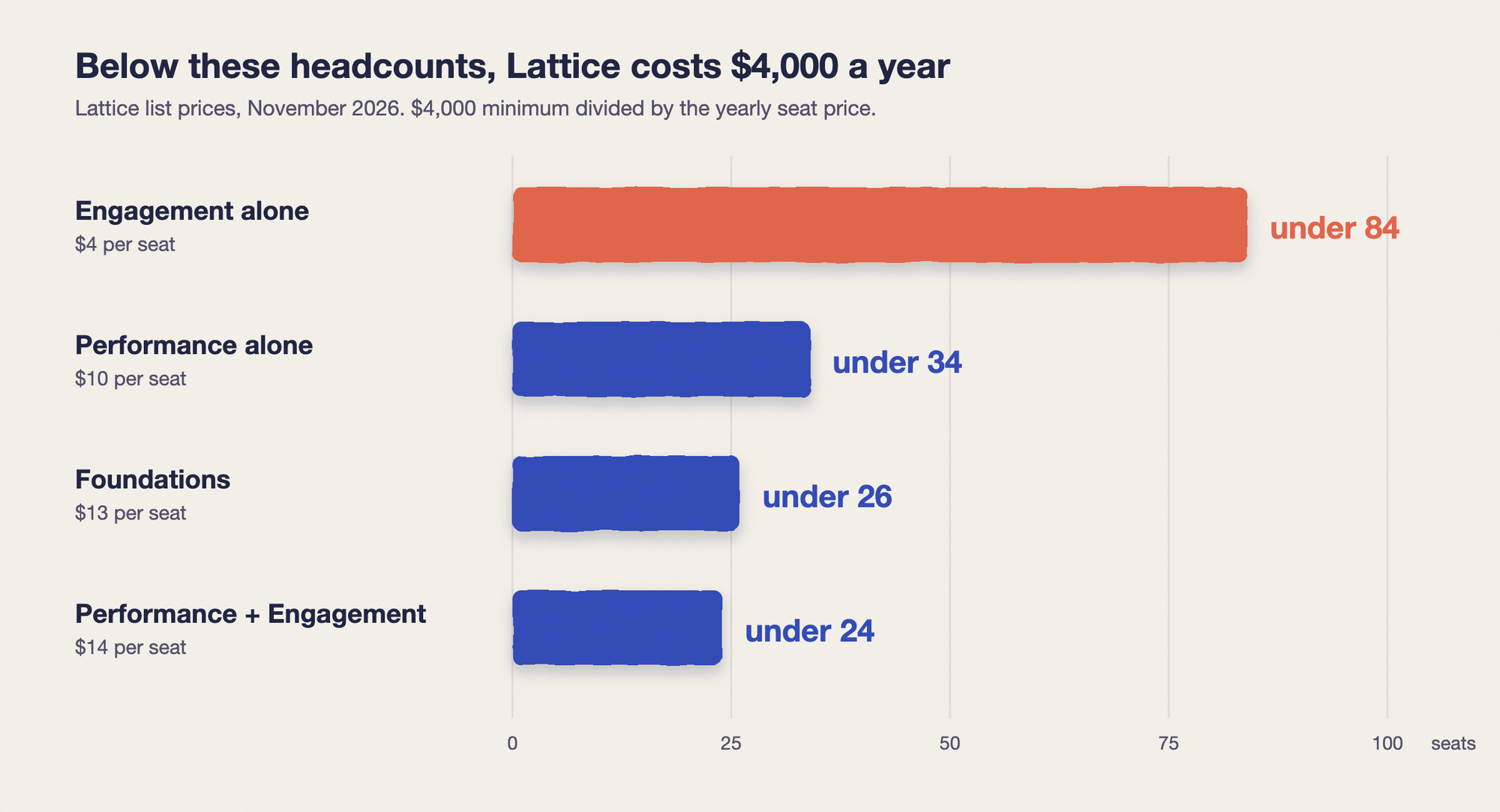
The seat price is what Lattice advertises. The minimum is what a small team actually pays. Divide $4,000 by a module's yearly seat price and you get the headcount below which the seat price doesn't matter: you pay $4,000 regardless.
- Engagement alone ($4): the minimum applies below 84 seats. A 50-person team pays $4,000 a year, which works out at $6.67 per person per month, not $4.
- Performance alone ($10): below 34 seats. A 25-person team pays $13.33 per person per month.
- Foundations ($13): below 26 seats.
- Performance plus Engagement ($14): below 24 seats.
That's the pricing trap in its plainest form. The cheapest module on the list is the one most likely to cost a small company more than its sticker, because a survey tool is often the first thing a 40 or 60-person company buys. And since the contract is annual, a module you stop using in March is still on the bill in December.
Price your Lattice contract
Enter your headcount and tick the Lattice products you'd buy. The calculator applies the Foundations bundle when you pick Performance and Goals together, applies the $4,000 minimum, and shows what the same seats cost on BuddiesHR where there's an equivalent app. Where there isn't one, it says so.
Lattice cost calculator
List prices from lattice.com/pricing and buddieshr.com/pricing, checked November 26, 2026.
Lattice products
List prices only. Lattice negotiates contracts and its enterprise tier is quoted. BuddiesHR prices are public rates; teams of 200+ can ask for flat yearly enterprise pricing. Nothing you enter is sent anywhere.
What companies actually pay for Lattice
List price is the starting point for a negotiation, not the end of one. Vendr, a software buying platform, reports a median Lattice contract of $30,240 a year, based on 641 purchases, with deals ranging from $9,392 to $84,000 and buyers saving 21% on average (Vendr, read November 26, 2026). Two caveats. Vendr's figures are negotiated contracts across every company size, so they say more about mid-size buyers than about a 40-person startup. And Vendr's page still describes Lattice with older product names, so use it for the range, not the line items.
The useful reading of that range: the low end is still more than double the $4,000 minimum. Whatever you negotiate, you're negotiating an annual commitment.
What's included in Lattice pricing, and what isn't
Lattice is clearer than most enterprise vendors about what the seat price covers. According to the FAQ on its pricing page:
- Implementation: no additional fees for implementation or change management on the performance management software.
- Support: every contract includes dedicated human support from the customer success team.
- Manager tools: 1:1s, feedback and updates come with any of Performance, Goals & OKRs or Engagement.
- Billing: annual only, USD only, $4,000 minimum.
So the hidden cost isn't a setup fee. It's the shape of the contract. You commit to a year, for a headcount, for a set of modules, before anyone on your team has used it. If the engagement survey lands at a low response rate or the review cycle stalls, you find out after you've paid. Our guide to improving survey response rates covers why that happens more often with tools people have to log into.
What you can swap for less, and what you can't
Most small teams looking at Lattice want two things: a review cycle that finishes and a regular read on how people feel. That's Performance and Engagement. Both have a cheaper equivalent that runs where your team already works. The rest of Lattice doesn't, and it's better to say so now than after you've switched.
- Performance to Growy Perf. Self, peer, upward and manager reviews, 360 feedback, reminders that chase people for you and an AI coach for writing better answers. Reviews open in a web app with notifications in Slack.
- Engagement to Pulsy. Pulse surveys, eNPS, polls and recurring multi-question surveys, answered as a message in Slack, with segmentation and exportable reports in the web dashboard.
- Microsoft Teams: not yet. On Teams today, only Billy (birthdays and anniversaries) and Alfy (coffee chats) are live, and the rest of the suite is rolling out (BuddiesHR for Teams). Lattice integrates with both Slack and Teams. If your company runs on Teams, the swap above isn't available to you yet.
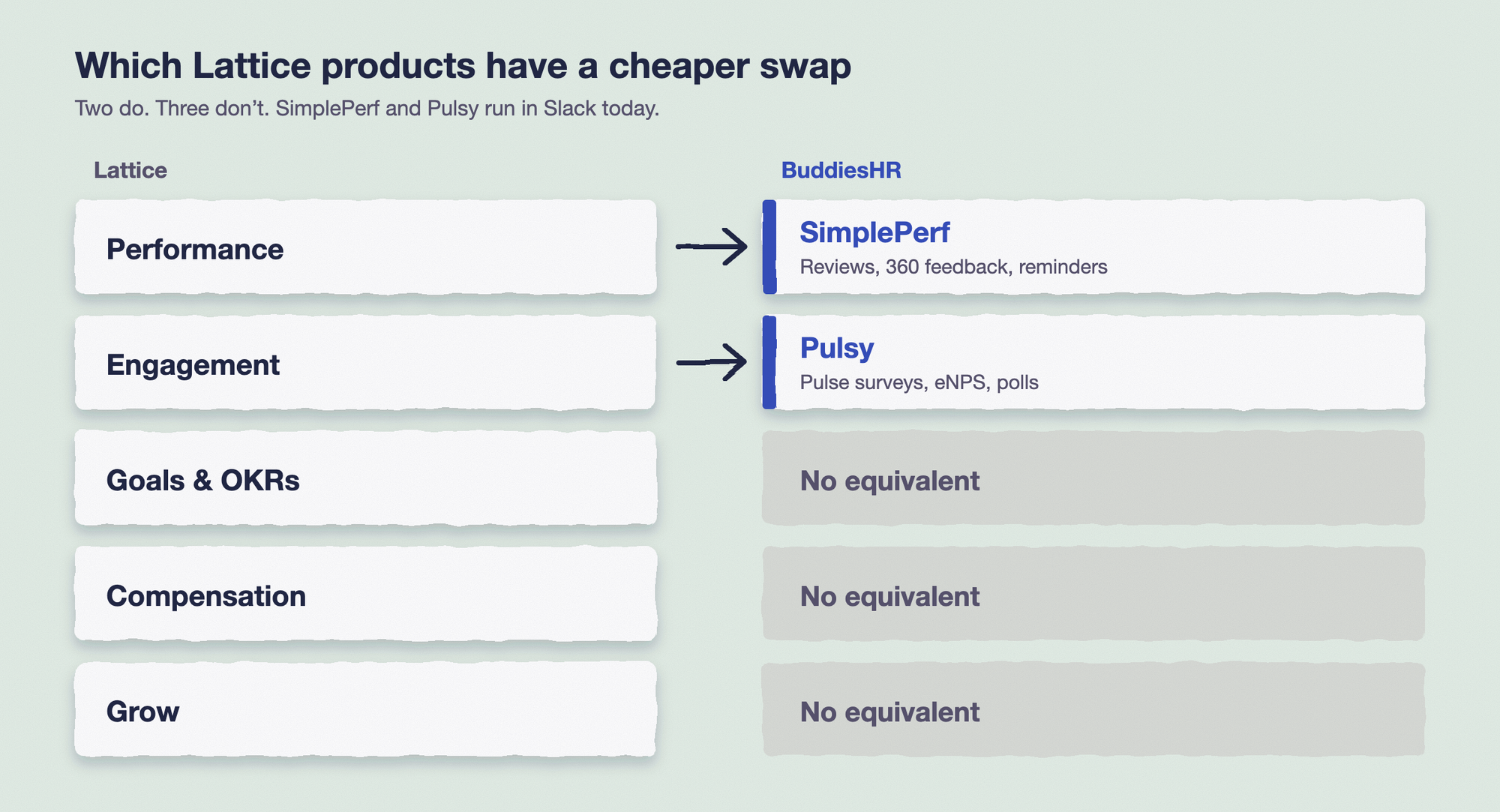
The architectural difference is the other half of the argument. Lattice is built around its own web platform, with Slack and Teams integrations. Pulsy asks the question inside Slack, where people answer it in the thread they're already reading, and the admin side lives in a web dashboard with the reporting HR needs. For the wider comparison, including tools that aren't ours, see our Lattice alternatives roundup and our list of performance management tools.
Lattice vs BuddiesHR at 25, 50, 100 and 200 people
Here's the most common pairing, Performance plus Engagement, at list price on both sides. On BuddiesHR, Growy Perf comes in the Culture & Performance plan, which also includes Pulsy and the culture apps (kudos, birthdays, coffee chats, org chart, time off, standups) at $3 per employee per month billed yearly, or $3.75 monthly.
| Team size | Lattice Performance + Engagement, per year | BuddiesHR Culture & Performance, per year |
|---|---|---|
| 25 people | $4,200 | $900 |
| 50 people | $8,400 | $1,800 |
| 100 people | $16,800 | $3,600 |
| 200 people | $33,600 | $7,200 at the public rate, or a flat yearly enterprise price |
List prices, both vendors, checked November 26, 2026: Lattice $14 per seat per month billed annually with a $4,000 minimum; BuddiesHR $3 per employee per month billed yearly. Lattice contracts are often negotiated below list. Lattice is a trademark of its owner, used here for comparison only.
If you only need the survey half, the gap is wider in relative terms. Lattice Engagement for 50 people is $4,000 a year because of the minimum. Pulsy alone is $1 per employee per month billed yearly, so $600 for the same 50 people, and it's free under 10 users.
Cost was the second of three reasons Roo gave for choosing BuddiesHR, after functionality and before supporting other start-ups. The fully remote veterinary marketplace grew from 40 to 120+ employees in 12 months and runs Clappy for kudos, Pulsy for eNPS, Billy for birthdays and Stany for standups in Slack (Roo case study). Modular pricing is what made that order possible: start with one app, add the next when the team needs it, and pay for nothing you haven't installed.
When Lattice is worth the money
Lattice is a good product, and for some companies the price is fair. It's the stronger choice if you run compensation cycles with benchmarks and bands, if you manage goals and OKRs across departments, if you need succession planning and talent reviews, or if you're on Microsoft Teams and want everything there today. Those are real capabilities BuddiesHR doesn't sell.
Where Lattice stops making sense is the 25 to 150-person company that wants reviews and a pulse survey, and ends up on an annual contract sized for a company three times bigger. That's not a negotiation problem. It's a mismatch between what's being bought and what's being used.
If that's you, install BuddiesHR free: it's free under 10 employees, each app has a 30-day trial, and you can pay monthly and cancel anytime (pricing). 1,000+ HR teams use it, and it's rated 4.8/5 on G2 (our own figures). If you're 200 people or more and want a flat yearly price instead of per-seat maths, book a 15-minute demo. For the review side specifically, read our take on performance review software for small companies, and for the survey side, our guide to the employee engagement survey.
FAQ
How much does Lattice cost per user?
As of November 2026, Lattice lists Performance at $10 per seat per month, Goals & OKRs at $8, Engagement at $4 and the Foundations bundle (Performance plus Goals) at $13. Compensation adds $6 and Grow adds $4. All contracts are billed annually in USD.
Does Lattice have a minimum price?
Yes. Lattice's minimum annual agreement is $4,000. Below 84 seats for Engagement alone, or below 34 seats for Performance alone, you pay the $4,000 minimum rather than the seat price.
Can you pay for Lattice monthly?
No. Lattice's pricing page says all contracts are billed annually. BuddiesHR can be paid monthly or yearly and cancelled anytime.
Does Lattice charge for implementation?
Not for its performance management software, according to its pricing FAQ, and every contract includes dedicated human support. The cost to watch is the annual commitment, not a setup fee.
Is there a cheaper alternative to Lattice for small teams?
For reviews and engagement surveys, yes. BuddiesHR's Culture & Performance plan covers Growy Perf and Pulsy at $3 per employee per month billed yearly, free under 10 users, in Slack today. It doesn't replace Lattice's goals, compensation or career-track products, and most of the suite isn't on Microsoft Teams yet.